The American License Plate
A Detailed National History: From owner-made identifiers to state branding, constitutional speech, and automated recognition.
Executive Overview
The American license plate began as a practical answer to a new public problem: fast, noisy, accident-prone machines were entering streets built for pedestrians, horses, and streetcars, and the public wanted a way to identify their owners. What began as a local permit and an owner-made tag became a state-administered system of registration, taxation, enforcement, safety, visual identity, political expression, fundraising, and—most recently—machine-readable location data.
The Central Idea
A plate is not merely a piece of metal. It is the visible endpoint of a government database record linking a jurisdiction, a vehicle, a registration class, and—subject to privacy law—an owner or registrant.
How to Read “Firsts” Correctly
The municipal claims depend heavily on local records; the state milestones are consistently documented by museum, government, and judicial sources.
| Milestone | Credited Jurisdiction & Date | What It Actually Means |
|---|---|---|
| Early municipal permit | Boston Park Commission, 1898 | A local permit to operate in regulated park roads; not a statewide plate system. |
| Early government plate | Philadelphia Fairmount Park Commission, 1900 | A local authority reportedly distributed leather vehicle tags; still not statewide. |
| First statewide registration law | New York, 1901 | The state required registration and visible owner initials; the owner supplied the plate. |
| First state-issued plate | Massachusetts, 1903 | The state manufactured and distributed a standardized numbered plate. |
| First state plate graphic | Arizona, 1917 | A Hereford steer head appeared as a visual emblem. |
| First state plate slogan | Idaho, 1928 | “Idaho Potatoes” turned the plate into an overt promotional medium. |
1 Before Plates: Governing the First Automobiles
In the 1890s, automobiles were rare, mechanically unreliable, and socially disruptive. Their speed and anonymity caused a basic accountability problem. A horse, wagon, or carriage was often locally recognizable; a motorcar could pass quickly and disappear. Cities and park commissions responded before most state governments did, using permits, speed rules, and identification requirements on roads under their control.
The earliest American registration practices borrowed from older systems for numbered carriages, bicycles, boilers, and other regulated property. The object later called a “license plate” performed two linked jobs: proving permission to operate and making the vehicle traceable after an incident.
New York’s 1901 Model: Register First, Fabricate Locally
On April 25, 1901, New York enacted a statewide motor-vehicle registration requirement. The state recorded the owner and assigned the identifying mark, but the owner supplied the physical display. Early New York motorists commonly showed their initials on leather, metal, or other homemade backings.
This explains why “New York was first” and “Massachusetts was first” can both be true: New York led in statewide registration law, while Massachusetts led in state-manufactured plates.
Massachusetts, 1903: The State-Issued Object
Massachusetts centralized both the record and the artifact. Its 1903 porcelain-enamel plates used white characters on a dark blue background and carried the words “MASS. AUTOMOBILE REGISTER.”
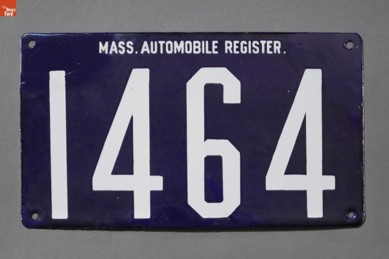
The Henry Ford and the Smithsonian identify Massachusetts as the first state to issue standardized automobile license plates directly to motorists.
2 The State Systems Spread (1903–1918)
The next fifteen years were a period of rapid but uneven adoption. Some states issued finished plates; others assigned a number and left the owner to buy or make a tag. Nebraska, for example, registered vehicles beginning in 1905 but allowed individuals to make leather plates with metal numbers until 1915. California required registration in 1905 but did not issue state plates until 1914. Florida did not create a uniform statewide annual plate until 1917.
Why Governments Embraced Registration
- Identification: Connect a vehicle observed on the road to a government record.
- Accountability: Support enforcement after crashes, speeding, theft, or other violations.
- Revenue: Collect registration fees to administer motor-vehicle systems and fund road building.
- Classification: Distinguish passenger cars, trucks, dealers, motorcycles, public vehicles, and other uses.
- Proof of current status: Show that a registration was valid for the relevant year or renewal period.
By 1915 nearly all jurisdictions issued plates annually and charged registration fees. By 1918 every US state required plates.
3 The Physical Plate: Materials, Numbers & Manufacture
Owner-made plates could be leather with attached metal characters, painted wood, sheet metal, or other locally available material. Early government plates often used porcelain enamel: glass fused onto metal created a durable, high-contrast surface, but it could chip easily and was expensive to produce. Stamped or embossed metal eventually dominated because it was economical, robust, and well suited to mass production.
Expert Vocabulary
Base plate: The underlying plate design.
Serial: The unique displayed character sequence.
Validation: Year/month evidence, such as a sticker or tab.
Plate type / class: Indicates the registration category (passenger, commercial, dealer, etc.).
Issue: Refers to a specific design, series, or issuance period.
Serial Systems & Coded Sequences
As vehicle populations grew, states expanded from simple numeric sequences (1, 2, 3...) to letter-number combinations and coded series. Prefixes, suffixes, stacked characters, county numbers, weight classes, and vehicle-type abbreviations conserved serial space and helped officials interpret a plate at a glance.
Who Makes the Plates?
License-plate production became closely associated with state correctional industries. Prison workshops offered governments a captive manufacturing workforce. This practice remains historically important and connects one of the most visible state objects to the history of incarcerated labor.
4 Plates Become State Billboards
Once plates were universal, states recognized that millions of moving metal rectangles could do more than identify vehicles. A plate could condense a state’s economy, geography, mythology, and tourism pitch into a few words or a tiny image.
Arizona’s Steer Head
In 1917, Arizona became the first state to display a visual graphic on a plate: a Hereford steer’s head emblem.
Idaho Potatoes
In 1928, Idaho became the first state to include a slogan, proclaiming “Idaho Potatoes” and placing the serial over a potato graphic.
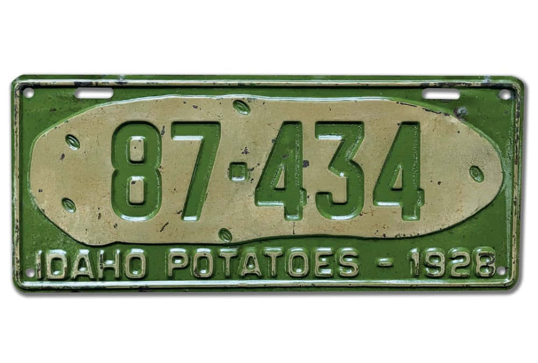
From there, plates accumulated mottos, nicknames, landscapes, crops, wildlife, state seals, and tourism messages: Maine’s “Vacationland,” Arizona’s “Grand Canyon State,” Wisconsin’s “America’s Dairyland,” New Hampshire’s “Live Free or Die,” and Wyoming’s bucking horse and rider.
5 Depression, War & Material Scarcity
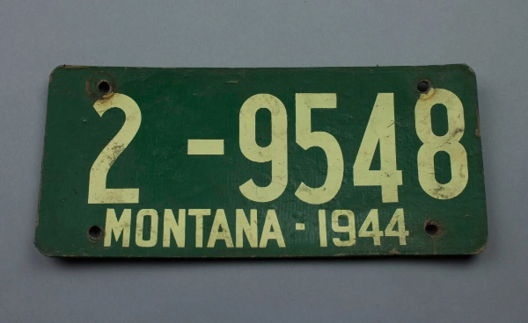
The Great Depression increased pressure to economize, while World War II created a direct material crisis. Steel, aluminum, and other metals were critically needed for wartime production. States extended existing plates with windshield decals or metal tabs, issued only one plate instead of a pair, repainted old stock, or experimented with substitutes such as fiberboard and cardboard.
Montana’s Soybean Fiberboard Plates (1943–44)
Montana’s 1944 plates were manufactured from a soybean-based fiberboard. Contemporary newspaper accounts warned that hungry livestock and dogs might try to eat the soy-bonded tags off parked vehicles! This shortage accelerated the practice of validating base plates with small stickers or tabs rather than replacing the whole metal plate every year.
6 The 1956 Standard & the Modern Base Plate
Early plates came in many widths, heights, shapes, and mounting-hole patterns. That inconsistency complicated automobile styling and bracket manufacturing. In 1956, at the request of automobile manufacturers, U.S. and Canadian jurisdictions adopted the standardized 12-by-6-inch passenger-plate format.
During the mid-twentieth century, states also adopted retroreflective sheeting. Reflectivity returned headlight illumination directly toward its source, making characters easy to read at night and laying the groundwork for modern optical camera systems.
7 Personal Expression: Vanity & Specialty Plates
Personalized Vanity Serials
Pennsylvania introduced initial-based personalized plates in 1931. California launched its modern open personalized program in 1970 (issuing plate AMIGO as its first ceremonial example). Vanity plates turned the serial into driver-authored expression.
Specialty & Cause Fundraising
From the late 20th century onward, states expanded graphic plates for universities, sports teams, conservation, military veterans, and causes. Extra charges directly fund state parks, scholarships, or charity programs.
8 License Plates & the First Amendment
Wooley v. Maynard (1977) — Compelled Speech
New Hampshire required drivers to display “Live Free or Die.” Jehovah’s Witnesses George and Maxine Maynard objected on religious and political grounds and covered the motto. The Supreme Court held that states cannot force private citizens to serve as mobile billboards for state ideological messages.
Walker v. Texas Division, SCV (2015) — Government Speech
Texas rejected a specialty plate featuring the Confederate flag. The Supreme Court ruled that specialty plate designs constitute government speech, giving states authority over official plate artwork and messaging.
9 Registration Data, Privacy & Policing
A license plate is publicly visible on the road, but the personal information behind it sits in a motor-vehicle record. Congress enacted the Driver’s Privacy Protection Act of 1994 (DPPA) to restrict public disclosure and resale of DMV records while preserving permissible uses for law enforcement, safety recalls, and insurance.
Modern Automated License-Plate Readers (ALPRs) combine high-speed cameras, infrared illumination, optical character recognition (OCR), timestamps, and GPS coordinates to scan thousands of plates per hour. Digital electronic plates are now also deployed in select states.
10 The Plate System Today
The United States still has no single national passenger license plate. Each state and territory controls its own registration authority. A modern plate is defined across eight key dimensions:
11 Concise National Chronology
Boston Park Commission Permit
Issues an early motor-vehicle permit, a local precursor rather than a statewide plate system.
Philadelphia Park Tags
Fairmount Park Commission credited with distributing early leather vehicle tags.
First Statewide Registration Law
New York enacts the first statewide law; owners display their own handmade initial tags.
First State-Issued Porcelain Plate
Massachusetts becomes the first state to manufacture and issue standardized plates.
First Plate Graphic
Arizona features a Hereford steer head graphic on its plate.
Universal Adoption
All 48 states require automobile license plates.
First State Slogan
Idaho adds “Idaho Potatoes” to promote state agriculture.
First Personalized Vanity Options
Pennsylvania introduces personalized initial options.
Wartime Shortages
Steel rationing leads to fiberboard plates (such as Montana soy tags), tabs, and single plates.
12 × 6 Standard
North American passenger plates standardize to 12 × 6 inches for universal vehicle mounting.
Modern Vanity Programs
California launches modern vanity plate program with environmental revenue sharing.
Wooley v. Maynard
Supreme Court rules drivers cannot be compelled to display state ideological slogans (“Live Free or Die”).
Driver’s Privacy Protection Act
Congress enacts the DPPA to restrict public disclosure of personal DMV records.
Walker v. Texas Division, SCV
Supreme Court holds specialty plate designs are state government speech.
Digital & Automated Era
ALPR camera networks, digital flat printing, and electronic digital plates expand nationwide.
12 Common Myths & Corrections
“New York issued the first plate in 1901.”
New York enacted the first statewide registration law but initially made owners supply the identifier. Massachusetts issued the first state-made plates in 1903.
“Idaho had the first graphic.”
Arizona used a steer-head graphic in 1917. Idaho introduced the first slogan in 1928 and paired it with a potato image.
“All old plates were porcelain.”
Porcelain was important, but early plates also used leather, wood, and sheet metal; embossed metal eventually became dominant.
“Every plate is made in prison.”
Correctional industries are historically significant manufacturers, but production arrangements differ by state, date, and plate type.
“A visible plate number is private DMV data.”
The displayed serial is public-facing; the protected personal information linked to it in DMV records is a separate legal category regulated by the DPPA.
“Specialty and vanity plates are the same.”
A specialty plate changes the state-approved base design; a vanity plate changes the motorist-selected serial text.
“There is one national plate format.”
The 12 × 6-inch size is standardized, but serials, fonts, classes, validation, designs, and front/rear rules remain jurisdiction-specific.
13 Research Notes & Source Guide
Key primary authorities, museum archives, statutory references, and landmark court decisions:
- Smithsonian National Museum of American History, “Licensing Cars and Drivers.”
- New York State Museum, “1907 Leather License Plate.”
- The Henry Ford, “Massachusetts Automobile Register License Plate, 1903,” Object 78.137.1.
- Smithsonian National Museum of American History, “Massachusetts License Plate,” Object NMAH 844507.
- Walker v. Texas Division, Sons of Confederate Veterans, Inc., 576 U.S. 200 (2015).
- American Association of Motor Vehicle Administrators (AAMVA) Historical Overview & Standardization.
- Nebraska DMV, “History of Nebraska Passenger Vehicle License Plates.”
- Smithsonian National Museum of American History, “California License Plate,” Object NMAH 1330982.
- Florida Highway Safety and Motor Vehicles, 100 Years of Motor Vehicles in Florida.
- The History Museum, Cascade County Historical Society, “Soy License Plates” (2021).
- AAA Northeast, “License Plate History: A Timeline” (1931 Pennsylvania vanity milestone).
- Ronald Reagan Presidential Library, California personalized plate program press materials (1970).
- Ohio Bureau of Motor Vehicles, “Special Interest License Plates Information.”
- Wooley v. Maynard, 430 U.S. 705 (1977).
- U.S. Department of Justice, Driver’s Privacy Protection Act (DPPA) Background.
- U.S. Government Accountability Office, Law Enforcement & Public Space Technologies (GAO-25-107302).
- U.S. Government Accountability Office, Smart Cities & Privacy Risks (GAO-25-107019).