AL American plate atlas
Alabama
The Yellowhammer State
Meet the plate, people, places, and stories behind one of the road-trip game’s fifty-one essential finds.
Capital
MontgomeryState bird
Yellowhammer (Northern flicker)Joined the Union
December 14, 181901
A quick trip through time
The Alabama story
Alabama became a center of the cotton economy, the civil rights movement, and American spaceflight. Montgomery, Birmingham, Selma, and Huntsville each tell a different chapter of that story.
02
Bumper-sized history
About the plate
Alabama was among the early states to require vehicle registration in the 1910s. Its many specialty plates make the state an especially colorful road-trip catch.
Deep Dive Archive · State Volume 08
Alabama License Plate History
Alabama’s license plate history stretches back more than a century.
The state was issuing passenger plates by 1912, and over the decades its tags evolved from simple annual metal plates into one of the most recognizable state plate identities in the country — centered on the small heart and the words “Heart of Dixie.”
Alabama’s plates also contain another useful clue for license-plate spotters: historically, the leading numbers on many standard plates have identified the county where the vehicle was registered.
Alabama Plate History at a Glance
| Year | Milestone |
|---|---|
| 1912 | Early Alabama state passenger plates documented by Alabama Revenue |
| 1941 | County-number prefixes introduced on standard plates |
| 1955 | “Heart of Dixie” first appears on Alabama plates |
| 1969 | First reflectorized Alabama plates |
| 1977 | Alabama begins issuing five-year plates |
| 1981 | Staggered registration system begins |
| 1998 | License plate begins following the vehicle owner |
| 2003 | Digital aluminum license-plate production begins |
| 2022 | Current standard passenger design becomes effective |
SOURCE: Alabama Department of Revenue.
Alabama’s Early License Plates
The Alabama Department of Revenue maintains original-vintage passenger plate records beginning with 1912.
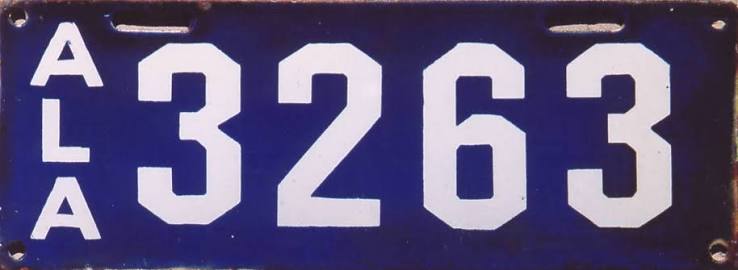
The earliest Alabama plates were simple annual issues, and their colors and formats changed regularly from year to year — so an old Alabama tag is often datable at a glance once you know the era’s palette and layout.
A New Plate From Year to Year
Like many states, Alabama spent much of the first half of the 20th century issuing frequently changing plate designs rather than a single long-lived base.
Colors, serial formats and even plate dimensions evolved over time. Each year brought a fresh combination — sometimes a subtle shift, sometimes a completely new look — so the plate itself usually announced its year. It was not until the state moved to longer-lived base plates in 1977 that this rapid visual turnover slowed.
Because designs changed so often, these annual issues are among the easiest Alabama plates to date at a glance — and among the most varied for a collector to gather.
When Did “Heart of Dixie” First Appear on Alabama License Plates?
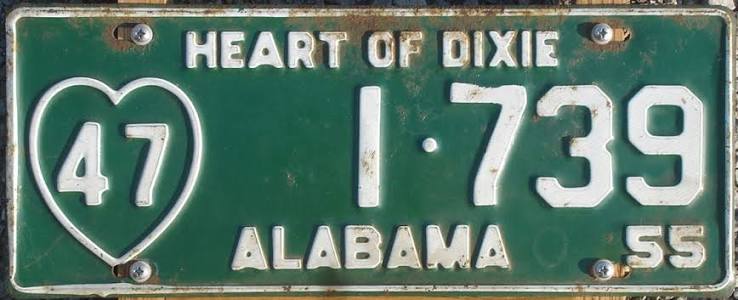
According to Alabama Department of Revenue training materials, “Heart of Dixie” first appeared on Alabama license plates in 1955.
The slogan quickly became deeply associated with the state’s plate identity, and it has remained a fixture of Alabama’s standard designs for decades.
Alabama law still generally requires state-issued motor-vehicle plates to display:
- a conventionalized heart
- the words “Heart of Dixie”
unless a particular plate category is exempt. (The exemption for personalized and distinctive plates is covered below.)
SOURCE: Alabama Department of Revenue; Alabama Code §32-6-54 / current Alabama plate design specifications.
Why Is There a Heart on the Alabama License Plate?
The heart is part of the state’s “Heart of Dixie” plate identity.
Current Alabama plate-design rules generally require a stylized heart along with the words “Heart of Dixie” on state-issued plates unless the plate qualifies for an exemption. On many modern plates, the heart is a relatively small design element rather than the dominant graphic — but it is one of the fastest ways to recognize an Alabama tag.
Reflective Plates Arrive — 1969
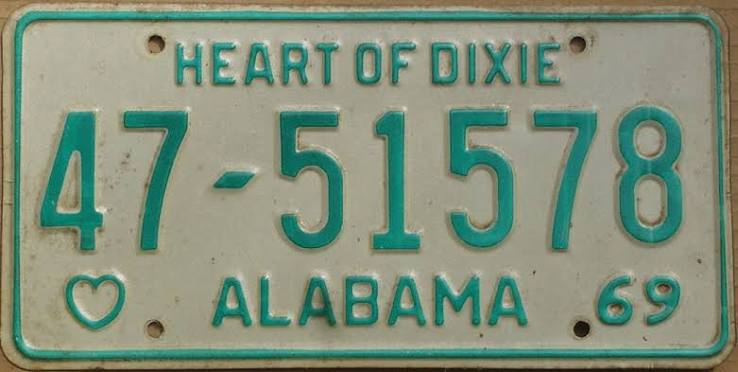
According to the Alabama Department of Revenue, 1969 marked the first reflectorized Alabama license plates.
Reflectorization makes a plate much easier to read at night when headlights shine on it — a road-safety improvement that spread across the country in the decades that followed.
Alabama Moves Away From Annual Plate Replacement
1977 — Alabama began issuing five-year plates.
This marked a shift away from replacing the physical metal plate every year. Annual registration could instead be shown through decals or other validation methods while the base plate remained in service longer.
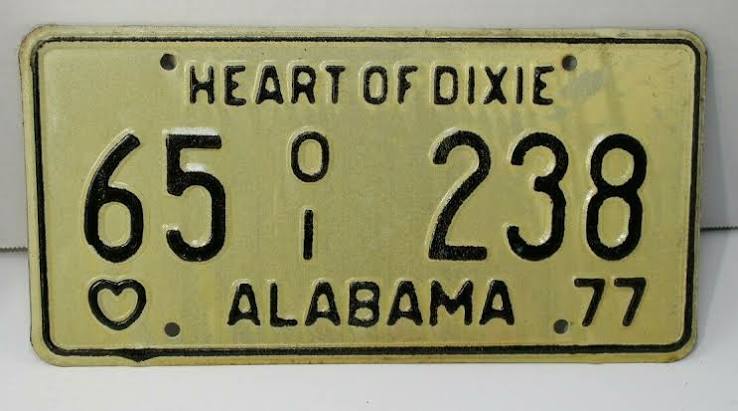
Staggered Registration Begins — 1981
Alabama adopted a staggered registration system in 1981. Rather than every vehicle registration expiring at exactly the same point in the year, renewals could be distributed across different months.
What Does the First Number on an Alabama License Plate Mean?
Alabama has historically used county-number prefixes on many standard passenger plates. These numbers allow a plate spotter to infer the county where the vehicle is registered.
The system was introduced in the 1940s, and it remains one of the most informative county-coding traditions in the country. A few of the most recognizable examples:
| Number | County |
|---|---|
| 1 | Jefferson County |
| 2 | Mobile County |
| 3 | Montgomery County |
| 5 | Baldwin County |
| 31 | Etowah County |
| 47 | Madison County |
| 58 | Shelby County |
| 63 | Tuscaloosa County |
Alabama has 67 counties, and the county-number system makes its standard plates unusually informative for plate spotters.
One caveat: the numbering was fixed decades ago and reflects the Alabama of that era, so today’s fastest-growing counties do not necessarily hold low numbers. Some newer, fast-growing counties now rank among the state’s most populous despite holding mid-range numbers.
SOURCE: Alabama Department of Revenue; county numbering as documented in standard plate references.
Why Are Jefferson, Mobile and Montgomery 1, 2 and 3?
The county prefixes were assigned historically and are not alphabetical.
The lowest numbers have long been associated with the state’s most populous counties of the era, but the full numbering scheme has never been re-ranked to match modern population, so the prefixes should be treated as a historical snapshot rather than a current population ranking.
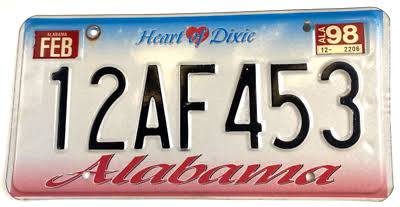
1998: The Plate Begins Following the Owner
According to Alabama Revenue, 1998 marked a change in which the license plate follows the vehicle owner.
In plain language: when ownership of a vehicle changes, the plate is generally associated with the registrant rather than automatically staying with the vehicle.
See Alabama Revenue for current registration requirements →
Digital Plate Production — 2003
The Alabama Department of Revenue identifies 2003 as the beginning of digitally produced aluminum license plates. Digital production allows state agencies to produce graphics and specialty designs differently from the older fully embossed, stamped plates.
What Does the Current Alabama License Plate Look Like?
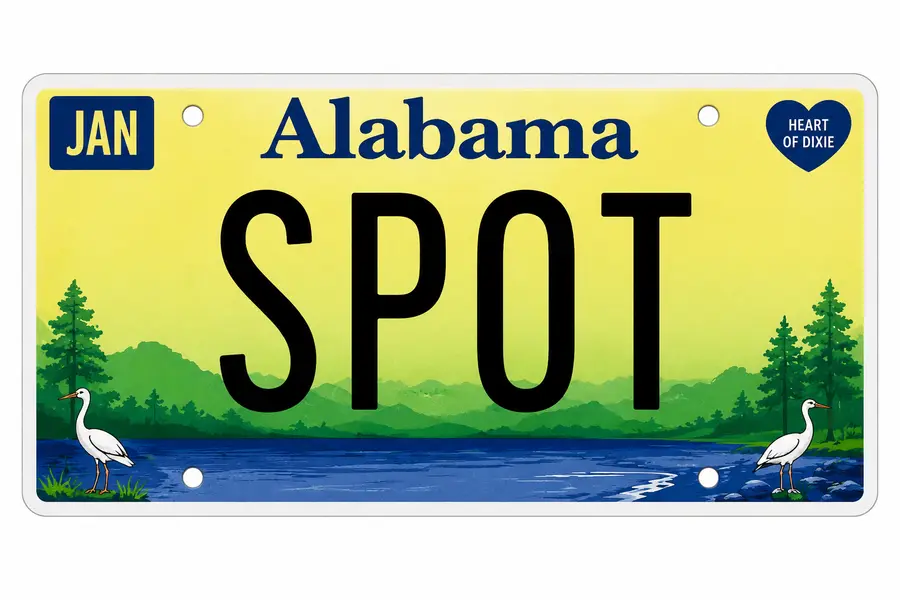
The current standard passenger design became effective October 1, 2022. It features a sunrise coastal-scene background with “ALABAMA” across the top, black serial characters, and “Heart of Dixie” set within a heart outline near the lower right. The county number appears as the leading digits of the serial on applicable standard passenger plates.
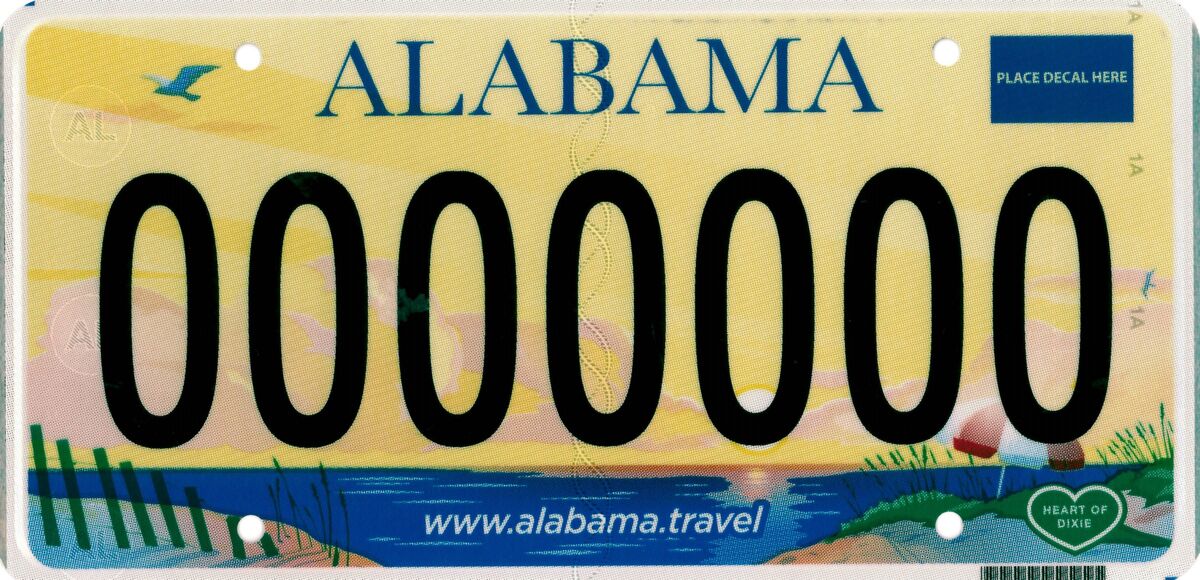
SOURCE: Alabama Department of Revenue — Standard Passenger.
Is “Heart of Dixie” Still on Alabama License Plates?
Generally, yes. Alabama’s license-plate design rules state that plates issued by the state generally display a stylized heart and the words Heart of Dixie. Some distinctive plate categories may be permitted to omit that language — owners of personalized and distinctive plates can specifically request that the slogan be omitted.
SOURCE: Alabama Department of Revenue license plate design specifications; Alabama Code §§32-6-54 and 32-6-54.1.
Alabama Specialty License Plates
Alabama offers a very large number of distinctive and specialty plates. Current categories include plates associated with:
- colleges and universities
- military service
- organizations
- causes
- professions
- government
- disability access
- special interests
Alabama Revenue’s current plate archive includes hundreds of plate categories — far too many to catalog here.
Can Old Alabama License Plates Be Used on Old Cars?
Alabama has provisions involving original vintage license plates for qualifying older vehicles. Under Alabama Code §40-12-297, the owner of a qualifying vintage vehicle may register an original Alabama plate issued in the vehicle’s model year (for model years 1976 and earlier), provided the plate is legible and in acceptable condition and the vehicle meets the vintage-vehicle rules.
The vintage-vehicle category itself covers vehicles more than 30 years old operated as collector’s items — for club activities, exhibitions, tours and parades — and not for general transportation.
In other words, simply owning an old Alabama plate does not allow someone to put it on any vehicle: the plate must match the vehicle’s model year, and the vehicle itself must qualify.
Alabama Revenue’s plate archive maintains examples of vintage passenger plates from 1912 through 1976 — the span eligible for the original-vintage treatment.
How to Recognize an Alabama Plate
The quickest clues are usually:
- ALABAMA across the plate
- the small Heart of Dixie emblem
- the county-number prefix on applicable standard passenger plates
- the current standard plate background/design
Alabama Plate Spotter’s Guide
| If You See | What It May Tell You |
|---|---|
| Heart + “Heart of Dixie” | Alabama plate identity |
| Leading county number | County of registration on applicable plates |
| Older embossed annual plate | Historic Alabama issue |
| Reflective plate | 1969 or later era |
| Current standard design | 2022-present base |
| Unusual organization graphic | Alabama distinctive/specialty plate |
Alabama License Plate FAQ
When did Alabama first issue license plates?
Alabama Revenue’s original-vintage passenger plate archive begins with 1912.
When did Heart of Dixie first appear on Alabama license plates?
1955, according to Alabama Department of Revenue training materials.
Why does the Alabama license plate have a heart?
The heart is part of the “Heart of Dixie” marking. Alabama’s plate-design rules generally require a stylized heart and the words “Heart of Dixie” on state-issued plates, with exemptions available for certain personalized and distinctive plates.
Is Heart of Dixie still required on Alabama license plates?
Generally yes, subject to exceptions for certain distinctive plates. Owners of personalized and distinctive plates may request that the slogan be omitted.
What does the number at the beginning of an Alabama license plate mean?
On many standard passenger plates, the leading number is the county code — the county where the vehicle is registered. The system has been in place since the 1940s.
What county is number 1 on an Alabama license plate?
Jefferson County.
What county is number 2 on an Alabama license plate?
Mobile County.
What county is number 3 on an Alabama license plate?
Montgomery County.
When did Alabama start using reflective license plates?
1969, according to the Alabama Department of Revenue.
When did Alabama stop issuing a completely new plate every year?
The transition came with the 1977 five-year plate: instead of a fresh metal plate every year, annual registration was shown through decals while the base plate stayed in service longer.
Does Alabama require a front license plate?
No. Alabama law (Ala. Code §32-6-51, “Rear tags required”) requires a single plate attached and plainly visible on the rear of the vehicle. A front plate is not required for standard passenger vehicles.
Can an old Alabama license plate be used on a vintage car?
Possibly. Under Alabama’s original-vintage plate provision (§40-12-297), a qualifying vintage vehicle — generally a vehicle more than 30 years old used as a collector’s item, not for general transportation — may display an original Alabama plate issued in the vehicle’s model year (1976 or earlier), subject to legibility and condition requirements.
Where Are You Likely to Spot an Alabama Plate?
Alabama plates travel naturally across the Southeast. Neighboring states — Georgia, Florida, Mississippi and Tennessee — are all reliable sighting ground, and Gulf Coast destinations draw Alabama traffic in every season.
The major Southeast interstate corridors that cross the state make Alabama plates a common sight well beyond the state line.
Sources
- Alabama Department of Revenue — License Plates Archive
- Alabama Department of Revenue — License Plate and Registration Information
- Alabama Department of Revenue — license plate design specifications (current standard passenger design)
- Alabama Code §32-6-54 and §32-6-54.1 — Heart of Dixie requirement and exemptions
- Alabama Code §40-12-290 and §40-12-297 — vintage vehicles and original vintage plates
- Alabama Code §32-6-51 — rear tag display requirement