VT American plate atlas
Vermont
The Green Mountain State
Meet the plate, people, places, and stories behind one of the road-trip game’s fifty-one essential finds.
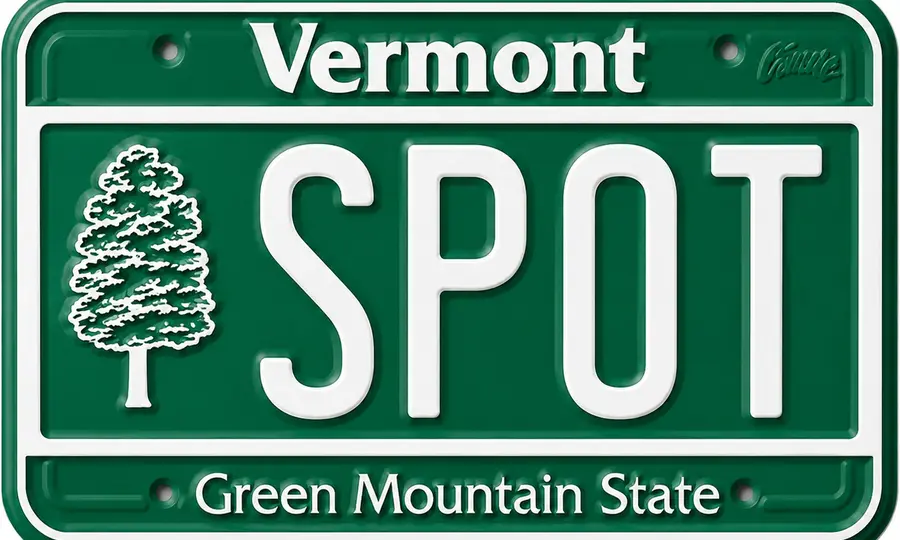
Capital
MontpelierState bird
Hermit thrushJoined the Union
March 4, 179101
A quick trip through time
The Vermont story
Vermont was an independent republic before becoming the fourteenth state. Town traditions, dairy farming, forests, maple syrup, abolitionism, and conservation shape its identity.
02
Bumper-sized history
About the plate
Vermont’s green-and-white plate is appropriately direct for the Green Mountain State and unlike nearly every neighboring design.
Deep Dive Archive · State Volume 02
The Detailed History of Vermont License Plates
From 1905 porcelain “Automobile Register” plates to the iconic Green Mountain State design: over 120 years of registration law, wartime conservation, tourism branding, and signature green identity.
Executive Chronology & Key Milestones
Vermont has one of the oldest state-issued license plate traditions in America. Its history moves from early porcelain plates through annual issues, wartime conservation, tourism slogans, reflective green plates, and the familiar Green Mountain State design.
| Year / Period | Historical Milestone | Significance & Impact |
|---|---|---|
| 1905 | First state-issued plate | White on dark-blue porcelain; “VERMONT AUTOMOBILE REGISTER” across the top. Single rear plate (#1–509). |
| 1907 | Paired plates introduced | Front and rear white porcelain plates with black characters mandated by legislative revision. |
| 1909 | Annual registration begins | Dated annual porcelain plates begin; registration numbers grew rapidly into the thousands. |
| 1916 | Pressed steel era | Embossed metal replaces porcelain, establishing durable annual color combinations. |
| 1943 | Wartime tab revalidation | 1942 plates revalidated with small metal tabs fabricated from recycled prison food tins. |
| 1944–1947 | Single plate issuance | Rear plate only during wartime and postwar steel conservation. |
| 1948 | First plate slogan | “GREEN MOUNTAINS” appears on standard passenger plates, beginning promotional branding. |
| 1957 | “SEE VERMONT” tourism era | Tourism-oriented slogan begins, turning vehicles into mobile promotional billboards. |
| 1967 | Modern green base foundation | Reflective white characters on green field; debossed numerals, six digits, and multi-year sticker transition. |
| 1969 | Reusable base with slogan | “SEE VERMONT” returns on multi-year green baseplates. |
| 1977 | “GREEN MOUNTAINS” revival | Revival of the first 1948 slogan on the modern green format. |
| 1985 | “Green Mountain State” base | Sugar maple tree graphic and current slogan debut on clean green field. |
| 1990–Present | Modern generation plate | Refined green-and-white standard design with ABC 123 serial format and continuous recognition. |
1. Vermont Becomes an Early Plate-Issuing State
Vermont was an early adopter of state-issued automobile registration plates. A 1904 law required motor vehicles to be registered by May 1, 1905, and the first plates were issued in 1905. They were undated porcelain-enamel plates with white numbers on a dark-blue field and the words “VERMONT AUTOMOBILE REGISTER” across the top.
Only one plate was initially issued, for the rear. Vermont Historical Society research records 509 as the last number issued in 1905. Registration was not yet annual. The design closely resembled contemporary Massachusetts plates, which helped drive Vermont toward a more distinctive system.
2. White Porcelain Pairs and Annual Registration
A 1906 legislative revision required black numbers on a white field and a pair of plates for front and rear display. The new plates arrived in 1907.
In 1908 lawmakers moved Vermont to annual registration, and dated 1909 plates followed. Through 1915, plates remained porcelain enamel over steel. Their physical width varied with the number of digits, creating some unusually long early plates.
Registration growth tells the larger story: Vermont moved from only hundreds of registered automobiles in 1905 to thousands in the early 1910s and roughly 15,000 by 1916.
3. From Porcelain to Pressed Metal
By 1916 Vermont had entered the pressed-steel era. Annual plates continued, with changing color combinations making the current registration year easy to recognize for law enforcement and municipal clerks.
These interwar plates were still primarily functional: state name, year, and registration number. For collectors, however, the era is rich in changing typefaces, dimensions, colors, and manufacturing techniques.
4. World War II and the 1943 Tab
World War II interrupted the annual-plate cycle. Vermont revalidated 1942 plates for 1943 with small tabs instead of manufacturing complete new sets.
Vermont plate histories record a memorable detail: the 1943 tabs were made from recycled food tins from the prison system. From 1944 through 1947, Vermont also issued only a single rear plate, reflecting continued wartime metal conservation.
5. Vermont Turns Green — and Gets Its First Slogan
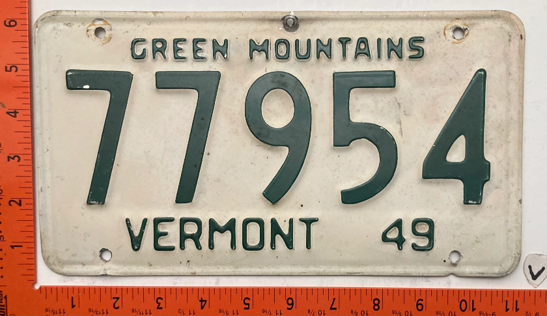
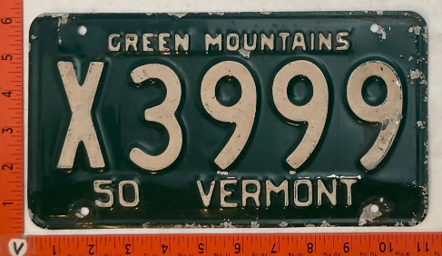
In 1948 the standard passenger plate carried Vermont’s first license-plate slogan: GREEN MOUNTAINS. The state was beginning to use the plate as more than an identifier; it could also promote Vermont itself.
GREEN MOUNTAINS remained through 1950. These plates are the bridge between Vermont’s old annual-color era and the green identity that would eventually become permanent.
6. “SEE VERMONT” — Mid-Century Tourism Marketing
In 1957 Vermont changed from description to invitation. The word SEE appeared alongside the state name so the plate effectively read “SEE VERMONT.”
It was classic mid-century tourism marketing: every Vermont automobile became a small traveling billboard. SEE VERMONT remained through 1966, disappeared during the 1967 technical redesign, and returned in 1969.
7. The 1967 Plate: Foundation of Modern Vermont
The 1967 issue is one of the most important plates in Vermont history. The state adopted reflective white characters on a green background, moved to six-digit serials, and used debossed rather than raised characters.
“SEE” was removed partly to leave space for validation stickers as Vermont prepared for reusable multi-year plates. The legislature authorized sticker revalidation, and the bright-green identity that still defines Vermont plates was firmly established.
8. SEE VERMONT Returns
With the multi-year system established, SEE VERMONT returned in 1969 and continued through the 1969–71 and 1972–76 bases.
These plates look much closer to modern Vermont: green dominates, white provides high contrast, and the plate has become a durable state identity rather than an annually disposable credential.
9. GREEN MOUNTAINS Returns
In 1977 Vermont revived GREEN MOUNTAINS, the slogan first used in 1948. The revival created a bridge between the tourism-focused SEE VERMONT period and the modern Green Mountain State design.
By now, green and white were no longer simply one annual color combination among many. They were Vermont’s signature.
10. The 1985 Graphic Base — Tree + Green Mountain State
The 1985 base modernized Vermont without abandoning its simplicity. It retained the green field and white characters, added a small tree graphic, and changed the slogan to GREEN MOUNTAIN STATE.
The tree represents the sugar maple, Vermont’s state tree and a fitting symbol for a state associated with maple syrup, forests, and fall foliage. Vermont avoided the busy illustrations adopted by many other states and kept the plate exceptionally readable.
11. The Current-Generation Vermont Plate
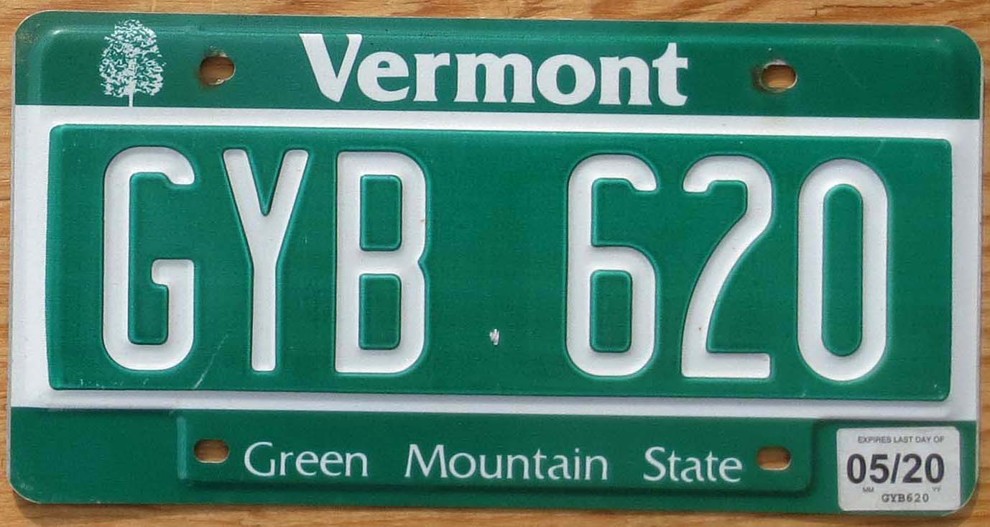
A refined base appeared around 1990 and established the modern design familiar today: saturated green, white serial characters, Vermont at the top, a small tree emblem in the upper-left, and Green Mountain State along the bottom.
Later passenger serials use the ABC 123 format. Vermont’s refusal to repeatedly reinvent the standard plate is one reason it remains so recognizable. At highway distance, a solid green U.S. plate is an unmistakable Vermont clue.
Vermont Plate Spotter’s Field Guide
Use this visual guide to date vintage Vermont plates seen at classic car shows, historical exhibits, or on antique vehicles:
| If You See… | You’re Looking At… |
|---|---|
| Dark-blue porcelain + VERMONT AUTOMOBILE REGISTER | 1905–1906/07 First state issue |
| White porcelain, black characters (pairs) | 1907–1915 Annual porcelain series |
| Annual metal plates, changing colors | 1916–1942 Pressed steel era |
| 1942 plate + small 1943 tab (food-tin steel) | World War II metal conservation |
| GREEN MOUNTAINS (all-caps slogan) | 1948–1950 or 1977–1984 |
| SEE VERMONT | 1957–1966 or 1969–1976 |
| Reflective white on green, debossed, no slogan | 1967–1968 Technical transition |
| Tree emblem + GREEN MOUNTAIN STATE | 1985 onward |
| ABC 123 on solid green with tree | Modern standard Vermont passenger plate |
The Four Plates to Remember
To understand Vermont’s evolution, four key moments tell most of the story: 1905 (VERMONT AUTOMOBILE REGISTER porcelain),1948 (GREEN MOUNTAINS debut), 1967 (reflective green modernization & multi-year stickers), and1985 (sugar maple tree + GREEN MOUNTAIN STATE). Together they chart Vermont’s journey from early vehicle regulation to one of the most distinctive, stable visual brands on American highways.
Sources & Image Credits
- Vermont Historical Society: Vermont License Plate Books and Vermont License Plate History Facts, compiled by Paul A. Carnahan with historical facts by Conrad Hughson.
- All About License Plates: Vermont pre-state/state and passenger-plate chronology.
- Licenseplates.tv: Vermont slogan chronology and historical archives.
- Wikimedia Commons: 1949 plate image by Zcarstvnz (CC BY-SA 4.0).
- LicensePl8s.com: 1950 plate image from historical collectible archives.
- Automobile License Plate Store: 2020 plate image from historical archive.