NY American plate atlas
New York
The Empire State
Meet the plate, people, places, and stories behind one of the road-trip game’s fifty-one essential finds.
Capital
AlbanyState bird
Eastern bluebirdRatified the Constitution
July 26, 178801
A quick trip through time
The New York story
New York grew from Dutch and English colonies into a center of immigration, finance, media, industry, arts, canals, agriculture, and global urban life.
02
Bumper-sized history
About the plate
New York has cycled through memorable blue-and-gold and white scenic designs. The state name is usually large enough to settle a fast-moving plate debate.
Deep Dive Archive · State Volume 11
New York License Plate History
New York’s license plate history goes back to the earliest days of the automobile. The state began requiring automobile owners to register their vehicles in 1901, making New York one of the country’s earliest states to establish a statewide motor-vehicle registration system.
The plates themselves have changed dramatically since then. New York drivers have carried simple numbered plates, bold orange-and-blue designs, the Statue of Liberty, Niagara Falls and the Manhattan skyline — before arriving at today’s Excelsior plate.
New York Plate History at a Glance
| Year | What Changed |
|---|---|
| 1901 | New York begins requiring statewide motor-vehicle registration |
| 1910 | First state-issued New York license plates |
| 1957 | First New York plate in the standardized 6 × 12-inch size |
| 1966 | Blue plate with orange characters introduced |
| 1973 | Orange plate with dark blue characters introduced |
| 1986 | Statue of Liberty plate introduced |
| 2001 | Blue-and-white Empire State plate introduced |
| 2010 | Empire Gold plate introduced |
| 2020 | Excelsior plate becomes New York’s standard issue |
SOURCE: New York State DMV; New York State Archives; Vehicle registration plate references for New York State.
New York Starts Registering Automobiles
In 1901, New York passed legislation requiring automobile and motor-vehicle owners to register with the Secretary of State. It was the first statewide motor-vehicle registration system in the country.
Registration in 1901 did not mean standardized plates. Motorists displayed their assigned registration numbers on owner-provided markers, and per the state’s earliest rules these homemade plates carried the owner’s initials until 1903, after which numbers were displayed instead. The state did not begin manufacturing plates for another decade.
SOURCE: New York State Archives.
New York Begins Issuing Its Own Plates
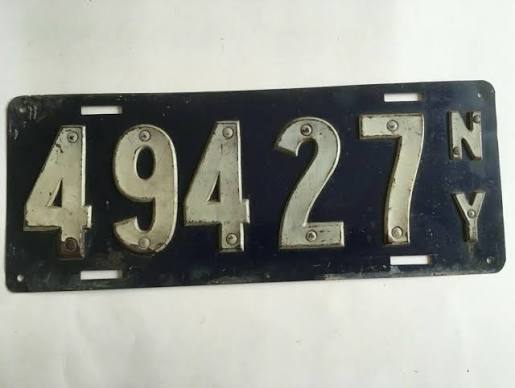
New York issued its first state-provided license plates in 1910. The first state-issued plates were dark blue with white, riveted serial numbers and a vertical “NY” at the right edge. Until then, motorists had registered with the state but built their own plates.
From 1910 on, New York supplied every registered vehicle with standardized state plates, and the state has issued its own plates continuously ever since.
A Different Plate From Year to Year
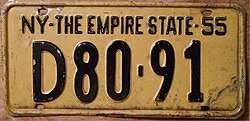
For much of the early and mid-20th century, New York issued a new plate every year. Colors changed regularly, the state name appeared in different forms — “NY,” “N.Y.,” “NEW YORK” — and plate dimensions evolved over the decades. “The Empire State” first appeared as a slogan on the plate in the early 1950s.
The 1957 issue was the first New York plate made in the standardized 6 × 12-inch size adopted nationwide in 1956. Over time, validation stickers and tabs also reduced the need to issue a completely new plate every year.
Blue and Orange
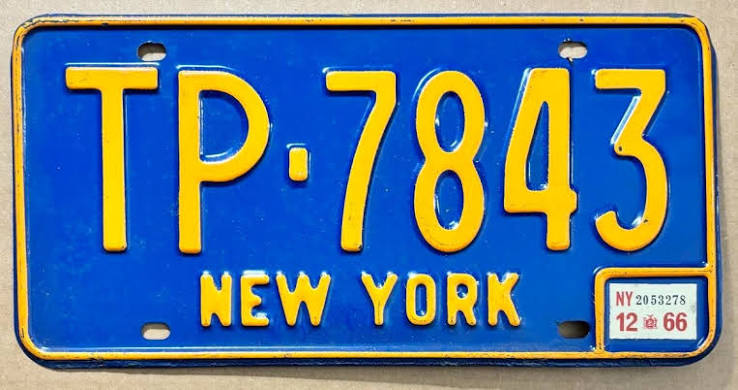
In 1966, New York introduced a new base plate with a blue background and orange serial characters, with “NEW YORK” across the bottom. This blue-and-orange design ran through 1972 and was validated with stickers rather than replaced annually.
Blue and gold have appeared repeatedly across New York plate history — from the yellow-on-black plates of the mid-century years to today’s Excelsior colors.
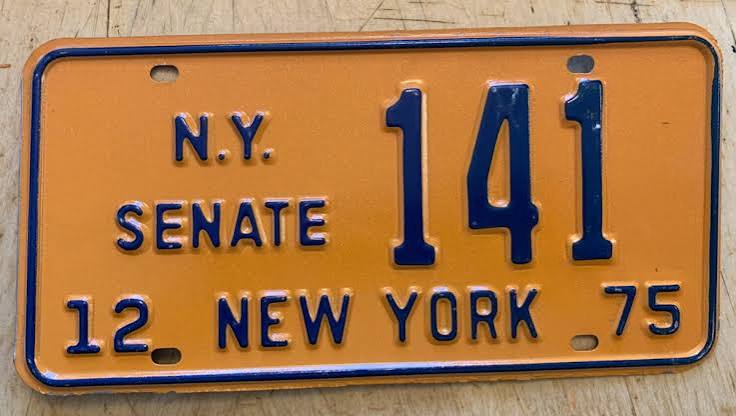
The Orange New York Plate
In 1973, New York flipped the color scheme and introduced an orange plate with dark blue characters, again labeled “NEW YORK” across the bottom. It was issued until 1986 and became strongly associated with New York vehicles of the 1970s and early 1980s.
The Statue of Liberty Plate
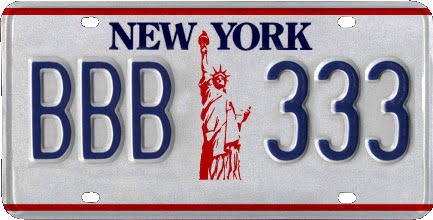
On July 1, 1986, New York replaced the orange plate with a white design featuring a red Statue of Liberty graphic at the center. The plate carried dark blue serial characters, red stripes at the top and bottom, and “NEW YORK” screened in dark blue at the top.
The timing lined up with a major moment for the monument itself: the Statue of Liberty was undergoing a major restoration ahead of its 100th anniversary in 1986. The design stayed in production for fifteen years, until the end of 2000, and its blue serials can still be remade on request today.
Why Was the Statue of Liberty on New York Plates?
The Statue of Liberty is one of New York’s most recognizable landmarks, and it became the central graphic on the state’s late-1980s and 1990s plate design. The statue still appears on the current Excelsior plate.
The Empire State Plate
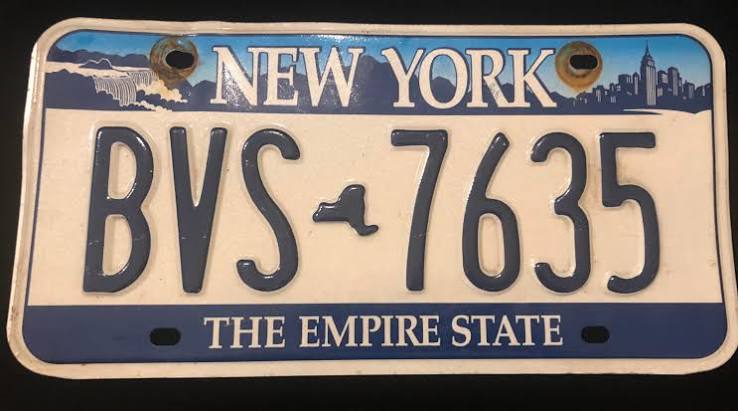
In January 2001, New York introduced a blue-and-white Empire State plate. The white plate carried dark blue characters between blue bands, with “NEW YORK” on the upper band and “THE EMPIRE STATE” on the lower one.
The upper band depicted Niagara Falls, the Adirondack Mountains and the New York City skyline. The design attempted to represent different parts of the state rather than focusing only on New York City.
Why Does the Plate Say “The Empire State”?
“The Empire State” is New York’s longstanding nickname. Its exact origin is disputed, but the phrase was in use by the early 19th century and eventually became closely associated with the state. It has appeared on New York plates since the 1950s.
New York Goes Back to Gold
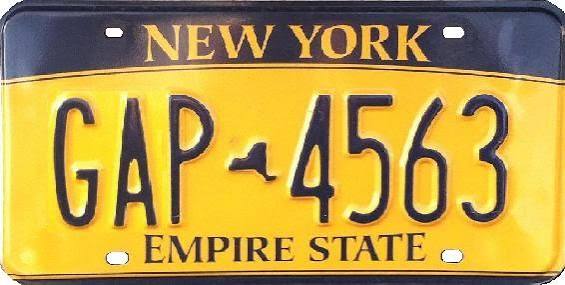
New York introduced the Empire Gold plate on April 1, 2010. Its gold-yellow background and dark blue characters brought back a color combination the state had used decades earlier on its black-and-gold plates of the 1950s and 1960s.
The design kept the layout of its predecessor — blue bars above and below the serial, with “NEW YORK” on the top bar and “EMPIRE STATE” at the bottom.
Today’s New York Excelsior Plate
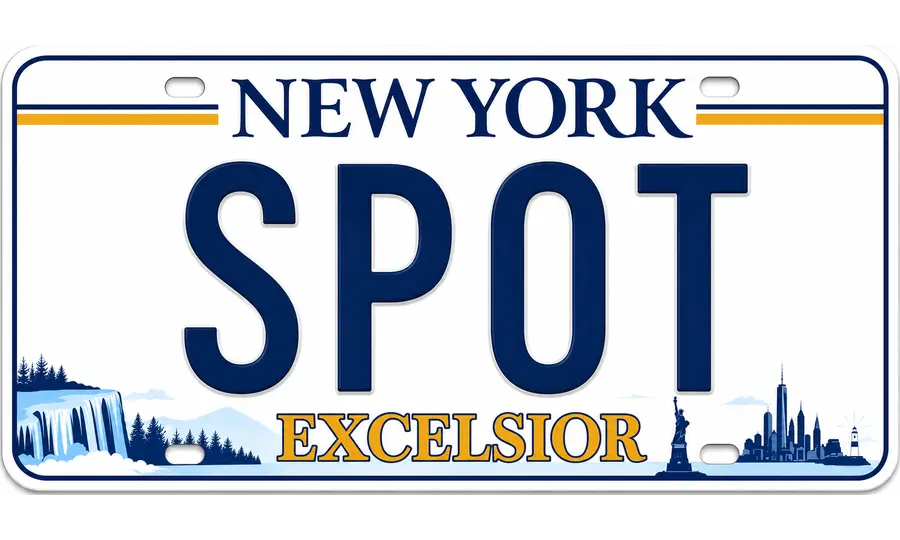
New York introduced the Excelsior plate as its standard passenger plate in June 2020. The design was chosen through an online public vote, and the DMV now offers it on new registrations and renewals, though switching to Excelsior is optional.
The white plate carries dark blue serial characters with gold and blue accents, “NEW YORK” across the top, and “EXCELSIOR” across the bottom. Its artwork shows several New York landmarks: Niagara Falls, the Adirondack Mountains, the Statue of Liberty, the New York City skyline and the Montauk Point Lighthouse.
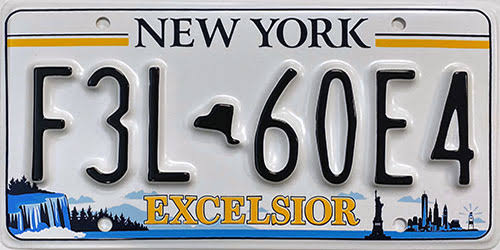
What Does “Excelsior” Mean on a New York License Plate?
Excelsior means “Ever Upward.” It is New York State’s motto, and it appears prominently on the bottom of the current standard plate.
The Landmarks on New York’s Current Plate
The Excelsior design packs several regions of New York State into one plate: Niagara Falls up near the Canadian border, the Adirondack Mountains of the North Country, the New York City skyline with the Statue of Liberty, and the Montauk Point Lighthouse at the eastern end of Long Island. It is a New York State plate, not a New York City plate.
Why Are There Different New York Plates on the Road?
Changing the standard design does not remove every older plate from the road. New York does not require drivers to swap plates each time a new base is introduced, so a motorist with a valid registration can keep displaying older plates.
That is why a spotter may still encounter Empire Gold plates, and occasionally older Liberty or Empire State plates, alongside the current Excelsior design. The DMV can even remake serials from the Liberty, Empire State and Empire Gold bases on request.
Historical Vehicle Plates
New York DMV offers Historical registrations for qualifying collector vehicles. A vehicle generally must have been manufactured more than 25 years before the current calendar year, be used only as a collector’s item or exhibition piece, not be used for daily transportation, and meet the applicable weight and registration requirements.
Standard Historical car and truck plates begin or end with HX (motorcycles use HM) and display “HISTORICAL” at the bottom. These are newly issued plates for old vehicles — not original old New York plates. Historical registrations are valid for one year and require special historical vehicle insurance.
Vintage Plates: Original Year-of-Manufacture Plates
New York also permits a Vintage plate program. Owners of qualifying vehicles may display actual original plates issued by New York in the year the vehicle was manufactured — reproductions are not accepted. If New York issued two plates that year, both matching plates must be displayed, and the plate number must be verified as available with the DMV’s Custom Plates Unit before registration.
SOURCE: NYS DMV — Historical and Vintage Plates.
Does New York Require a Front License Plate?
Yes. Under New York Vehicle and Traffic Law § 402, standard passenger vehicles are issued two plates and must display one at the front and one at the rear of the vehicle. Motorcycles and trailers are issued a single rear plate.
How to Recognize a New York Plate
When searching for New York on the road, look for:
- “NEW YORK” across the top
- Blue-and-gold color elements on the current design
- “EXCELSIOR” along the bottom of the current standard plate
- Multiple New York landmarks pictured on the current plate
- Plates displayed on both the front and rear of standard passenger vehicles
Older Empire Gold plates may look dramatically different from the current Excelsior design, despite carrying the same state name.
New York Specialty Plates
NYS DMV offers many custom picture and professional plate designs, covering regional themes, causes, colleges, military and veteran plates, organizations, sports and professions. Browse the DMV’s custom plate directory for the current lineup.
New York Plate Spotter’s Guide
| If You See | Likely Era / Design |
|---|---|
| Blue background, orange characters | 1966–1972 design |
| Orange background, blue characters | 1973–1986 era |
| Statue of Liberty graphic | Liberty plate era, 1986–2000 |
| White plate with blue scenic bands | Empire State plate, 2001–2010 |
| Gold/yellow background | Empire Gold, 2010–2020 |
| White scenic plate with “EXCELSIOR” | Current standard design, 2020–present |
Frequently Asked Questions
When did New York first require vehicle registration?
In 1901, making New York the first state to require motor-vehicle registration.
When did New York start issuing license plates?
New York issued its first state-manufactured plates in 1910. The 1901 registration law required owners to register but did not provide standardized plates; motorists displayed their numbers on owner-provided markers until the state took over plate production in 1910.
What does Excelsior mean on a New York license plate?
Excelsior means “Ever Upward” — New York State’s motto.
Why is the Statue of Liberty on New York license plates?
The statue became the central graphic on the plate introduced in 1986 and still appears on today’s Excelsior design as one of New York’s most recognizable landmarks.
When did New York have orange license plates?
From 1973 through 1986, with dark blue characters on an orange background.
Why are some New York license plates yellow?
Those are Empire Gold plates, the standard design issued from April 2010 until the Excelsior plate arrived in 2020. Valid ones can still be on the road.
What is the current New York license plate?
The Excelsior plate, introduced in 2020.
Does New York require a front license plate?
Yes. Standard passenger vehicles display plates front and rear; motorcycles and trailers carry a single rear plate.
Can old cars use historical New York license plates?
Yes. Vehicles over 25 years old used as collector’s items can receive newly made Historical plates (HX for cars and trucks), or the owner can register original vintage plates from the vehicle’s model year, subject to DMV approval.
Where Are You Likely to Spot a New York Plate?
New York plates are common throughout the Northeast: New Jersey, Connecticut, Pennsylvania, Massachusetts and Vermont all border the state, and New York tags travel the East Coast interstate corridors in heavy numbers. Florida is another good place to look, thanks to the steady seasonal movement of New Yorkers between the two states.
Sources and Historical References
- New York State DMV — Vehicle License Plates
- NYS DMV — Historical and Vintage Plates
- New York State Archives — Department of Motor Vehicles history
- New York Vehicle and Traffic Law § 402 (plates to be displayed, one on the rear and one on the front).