Deep Dive Archive · State Volume 05
Montana License Plates: History, County Numbers & Big Sky Designs
Montana has one of the most distinctive license plate systems in the country.
The state’s plates are known for their Big Sky imagery, blue-and-white designs and bison skull separator — but for license plate spotters, the most interesting feature may be the number at the beginning of the plate.
That number identifies the Montana county where the vehicle was registered.
Montana began registering motor vehicles in 1913 and issued its first state-provided license plates in 1914. More than a century later, the county-number system introduced during the 1920s is still visible on Montana roads.
Montana Plate Quick Facts
| First state-issued plate | 1914 |
|---|---|
| County-number system introduced | 1926 |
| County numbers revised to represent actual counties | 1933 |
| First plate slogan | Treasure State — 1950 |
| Big Sky Country introduced | 1967 |
| Current standard design | 2010 |
| Current standard slogan | Treasure State |
Before Montana Issued Plates — 1913
Montana began requiring motor vehicle registration in 1913. The state assigned motorists registration numbers, but it did not initially provide the physical license plate.
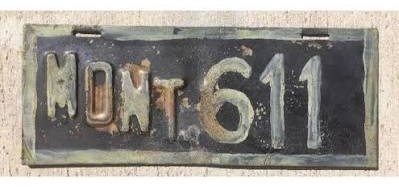
Vehicle owners had to display the assigned number themselves. Some motorists reportedly painted or attached the registration number to leather, metal or another suitable material.
This lasted only briefly. In 1914, Montana began issuing standardized state license plates.
Source: Montana Motor Vehicle Division — A History of Montana License Plates
The First Montana License Plate — 1914
The first state-issued Montana plate appeared in 1914. The earliest plate was extremely simple and primarily displayed the registration number.
In 1915 and 1916, plates began displaying MON, the year, and the registration number.
What Does the Number at the Beginning of a Montana License Plate Mean?
The number at the beginning of a Montana license plate identifies the county where the vehicle was registered.
Montana first assigned prefix numbers in 1926. Those original numbers represented population centers based on population patterns dating to 1914. In 1933, the system was revised so the prefix specifically identified the county of registration. The basic county-number concept survives today.
| Prefix | County | County seat |
|---|---|---|
| 1 | Silver Bow County | Butte |
| 2 | Cascade County | Great Falls |
| 3 | Yellowstone County | Billings |
| 4 | Missoula County | Missoula |
| 5 | Lewis and Clark County | Helena |
| 6 | Gallatin County | Bozeman |
There are 56 Montana counties, each with its own prefix.
See the full Montana county-prefix list →
Sources: Montana Department of Transportation; Montana Motor Vehicle Division; Montana Association of Counties.
Why Are the County Numbers in That Order?
The numbers are not alphabetical. They trace back to historic population rankings. When Montana introduced its prefix system in 1926, the numbers were assigned to population centers as they existed in 1914 — so the fastest-growing counties of the 1910s earned the lowest numbers, with Silver Bow County (Butte) at the top of the list.
In 1933 the prefixes were revised to designate counties rather than population centers, but the old ranking carried over. Today’s county numbers are essentially a snapshot of Montana as it looked a century ago — which is why counties that were minor in 1914 can hold low numbers, and newer population booms, like Flathead County’s growth around Kalispell, never moved their prefix at all (Flathead is 7).
Prison-Made Montana Plates
The first Montana prison-made plates were issued in 1928. Beginning that year, MONTANA was spelled out rather than abbreviated; before 1928, Montana’s plates had been manufactured out of state.
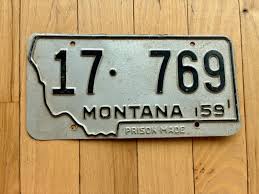
From 1939 through 1957, plates actually carried the words PRISON MADE.
Montana Correctional Enterprises continues to play a role in license-plate manufacturing today; a committee that includes the Department of Corrections helps choose each standard plate design.
The License Plates That Got Eaten
During World War II, steel shortages forced Montana to experiment with alternative materials. In 1944, Montana manufactured license plates using pressed soybean fiberboard.
According to the Montana Motor Vehicle Division, goats, cows and mice apparently liked the material too. Some motorists reportedly lost their license plates because animals ate them.
Yes — Montana once issued license plates that animals could eat.
Source: Montana Motor Vehicle Division.
The Treasure State — 1950
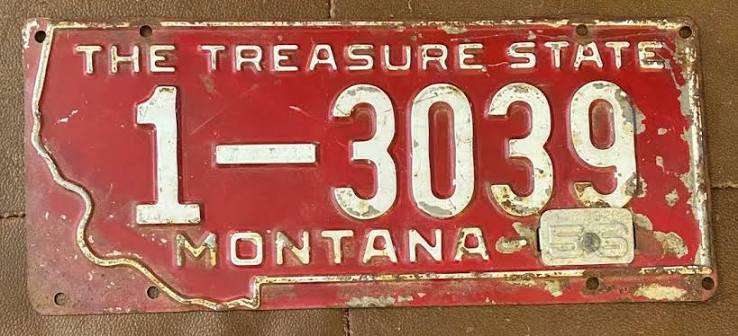
Montana first placed TREASURE STATE on its license plates in 1950.
The nickname refers to Montana’s rich mineral resources and mining history — gold, silver and copper booms made mining the economic engine of early Montana, and the state’s mountains yielded fortunes that earned it the “Treasure State” name.
Big Sky Country — 1967
Montana replaced Treasure State with BIG SKY COUNTRY in 1967. It became one of America’s most recognizable state slogans, reflecting Montana’s broad landscapes and expansive skies.
1967 was also important because Montana introduced reflectorized plate materials that year, making plates easier to read at night.
What Is the Symbol Between the Numbers on a Montana License Plate?
The small symbol used as the separator on many Montana plates is a bison skull.
The bison skull first appeared on a Montana plate for a single year in 1938. It later returned as an important element of modern Montana plate design.
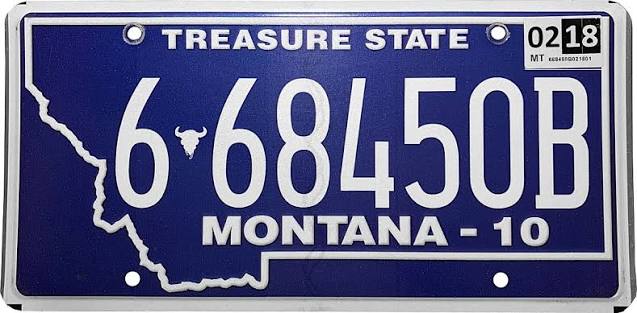
On today’s blue standard plate, the bison skull appears as the separator between the county prefix and the rest of the plate number.
On the current plate it reads like a period between the two groups of characters — a small, distinctive detail that makes a Montana plate identifiable even at a distance.
The 1976 Bicentennial Plate
Montana marked the United States Bicentennial with a red, white and blue plate introduced in 1976. Validation stickers kept the base in use afterward — all the way until 1991, according to the Montana Motor Vehicle Division.
The Bicentennial era also introduced National Guard and Disabled Veteran plates to Montana.
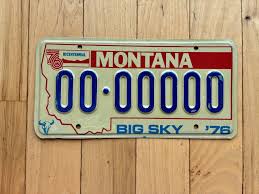
The 1989 Montana Centennial Plate
Montana became a state in 1889. For its 100th anniversary in 1989, Montana introduced a Centennial plate with a Montana outline, mountains transitioning toward the plains, and a Centennial “1889–1989” theme.
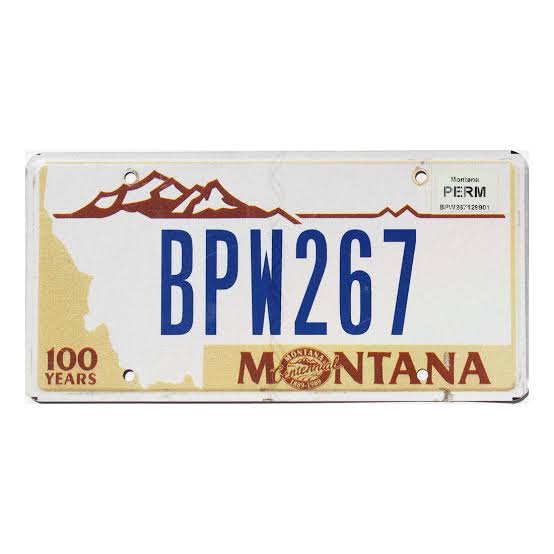
The 1989 Centennial design is still available today as an alternative standard plate — one of several retired designs Montana drivers can choose instead of the current blue plate.
The Big Sky Graphic Era — 1991, 2000 and 2006
Three graphic designs carried Montana through the 1990s and 2000s.
1991 — a gradient blue plate with striped mountain silhouettes and “Big Sky” on the bottom, alongside a bison skull. This design remained in use through the ’90s.
2000 — an updated Big Sky design with rugged mountains, vast plains, and the rich purple and gold colors associated with both.
2006 — a mountains-to-plains design under “Big Sky Country,” notable as Montana’s first standard plate to be printed on the metal rather than embossed or stamped. It also brought the bison skull back as the county-prefix separator for the first time since 1938.
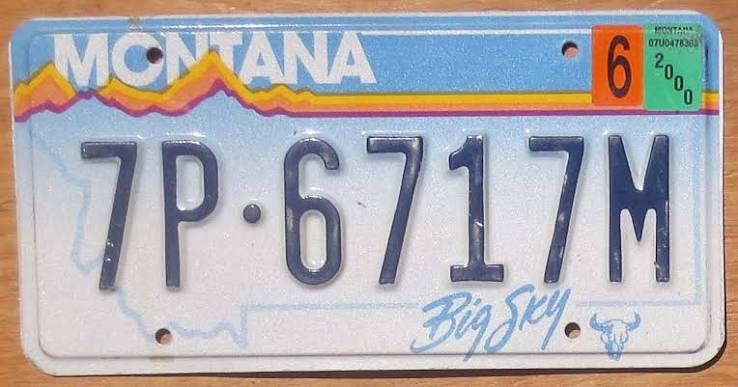
The Current Blue Plate — 2010
In January 2010 Montana introduced its current blue retro-style standard plate: a royal/dark blue background, a white Montana outline, white characters, TREASURE STATE at the top, MONTANA 10 below, a bison skull separator and a county-number prefix.
Virtually every design element intentionally references older Montana plates. According to Montana MVD:
- the white state outline recalls the plates of the 1970s
- Treasure State revives the 1950s slogan
- the “10” indicates the design’s 2010 issue year
- the bison skull separator revives an older Montana symbol
Source: Montana Motor Vehicle Division.
Montana Has Multiple “Standard” Plates
Montana drivers are not limited to the current 2010 blue design. Montana currently allows motorists to choose several retired designs as standard alternatives. According to Montana MVD, available standard choices include:
- 2010 blue Treasure State
- 1989 Centennial
- 1991
- 2000
- 2006
You may see several very different-looking Montana plates on the road — and all of them can be normal, current Montana registrations.
For Spot the States players, this means a pale-blue Big Sky graphic plate or a gold Centennial plate might not be a classic car’s vintage tag — it could have been issued yesterday.
Why Do Some Old Montana Plates Stay on the Road?
Certain Montana vehicles can qualify for permanent registration. Vehicles that have been permanently registered may continue displaying the plate issued when permanent registration occurred.
In Montana, light vehicles 11 or more years old may be permanently registered — and the registration does not need to be renewed as long as ownership is unchanged. That’s why an older Montana standard design can remain legitimately visible decades later.
Montana MVD has current permanent-registration requirements →
Why Do You Sometimes See Montana Plates on Exotic Cars and RVs Far From Montana?
Montana has become well known for vehicle registrations associated with Montana LLCs, particularly for expensive vehicles, RVs and specialty cars. Because Montana does not impose a general sales tax, some out-of-state owners have formed Montana entities and registered vehicles there.
Legality and tax obligations depend on the owner’s actual state of residence and circumstances. Other states may challenge registrations intended to avoid their taxes or registration requirements. And seeing a Montana plate does not necessarily mean the owner lives in Montana.
That’s why Montana plates sometimes appear disproportionately on exotic cars, supercars, RVs and other high-value vehicles — far from Big Sky Country.
Montana Plate Spotter’s Guide
| If You See | Likely Era / Design |
|---|---|
| Old annual plate with simple numbers | Early Montana |
| PRISON MADE marking | 1939–1957 |
| TREASURE STATE | 1950s/60s or current 2010 plate |
| BIG SKY COUNTRY | 1967 onward on various designs |
| Red/white/blue | 1976 Bicentennial era |
| Centennial / 1889–1989 | 1989 design |
| Pale blue Big Sky graphic | 1991/2000 era |
| Mountains to plains | 2006 design |
| Solid blue + white state outline | 2010 current plate |
Frequently Asked Questions
What does the number at the beginning of a Montana license plate mean?
It identifies the county where the vehicle was registered.
What does 1 mean on a Montana license plate?
County prefix 1 represents Silver Bow County (Butte-Silver Bow), home of Butte.
What does 2 mean on a Montana license plate?
Cascade County — Great Falls.
What does 3 mean on a Montana license plate?
Yellowstone County — Billings.
Why are there so many different Montana license plates?
Montana offers several standard alternatives (the 2010 blue plate plus retired 1989, 1991, 2000 and 2006 designs), a wide range of sponsored specialty plates, and permanently registered vehicles that may keep plates issued years ago. One Montana road can show plates spanning many decades of design.
What is the skull on a Montana license plate?
A bison skull.
Why does the Montana license plate say Treasure State?
The slogan first appeared on plates in 1950 and refers to Montana’s rich mineral resources and mining history — the gold, silver and copper that built the state’s early economy.
Why does Montana use Big Sky Country?
Montana replaced Treasure State with Big Sky Country in 1967. The phrase reflects Montana’s broad landscapes and expansive skies, and it became one of the most recognizable state slogans in America.
When did Montana first issue license plates?
1914.
Why do exotic cars have Montana plates?
Montana has become known for vehicle registrations associated with Montana LLCs, particularly for expensive vehicles, RVs and specialty cars, because the state does not impose a general sales tax. Some out-of-state owners have formed Montana entities and registered vehicles there. Legality and tax obligations depend on the owner’s actual state of residence and circumstances, and other states may challenge registrations intended to avoid their taxes or registration requirements.
Does Montana require a front license plate?
Yes. According to Montana MVD, two plates are required in Montana — one displayed at the front of the vehicle and one at the back. Both plates must be clean and clearly visible, the rear plate must be illuminated when the vehicle lights are on, and a registration tab displaying the month and year must be displayed on the rear plate.
Where Are You Likely to Spot a Montana Plate?
Montana plates travel most naturally through the neighboring Western states. The Yellowstone region funnels traffic between Wyoming and Montana, and you’ll see Montana plates regularly in Idaho, Wyoming, Washington and Colorado, with steadier numbers across the Dakotas on cross-plains routes.
National parks and RV destinations across the Mountain West are reliable sighting grounds — and because Montana registrations are associated with RVs and high-value vehicles, Montana plates sometimes appear surprisingly far from the state, on campers and exotic cars across the country.