CA American plate atlas
California
The Golden State
Meet the plate, people, places, and stories behind one of the road-trip game’s fifty-one essential finds.
Capital
SacramentoState bird
California quailJoined the Union
September 9, 185001
A quick trip through time
The California story
California grew rapidly after the Gold Rush and became a global center for agriculture, entertainment, technology, trade, and environmental innovation.
02
Bumper-sized history
About the plate
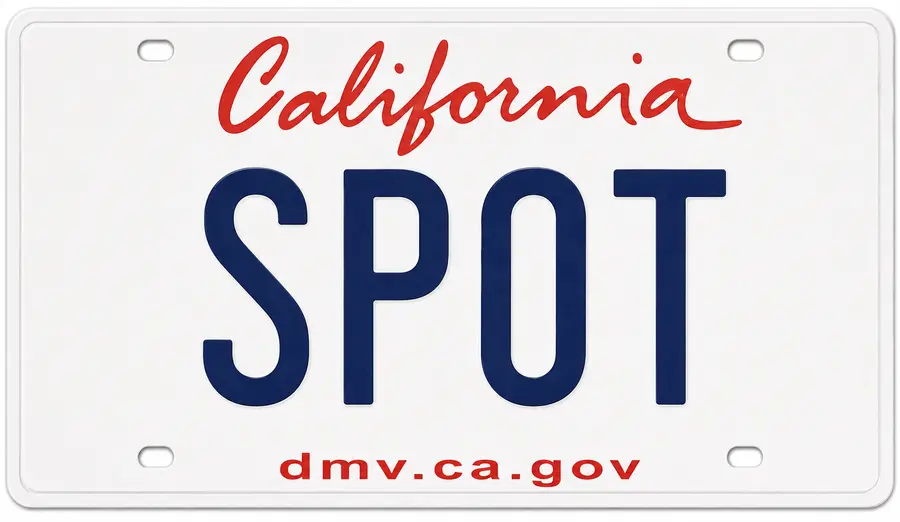
California’s clean white plate with red script is one of America’s most recognizable designs. The state also helped popularize personalized plates and has issued many celebrated legacy designs.
Deep Dive Archive · State Volume 07
California License Plates: History, Black Plates & Designs
California has one of the most recognizable license plate histories in the United States.
From early porcelain plates to the famous black-and-yellow plates of the 1960s, blue-and-yellow plates of the 1970s and the simple white plates seen on millions of cars today, California’s license plates have evolved alongside the state’s enormous automobile culture.
California began issuing permanent state license plates in 1914.
California License Plate History
| Year | Milestone |
|---|---|
| 1914 | California begins issuing permanent state license plates |
| 1916 | Registration validation tags begin |
| 1920 | Annual plates showing the registration year begin |
| 1942 | Wartime metal-conservation strips replace full annual plates |
| 1956 | Standardized 6 × 12-inch plate era |
| 1963 | Famous black plate with yellow characters introduced |
| 1970 | Blue plate with yellow characters introduced |
| 1972 | Personalized plates debut |
| 1987 | Reflective coating used on all newly issued plates |
| 1998–2000 | California Sesquicentennial plate issued |
| 2011 | DMV website address added to newly issued plates |
| 2015 | Modern 1960s Legacy black plate program begins |
Dates per California DMV’s published license plate history.
Before California Issued Standard Plates
California required vehicle registration before the state began supplying standardized permanent license plates. In the earliest years, the state assigned registration numbers and motorists were responsible for providing and displaying the plates themselves.
The important transition for this page comes in 1914 — the year California began issuing permanent state license plates, replacing the earlier make-your-own era.
Source: California DMV.
The First California State Plates — 1914
According to California DMV, California began issuing permanent license plates in 1914. The first plates were:
- made of porcelain
- brick red
- white lettering
Porcelain was commonly used on early American license plates because it produced a durable, weather-resistant surface. Fired enamel over metal stood up to sun, rain and road grit far better than paint, which is why so many surviving 1910s plates still look remarkably crisp today.
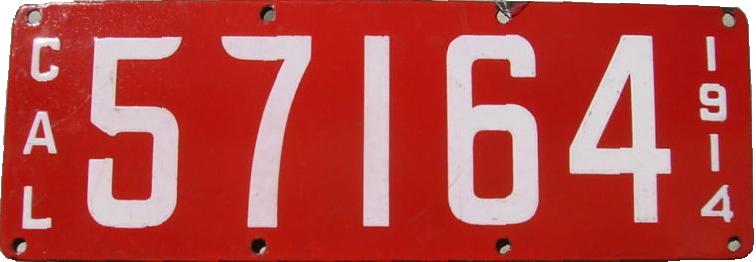
Source: California DMV — History of the Department of Motor Vehicles.
California Experiments with Registration Tags
In 1916, California began using separate registration tags to prove that a vehicle’s registration was current. According to California DMV, these tags were attached to a white metal license plate with blue lettering.
This is an early example of a system California would repeatedly return to: keep the plate, update the registration indicator. Rather than stamping a fresh plate every year, the state attaches a small tag or sticker to show the registration is current — the same idea behind today’s corner stickers.
Source: California DMV.
A New Plate Every Year
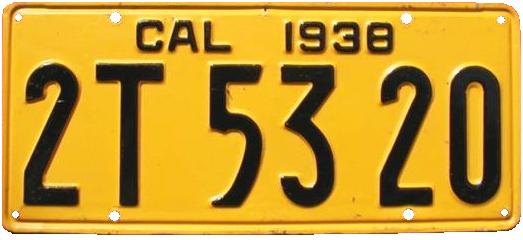
From 1920 through 1941, California issued new license plates annually with the registration year displayed.
Colors changed from year to year — yellow one year, black the next, orange after that. Collectors can often identify an early California plate almost immediately by its color combination and stamped year, and spotters can do the same at a glance: a stack of 1930s sedans wearing different-colored tags is a time capsule of annual issues.
World War II Changes California Plates
In 1942, America’s entry into World War II created pressure to conserve steel and other metals.
Rather than manufacture an entirely new full-size plate, California DMV issued long steel validation strips showing the registration year. Drivers attached the strip to their existing license plate.
This allowed California to conserve metal while still showing current registration — the plate stayed on the car, and the small strip carried the update.
Source: California DMV.
The Modern 6 × 12 Plate Era
By the mid-1950s, U.S. license plates were standardized around the familiar 6 × 12 inch size, with standardized mounting holes, under an agreement among state motor vehicle administrators, automakers and safety groups.
California’s 1956 base is an important transition into the modern plate era: a black-on-yellow passenger plate in the then-new ABC 123 three-letter, three-number format, kept current through 1962 with validation stickers rather than annual reissues.
1963: The Famous California Black Plate
California introduced one of its most recognizable license plates in 1963:
yellow characters on a black background.
California DMV’s Year of Manufacture documentation confirms that the 1963 base was used for passenger vehicles through the 1969 model-year period using year stickers after the initial issue. The serial format was the classic AAA 000 style — three letters, three numbers.
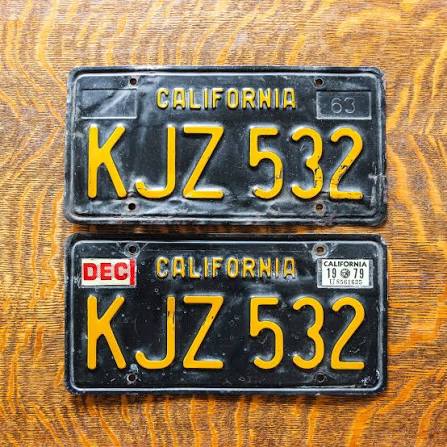
The black plate became strongly associated with California cars of the 1960s. Today it is highly recognizable among collectors and classic-car enthusiasts — one of a handful of plate designs, like Texas’ 1960s plates or New York’s orange-and-blue tags, that instantly conjures a specific place and decade.
What Is a California “Black Plate Car”?
In classic-car culture, the phrase often refers to a vehicle displaying California’s original black-and-yellow license plates from the 1960s.
Historically, an original black plate can suggest that the vehicle was registered in California during that era, although the plate by itself does not prove uninterrupted California ownership — plates can be re-registered, moved between vehicles through official programs, or reproduced.
Modern reproduction-style Legacy plates complicate identification further, because a modern vehicle can now legally display a newly issued black-and-yellow California plate. When you spot a black plate today, check the car itself — a black plate on a brand-new SUV is a Legacy plate, not a 60-year-old original.
California Goes Blue — 1970
In 1970, California introduced its blue-background plate with yellow characters. California DMV confirms that the blue-and-yellow plates were not introduced until 1970.
These became one of the defining California plate designs of the 1970s and early 1980s: a blue background, yellow characters, and CALIFORNIA across the top. Some original blue plates remain visible today on older vehicles that have kept their original registration.
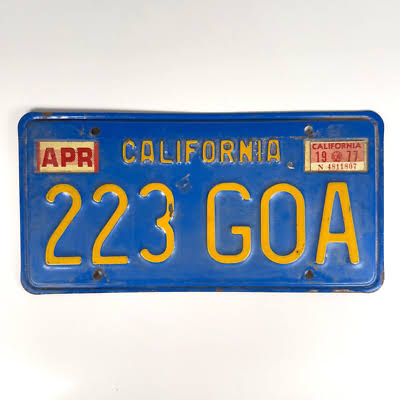
Source: California DMV Year of Manufacture documentation.
Personalized Plates Arrive — 1972
According to California DMV, personalized license plates made their debut in 1972.
California today refers to its basic personalized plate program as the Environmental License Plate (ELP) program. According to DMV, Environmental License Plates are the standard California design without a special graphic, available with a personalized configuration — the personalization is the point, not a special environmental-themed graphic.
Source: California DMV.
From Blue Plates to White
California moved away from the blue-and-yellow base during the 1980s toward the white reflective plate style that eventually became familiar throughout the state.
The transition happened in steps — an optional white Golden State graphic plate arrived first, followed by plain white bases as the standard — and the larger change is easy to summarize: dark-background California plates gave way to a highly reflective white background designed for greater visibility.
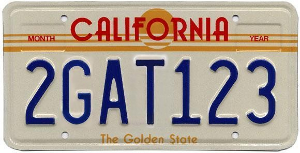
Reflectivity Becomes Standard — 1987
California DMV says that beginning in 1987, a new reflective coating was used on all newly issued license plates. Reflective sheeting makes plates easier to read at night and in poor visibility when illuminated by vehicle headlights.
Source: California DMV.
The California Plate Most People Know Today
The current regular passenger plate is deliberately simple:
- a white reflective background
- dark blue serial characters
- a red scripted California
- registration stickers in the upper corners
- generally minimalist design throughout
Unlike many states, California’s modern standard plate does not rely heavily on scenery, slogans or large background graphics. That simplicity has made it one of the most recognizable plates in the country.
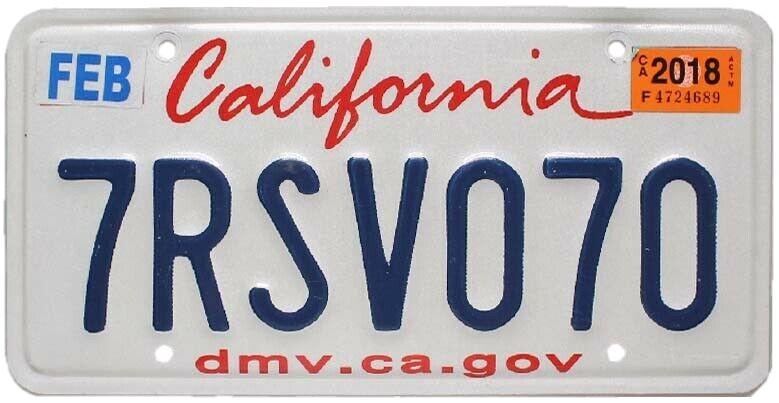
Why Is “California” Written in Red Script?
The cursive red California wordmark is one of the defining elements of the modern standard plate. The flowing script reads instantly as “California” even at a glance, and its red ink is the only strong color on an otherwise plain white plate — which is exactly why it works so well for spotting.
The red script treatment arrived with the white graphic-base plates of the late 1980s and 1990s; we avoid pinning this page to one exact introduction date because the wordmark’s styling evolved across several successive bases rather than appearing all at once.
How Do California License Plate Numbers Work?
The familiar modern passenger format is 1ABC234 — California’s standard passenger sequence uses one number, three letters, then three numbers.
California has an enormous registered-vehicle population and has worked through many serial blocks over the life of the current numbering format. When a format runs out of combinations, DMV has historically flipped to a new arrangement rather than letting serials collide — so the pattern you see most often simply reflects which block is currently being issued.
Why Are California Plates So Easy to Recognize?
Even from a distance, California plates are often identifiable because of:
- the white background
- red script across the top
- blue/dark serial
- lack of a large scenic background
- distinctive 1ABC234-style serial pattern
That combination is genuinely useful for plate spotting at highway speeds: no scenery to parse, no slogan to read — just a white rectangle, a red wordmark and a short serial.
The Black Plate Comes Back
California now offers a modern California 1960s Legacy License Plate that recreates the appearance of the classic 1960s black plate: black background, yellow characters.
This is a modern specialty/legacy plate. It is not necessarily an original plate from the 1960s. According to California DMV, Legacy plates are available in sequential configurations and personalized configurations, and may be issued to several vehicle types, including automobiles, commercial vehicles, motorcycles and trailers.
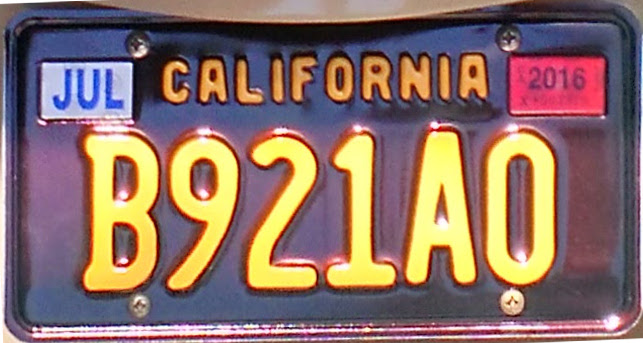
The distinction is important: an old car displaying a black plate might have an original period plate through the Year of Manufacture program, or it might have a modern Legacy plate. A newer car with a black plate is using the modern Legacy program.
Source: California DMV Legacy License Plates.
Can Old California Plates Still Be Used Legally?
Yes, under California’s Year of Manufacture (YOM) program, qualifying vehicles can use authentic California plates appropriate to the vehicle’s model year.
According to California DMV, passenger automobiles, motorcycles and trailers can use qualifying officially manufactured California plates from 1969 or earlier, and certain qualifying commercial vehicles can use plates from 1972 or earlier.
The plates must:
- be authentic
- be legible and serviceable
- match the appropriate year and vehicle type
- be authenticated by DMV
For 1963–1969 passenger vehicles, the correct plate is the black 1963 base with the appropriate validation sticker for later years.
California DMV publishes the full YOM rules for vehicle owners.
Source: California DMV Year of Manufacture program.
Original or Modern?
How to tell the two black-plate eras apart, simply:
Original 1960s plate
A period-issued California plate, potentially still assigned to an old vehicle or legally used through the YOM program.
Modern 1960s Legacy plate
A newly manufactured plate inspired by the old 1960s design, available to today’s vehicles of many types.
The main point: a black California plate does not automatically mean a 1960s plate.
California Turns 150
For California’s 150th anniversary, DMV issued special license plates marked Sesquicentennial – 150 years. The plates were available from 1998 through 2000.
Source: California DMV.
A Website Appears on the Plate
According to California DMV, beginning in 2011 its website address was added to newly manufactured license plates. This is a small design change, but it can help collectors distinguish older and newer examples of the otherwise similar standard white plate.
Source: California DMV.
California Specialty Plates
California offers numerous Special Interest and Special Recognition plate programs. A few examples currently listed by DMV:
- California Coastal Commission / Whale Tail
- Yosemite Foundation
- Lake Tahoe Conservancy
- California Arts Council
- Pet Lovers
- Veterans’ Organization
- California Agriculture
- California Museums
This is only a sampling, not a catalog of every available plate — California’s full current selection lives on the DMV’s special interest license plates page.
The Whale Tail Plate
California’s Coastal Commission plate is commonly recognized by its whale-tail and ocean imagery — a breaking wave and fluke in place of any scenery photo. It is one of the easiest specialty plates to pick out in traffic and one of the state’s longest-running ocean-themed designs.
Does California Require a Front License Plate?
For standard passenger vehicles issued two plates, California generally requires plates displayed at both the front and the rear.
Not every vehicle class gets two plates: motorcycles, trailers and certain other vehicle types are issued a single plate, which is displayed at the rear. Registration validation stickers are required on the rear plate, with a different placement for some heavier commercial vehicles. Check the current California Vehicle Code and DMV guidance for the details that apply to a specific vehicle.
California Plate Spotter’s Guide
| If You See | Likely Design / Era |
|---|---|
| Porcelain, brick red | 1914 early California |
| Black background + yellow characters | 1963–69 original era OR modern Legacy |
| Blue background + yellow characters | 1970s / early 1980s |
| White reflective plate | Modern California |
| White + red scripted California | Current familiar standard design |
| Black/yellow on a newer vehicle | Modern 1960s Legacy plate |
| Period-correct plate on a classic car | Could be California YOM registration |
California Plate FAQ
When did California first issue license plates?
California DMV says the state began issuing permanent license plates in 1914.
What color was California’s first license plate?
Brick red porcelain with white lettering.
When did California use black license plates?
The famous black base with yellow characters was introduced in 1963 and served the 1963–1969 passenger era with annual validation stickers.
When did California switch to blue license plates?
1970.
Why are some California license plates black today?
Because of the modern California 1960s Legacy program, which issues newly manufactured black-and-yellow plates in sequential and personalized configurations for today’s vehicles.
Is every black California plate an original 1960s plate?
No. Original plates survive on classics or through the Year of Manufacture program, while modern 1960s Legacy plates are newly made reproductions of the design. A black plate on a newer vehicle is a Legacy plate.
When did California start personalized plates?
1972, according to California DMV.
Can you legally use an old California license plate?
Sometimes. Under the Year of Manufacture program, qualifying 1969-or- older autos, motorcycles and trailers (1972-or-older commercial vehicles) can display authentic, DMV-authenticated California plates matching the vehicle’s model year.
What does a modern California plate look like?
A white reflective background, red California script and dark serial characters.
Does California require a front license plate?
Standard passenger vehicles issued two plates generally must display one at the front and one at the rear. Motorcycles, trailers and some other vehicle classes are issued a single rear plate.
What is the format of a California passenger license plate?
The familiar format is 1ABC234 — one number, three letters, three numbers. DMV has also begun flipping to new serial formats as old blocks are exhausted.
Why do California plates have stickers?
The small stickers in the plate’s corners show that the vehicle’s registration is current — the month and year of expiration. It’s the modern version of the validation tags California first experimented with in 1916: keep the plate, update the indicator.
Where Are You Likely to Spot a California Plate?
California plates are among the easier out-of-state plates to find across much of the U.S. because California has a very large population and substantial interstate travel.
They are especially common throughout:
- Nevada
- Arizona
- Oregon
- Washington
- Utah
- major Western national parks
- interstate travel corridors
- military and university communities