TN American plate atlas
Tennessee
The Volunteer State
Meet the plate, people, places, and stories behind one of the road-trip game’s fifty-one essential finds.
Capital
NashvilleState bird
Northern mockingbirdJoined the Union
June 1, 179601
A quick trip through time
The Tennessee story
Tennessee’s three grand divisions connect Appalachian, central, and Mississippi River histories. The state shaped country, blues, soul, rock, civil rights, and frontier politics.
02
Bumper-sized history
About the plate
Tennessee plates often include the state outline, rolling hills, or Volunteer State references. County labels add another spotting detail.
Deep Dive Archive · State Volume 14
Tennessee License Plate History
Tennessee’s license plates have changed considerably over more than a century, from simple numbered metal tags to today’s blue standard plate.
Along the way, Tennessee plates have carried county names, state slogans and changing color schemes. Some older designs are immediately recognizable, including the green-and-white plates of the late 20th century and the white plates with green mountains used before today’s blue design.
The current plate introduced another unusual feature: Tennessee drivers can choose whether their standard plate includes the words “In God We Trust,” and the serial-number arrangement differs depending on that choice.
Tennessee Plate History at a Glance
| Year | What Changed |
|---|---|
| 1905 | Tennessee begins statewide motor-vehicle registration; owners supply their own plates |
| 1915 | The state begins issuing license plates |
| 1936–1956 | Plates cut to the shape of the state itself |
| 1939 | County coding begins on standard plates |
| 1957 | First standardized 6 × 12-inch plate |
| 1976 | “Volunteer State” slogan appears; first reflective plate |
| 1988–1993 | Three-star flag emblem plate |
| 1994–1999 | BicenTENNial plate marking 200 years of statehood |
| 2006 | Green rolling-hills standard plate introduced |
| 2017 | “In God We Trust” plate option added |
| 2022 | Current blue plate with the Tri-Star emblem introduced |
SOURCE: Tennessee Department of Revenue; Tennessee State Library & Archives; vehicle registration plate records.
Tennessee’s First License Plates
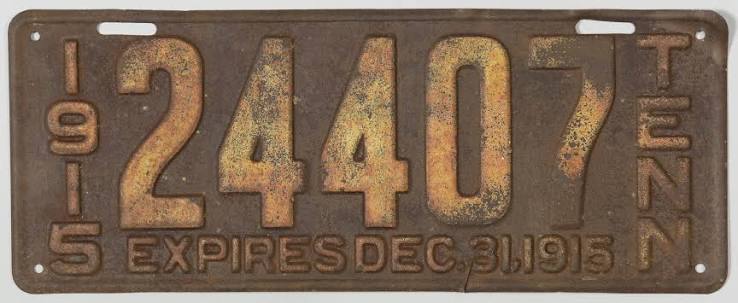
Registration came first. Tennessee required statewide motor-vehicle registration in 1905, but for the next decade registrants provided their own plates — typically homemade numbers on leather or metal attached to the vehicle.
The state began manufacturing and issuing its own plates on July 1, 1915. The first state issue was a dark blue plate with an embossed white serial and the year and “TENN” set vertically at the sides, issued only to new registrants for the second half of 1915.
From Annual Plates to Modern Registration
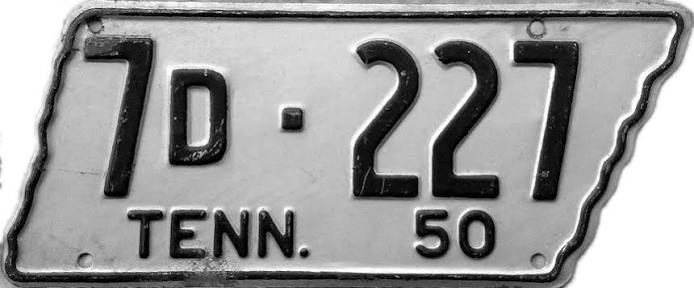
Through the early 20th century, Tennessee issued a new plate every year, with colors rotating annually so police could spot current registration at a glance. From 1936 through 1956, the plates were actually cut to the shape of the state itself — one of the most recognizable quirks in Tennessee plate history.
County coding began in 1939, with leading digits identifying the county of registration. In 1957, Tennessee adopted the standardized 6 × 12-inch plate size agreed to nationally the year before, with the state shape embossed inside the rectangle. The 1966 base added county names on stickers, the 1976 plate brought reflectorization and the first use of “Volunteer State,” and in 1977 Tennessee dropped its front-plate requirement, moving to a single rear plate.
Why Is Tennessee Called the Volunteer State?
Tennessee is widely known as The Volunteer State, and the nickname has appeared on its standard plates since the 1976 design. It has remained on every general-issue plate since.
The nickname is traditionally associated with Tennessee’s history of military volunteers, with accounts often connecting it to service in the War of 1812 and the Mexican-American War. Historians continue to debate exactly which conflict earned the name, so it is best treated as a tradition rather than a settled fact.
Tennessee’s Green Plate Era
The green-and-white plates most people remember date to January 2006, when Tennessee replaced its BicenTENNial and “Sounds Good to Me” bases with a flat graphic plate: black characters on a background of white sky and green rolling hills, with “Tennessee” in script above and “The Volunteer State” along the side.
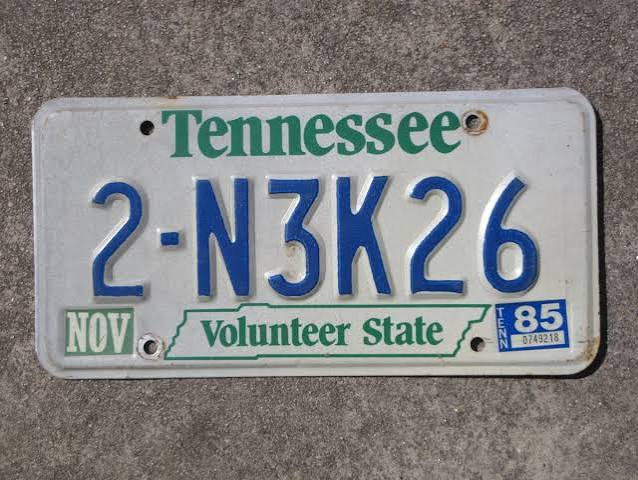
The hills design stayed in service for fifteen years, outlasting several older bases. Earlier green accents had appeared on the 1983–1987 plate, which screened the state name and slogan in green over a white background, but the rolling-hills issue is the design most often meant by “the green Tennessee plate.”
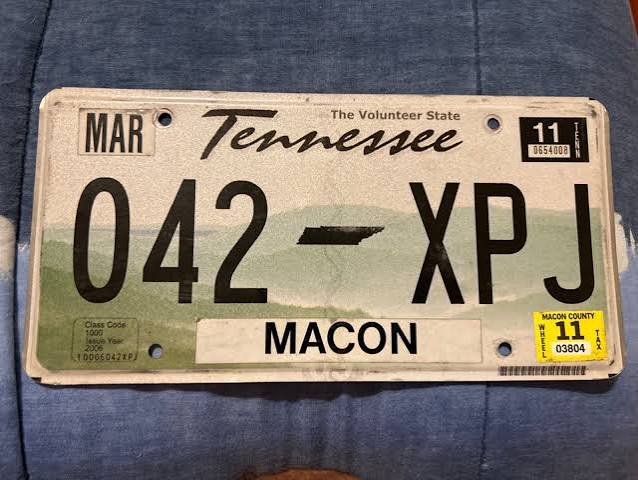
Mountains on the Tennessee Plate
The rolling-hills plate was not Tennessee’s first graphic mountain design. Its design lineage runs: the three-star flag emblem plate (1988–1993), the BicenTENNial plate with the State Capitol (1994–1999), a rising sun over the green state shape (“Sounds Good to Me,” 2000–2005), and then the green hills plate introduced in January 2006.
The hills themselves are generic rolling terrain rather than a portrait of any named range; Tennessee has never officially tied them to the Great Smoky Mountains. Revisions along the way added the state tourism website in 2011 and changed the serial format twice as supplies ran out, before the plate was retired at the end of 2021.
Tennessee’s Current Blue License Plate
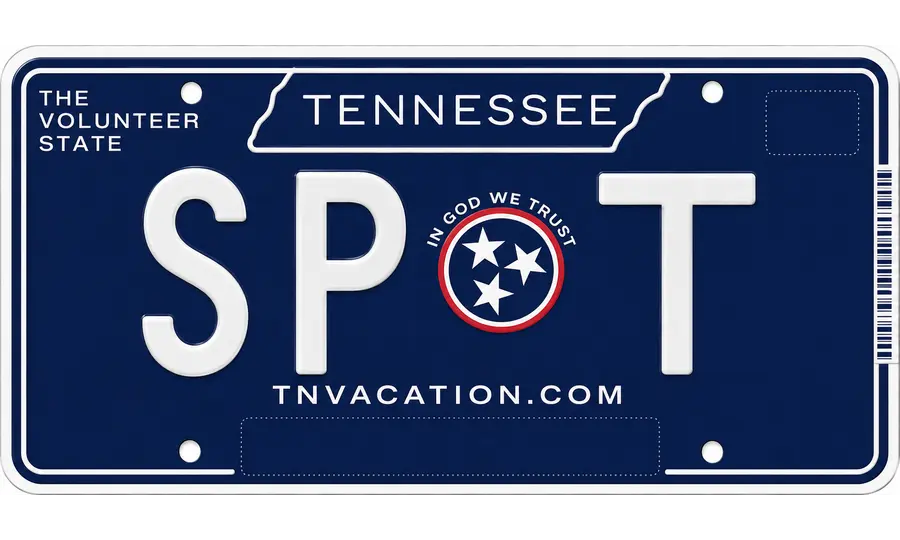
Tennessee introduced its current blue standard plate on January 1, 2022, and it remains the standard design today. It features a blue background, white characters, “TENNESSEE” in white inside an outlined state map at the top, the Tri-Star emblem in the center, “THE VOLUNTEER STATE” at the upper left, and the county of registration along the bottom. A minor revision in November 2023 removed the tourism website address from the plate.
The design was not chosen by a committee behind closed doors. In September 2021, Governor Bill Lee’s “Rate the Plates” online vote let Tennesseans pick the next standard design; more than 300,000 people voted, and the blue Tri-Star design won with about 42% of the vote.
SOURCE: Tennessee Department of Revenue; Office of the Governor.
What Do the Three Stars on the Tennessee License Plate Mean?
The three stars come from the Tennessee state flag, adopted in 1905. They represent the state’s three traditional geographic divisions — East Tennessee, Middle Tennessee and West Tennessee — and the blue circle around them stands for the unity of the three.
That emblem, known as the Tri-Star, has served as Tennessee’s unofficial logo for decades and now sits at the center of the current plate. It previously appeared on the 1988–1993 standard base.
Why Is a County Name on Tennessee License Plates?
Standard Tennessee plates display the county where the vehicle is registered. A few examples make the pattern easy to read: Davidson plates come from Nashville, Shelby from Memphis, Knox from Knoxville, and Hamilton from Chattanooga.
On the current blue plate, the county name is printed on a white strip along the bottom edge as part of the plate itself — it is not a sticker. Earlier designs handled it differently: the 1966–1970 base used an actual county-name decal, while plates from 1939 through the 1980s encoded the county as leading digits or letters instead.
Why Do Some Tennessee License Plates Say “In God We Trust”?
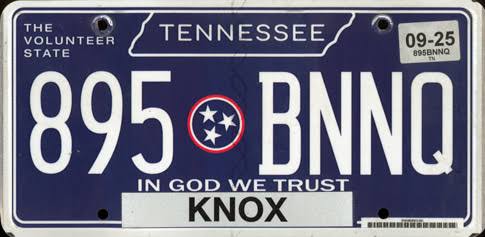
Tennessee motorists can choose between two standard passenger plates: one that includes IN GOD WE TRUST and one without it. The option was created by legislation signed in May 2017 and first issued on July 1 of that year, and it carries no additional fee — it is a standard plate, not a specialty one.
The choice is made when registering the vehicle. County clerks are required to ask each customer which version they prefer, and if no preference is given, the “In God We Trust” plate is issued by default. The rule remains unchanged today, and the option carried over to the 2022 blue plate.
SOURCE: Tennessee Code §55-4-103; Tennessee Department of Revenue standard plate FAQ.
Tennessee’s Two Standard Plate Number Formats
The two standard versions are easy to tell apart beyond the wording. On the current blue plates, the serial arrangement itself differs depending on the choice:
- Standard version: three letters, then four digits (for example, ABC-1234)
- “In God We Trust” version: three digits, then four letters (for example, 123-ABCD)
Both versions skip the vowels and Y, so issued series started at BBB and BBBB respectively. This letters-first/numbers-first split carried over from the previous green plate, where the 2017–2021 “In God We Trust” plates likewise used the ABC-123 arrangement while standard issues ran the opposite way.
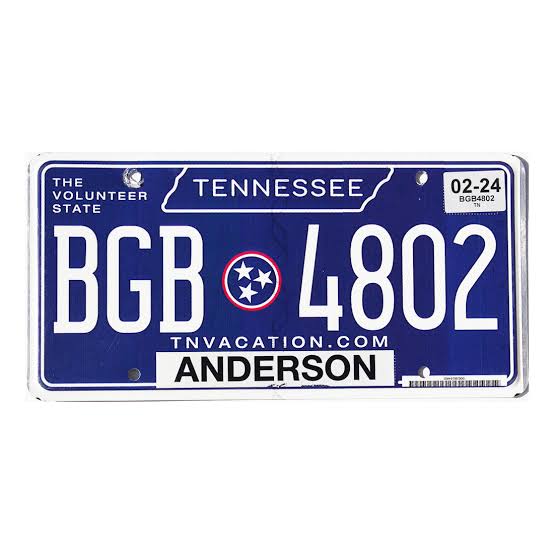
Why Does the Serial Format Change?
Tennessee’s Department of Revenue documents the two arrangements without stating a legislative reason. Whatever the origin, the practical effect is clear: the different formats let anyone identify at a glance which standard version a vehicle is carrying.
Specialty Plates
Tennessee offers more than 100 specialty plate designs as of 2026. Categories include colleges and universities, military service, charities, organizations, causes, professional groups, sports teams, and wildlife and conservation plates.
Browse the Tennessee Department of Revenue plate directory →
Antique Vehicle Plates
Tennessee registers vehicles over 25 years old with unmodified engines and bodies as antique motor vehicles. The registration is permanent — it stays valid as long as the owner holds the title and requires no annual renewal. The antique plate bears the word “ANTIQUE” at the bottom.
Usage is restricted: antique vehicles may be driven for club activities, exhibits, tours and parades, for selling, testing or repair, and for general transportation only on Saturdays, Sundays and federal holidays.
Tennessee also permits a vintage twist: owners of qualifying antique vehicles may register an official Tennessee plate from the era the vehicle was manufactured and display it while driving, in place of a new plate. The Department of Revenue approves the specific plate at registration, and only official era plates qualify — reproductions cannot be registered or displayed while driving.
SOURCE: Tennessee Code §55-4-111; Tennessee Department of Revenue antique motor vehicle registration form.
Does Tennessee Require a Front License Plate?
No. Tennessee law requires a single registration plate for passenger motor vehicles, attached to the rear of the vehicle. The state has issued one plate only since 1977.
How to Recognize a Tennessee Plate
The quickest clues on the current plate:
- dark blue background with white characters
- TENNESSEE across the top, inside an outlined state map
- the Tri-Star emblem in the center
- county name along the bottom
- one rear plate only on standard passenger vehicles
- optionally, “In God We Trust” wording — with the numbers-first serial format that goes with it
Tennessee License Plate FAQ
When did Tennessee first issue license plates?
1915. Statewide vehicle registration actually began a decade earlier, in 1905, but until 1915 owners supplied their own plates — often homemade metal or leather tags.
Why is Tennessee called the Volunteer State?
The nickname honors Tennessee’s tradition of military volunteers, with accounts often connecting it to the War of 1812 and/or the Mexican-American War. Historians debate which conflict started it. The slogan has been on the standard plate since 1976.
What do the three stars on the Tennessee license plate mean?
Tennessee’s three grand divisions: East, Middle and West Tennessee, bound together in the blue circle from the state flag.
Why are Tennessee license plates blue?
Tennesseans chose it. In September 2021, the state’s “Rate the Plates” online vote drew more than 300,000 participants, and the blue Tri-Star design won with about 42% of the vote. It went into service on January 1, 2022.
Why do some Tennessee license plates say “In God We Trust”?
It is an optional standard plate configuration, authorized by 2017 legislation and offered at no extra charge. Drivers pick between the two standard versions at registration; the motto version is issued by default if no preference is stated.
How can you tell whether a Tennessee plate is an “In God We Trust” plate?
Two ways: the wording itself, and the serial format. Standard plates run three letters followed by four digits; “In God We Trust” plates run three digits followed by four letters.
Why is the county name on a Tennessee license plate?
It identifies the county where the vehicle is registered, since registration is handled at the county level. On today’s plate the county name is printed along the bottom.
Does Tennessee require a front license plate?
No. One plate on the rear is required for passenger vehicles, a rule in place since 1977.
Can an old car use an old Tennessee license plate?
Yes. Owners of qualifying antique vehicles — over 25 years old with unmodified engines and bodies — can register an official Tennessee plate from the vehicle’s manufacturing era and display it while driving. The plate must be registered and approved by the Department of Revenue, and reproductions do not qualify.
Where Are You Likely to Spot a Tennessee Plate?
Tennessee borders eight states — Kentucky, Virginia, North Carolina, Georgia, Alabama, Mississippi, Arkansas and Missouri — which helps explain why its plates appear throughout a large part of the Southeast and lower Midwest.
Corridors like I-40, I-75 and I-24 funnel Tennessee traffic toward neighboring states daily, so Volunteer State plates are common well beyond the state line.
Sources
- Tennessee Department of Revenue — Title and Registration
- Tennessee Department of Revenue — License Plates
- Tennessee Department of Revenue — Standard Plate FAQ
- Tennessee Code §55-4-103 — standard plate issuance and “In God We Trust” option
- Tennessee Code §55-4-110 — rear plate display requirement
- Tennessee Code §55-4-111 — antique motor vehicles and vintage year-of-era plates
- Office of the Governor — “Rate the Plates” vote announcement (September 2021)
- Tennessee State Library & Archives — historical vehicle-registration records
- Tennessee Blue Book / Secretary of State — Tri-Star, state flag and nickname