GA American plate atlas
Georgia
The Peach State
Meet the plate, people, places, and stories behind one of the road-trip game’s fifty-one essential finds.
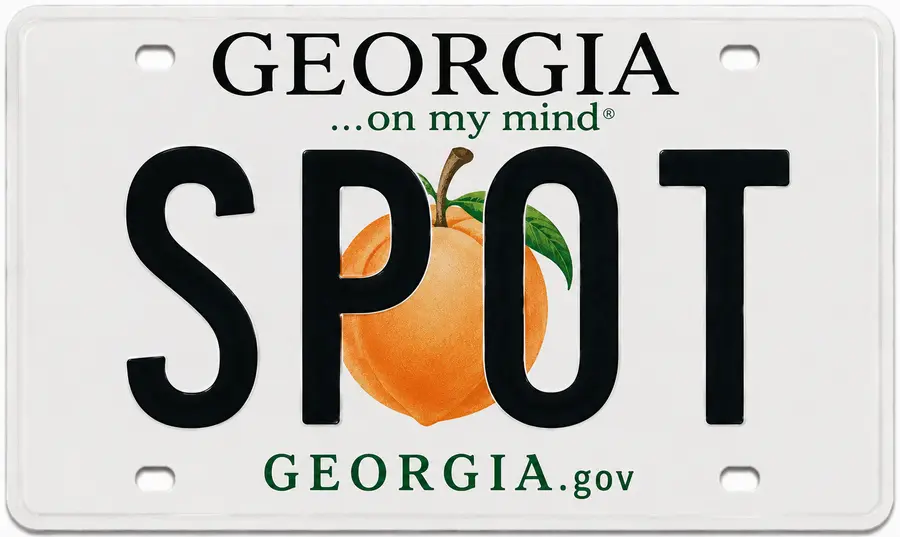
Capital
AtlantaState bird
Brown thrasherRatified the Constitution
January 2, 178801
A quick trip through time
The Georgia story
Georgia was the last of the original thirteen colonies to be founded. Its history runs from coastal settlement and agriculture through civil rights leadership, music, film, and modern Atlanta.
02
Bumper-sized history
About the plate
Georgia plates frequently feature peaches, the state outline, or both. County names at the bottom can turn one state sighting into a miniature geography quiz.
Deep Dive Archive · State Volume 06
Georgia License Plates: History, Peach Designs & Facts
Georgia began issuing state license plates in 1910, making its license-plate history more than a century old.
Over that period, Georgia moved from simple annual metal plates to reflectorized tags, long-term base plates, the famous peach graphic, hundreds of specialty designs and multiple standard plate choices.
Georgia Plate History
Georgia began issuing state license plates in 1910, making its license-plate history more than a century old.
Over that period, Georgia moved from simple annual metal plates to reflectorized tags, long-term base plates, the famous peach graphic, hundreds of specialty designs and multiple standard plate choices.
| Year | Milestone |
|---|---|
| 1910 | First Georgia state-issued license plate |
| 1910–1913 | Undated plate era |
| 1928 | Disks and plates used |
| 1941 | First reflectorized Georgia plate |
| 1956 | County-issued tags begin |
| 1959 | First historical tag |
| 1969 | First prestige / vanity tag |
| 1971 | First five-year plate |
| 1976 | First seven-year plate; Bicentennial and disabled-person tags |
| 1984 | First college license plate in the United States |
| 1990 | First graphic peach plate |
| 1990 | First Georgia wildlife and wildflower plates |
| 2026 | America 250 becomes a standard plate option |
Chronology sourced primarily to the Georgia Department of Revenue.
Georgia’s First State-Issued License Plate
Georgia issued its first state license plate in 1910.
The first plates used lustrous gray characters on a black background — a simple, elegant beginning for more than a century of Georgia plates.
Georgia’s earliest state plates were also undated through 1913, so an early plate does not always announce its own year at a glance.
Starting in 1914, the state moved into a long annual-plate era in which color combinations changed frequently — sometimes every single year. Georgia DOR maintains a year-by-year color history, and it is the best record of those changing combinations.

A Different Color Almost Every Year
For decades, Georgia changed the plate’s foreground and background colors annually, which makes early Georgia plates unusually easy to date once you know the palette.
A few representative examples:
- 1912 — black on yellow
- 1926 — white on red
- 1933 — blue on orange
- 1940 — orange on green
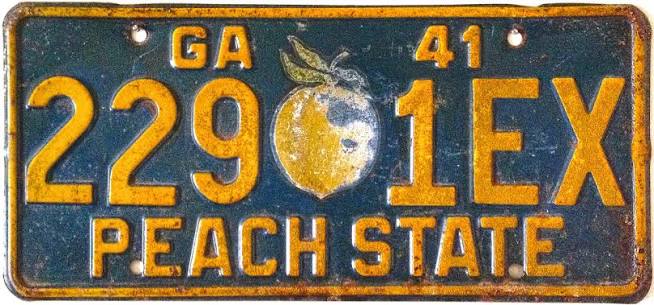
Georgia Experiments with Reflective Plates — 1941
Georgia DOR identifies 1941 as the state’s first reflectorized plate.
The official color history describes it as yellow on blue, with a reflectorized / “luminous peach” treatment.
Reflectorization mattered because it improved nighttime visibility when illuminated by headlights — a plates-and-road-safety milestone that most states adopted in some form in the decades that followed.
County-Issued Tags Begin — 1956
Georgia’s registration system has a particularly strong county connection. According to Georgia DOR, 1956 marked the beginning of county-issued tags.
That county connection endures: Georgia vehicle-registration services remain closely tied to county tag offices today, from renewals to specialty plate orders.
Georgia’s First Historical Tag — 1959
Georgia DOR lists 1959 as the first historical-tag program.
That early program connects directly to a rule that still benefits collectors today: Georgia allows certain owners of older vehicles to display an authentic Georgia license plate from the vehicle’s model year, for plates dated 1989 or earlier, provided the vehicle is also properly registered under current law.
The current registration and plate must be kept in the vehicle even though the authentic historical plate can be displayed.
Georgia DOR’s Authentic Historical License Plate Registration page →
Georgia Prestige Plates — 1969
Georgia introduced its first prestige tag in 1969.
“Prestige” is Georgia’s term for personalized/vanity plates — a combination of letters or numbers selected by the customer.
Today, prestige plates use the standard Peach plate background, so a customized peach tag is often a personalized one.
Georgia Moves Away From Annual Plates
1971 — Georgia introduced its first five-year plate, fully reflectorized.
1976 — Georgia introduced its first seven-year plate.
This marked the transition away from producing a completely new metal plate every year — a quiet but important shift in how Georgia plates were made and replaced.
1976: Bicentennial and New Plate Types
Georgia DOR identifies 1976 as a particularly important year. Along with the first seven-year base plate, the state rolled out new plate types:
- first seven-year base plate
- first disabled-person plate
- Georgia Bicentennial plate
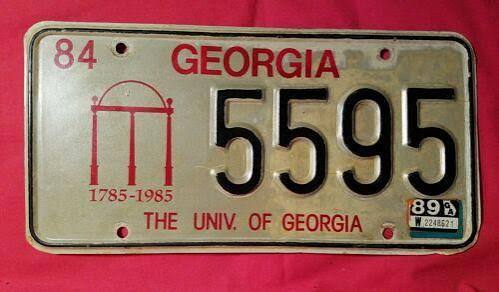
The First College License Plate in America
According to the Georgia Department of Revenue, Georgia introduced the first college license plate in the United States in 1984.
College and university plates later became common throughout the country, but Georgia’s 1984 tag came first — a distinctive Georgia first in American plate history.
1990: Georgia Puts the Peach on the Plate
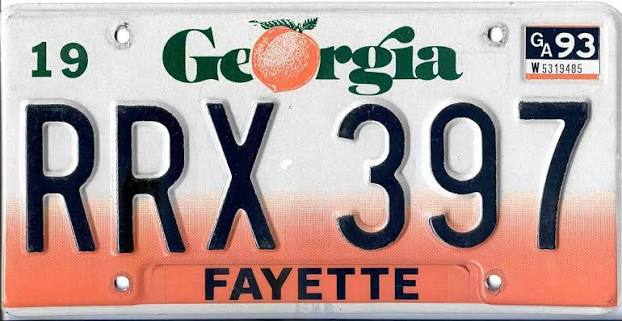
According to Georgia DOR, 1990 marked the introduction of Georgia’s first graphic “Peach” plate.
The peach is so closely associated with Georgia because the state is famously nicknamed the Peach State, and the peach became the obvious visual shorthand for the state on its most visible public canvas.
The 1990-era standard base paired a white background with black characters and the peach graphic — an important transition from simple typographic plates to a recognizable state graphic.
Spotter’s note: the peach design ran from 1990 to 1996 as a reflectorized seven-year tag, per Georgia DOR’s color history, so peach plates on the road can be older issue years rather than current standards.
Wildlife and Wildflower Plates
Georgia DOR also identifies 1990 as the first year for:
- Georgia wildlife plates
- Georgia wildflower plates
These helped launch what has since become a very large specialty-plate program. Today Georgia offers hundreds of specialty designs, including universities, military service, special-interest organizations and other causes.
What Does a Current Georgia License Plate Look Like?
Georgia currently offers multiple standard plate choices. According to Georgia DOR, motorists can currently choose among:
Peach Plate
The current standard Peach design is the modern heir to the 1990 graphic: a clean white background, black characters and a peach graphic anchoring the design. It is the plate most people picture when they think of Georgia.
Peach Orchard Plate
The Peach Orchard alternative swaps the classic graphic for a scenic orchard treatment — a green landscape with peach trees under a bright sky, with the county-name decal well along the bottom. Like the Peach plate, it is a standard passenger option at standard fees.
America 250 Plate
Beginning January 1, 2026, Georgia added an America 250 / USA Semiquincentennial plate as a standard plate option, commemorating the United States’ 250th anniversary. The plate is scheduled to remain available through 2030.
Georgia’s America 250 Plate
The plate was created as part of Georgia’s commemoration of the 250th anniversary of the United States, developed through a statewide civics education initiative in partnership with the Georgia Department of Education.
The winning design was created by Georgia middle-school student Eden Pethel. According to Georgia DOR, the red stars in the design represent Georgia Revolutionary War sites.
Notably, the plate is available as a regular standard option rather than a high-fee specialty plate — during your renewal period, standard fees apply with no additional charge for the new plate.

Why Do Georgia Plates Have a County Name at the Bottom?
Georgia plates have space for a county-name decal. Under Georgia law, when a county-name decal is required and space is provided, the valid county decal must be displayed.
From a spotter’s perspective, this is a gift: a Georgia plate can tell you not only the state but often the county in which the vehicle is registered — a miniature geography quiz on every tag.
Names you will see most often include:
- FULTON
- COBB
- DEKALB
- GWINNETT
- CHATHAM
One careful distinction: the county name is applied as a decal, not part of the permanent plate printing.
Does Georgia Require a Front Plate?
No. Georgia standard motor vehicles display a single license plate on the rear.
Georgia law requires the issued plate to be firmly attached and plainly visible at the rear of the vehicle.
Why You Might See a Very Old Georgia Plate on the Road
Georgia allows qualifying vehicles to display an authentic historical Georgia plate corresponding to the vehicle’s model year, for plates issued 1989 or earlier.
The current plate and registration must remain inside the vehicle but do not need to be displayed.
So a 1960s or 1970s Georgia plate seen on an appropriately old car may be legally registered, not simply decorative — one more reason to double-take before writing off an old plate as a garage relic.
Georgia Plate Spotter’s Guide
| If You See | Likely Era / Meaning |
|---|---|
| Simple annual plate, changing colors | Early–mid 20th century |
| Yellow on blue reflective plate | 1941 |
| Blue on white | 1971–75 five-year base |
| Red on white | 1976–82 seven-year base |
| Green on white | 1983–89 seven-year base |
| Peach graphic | 1990 onward |
| Modern orchard scene | Current Peach Orchard option |
| Revolutionary / America 250 design | 2026–2030 standard option |
Georgia License Plate FAQ
When did Georgia first issue license plates?
1910.
Why is there a peach on the Georgia license plate?
Georgia is famously the Peach State, and when the state introduced its first graphic plate in 1990, the peach was the natural visual shorthand. It has anchored Georgia’s standard designs ever since.
When did Georgia first put a peach on its license plate?
1990, according to Georgia DOR.
Does Georgia require a front license plate?
No. Georgia generally uses a single rear plate, which must be firmly attached and plainly visible at the rear of the vehicle.
Why does a Georgia license plate have a county name?
Georgia plates carry a county-name decal, and county tag offices handle registration services. The decal tells you where in Georgia the vehicle is registered — and county-issued tags date back to 1956.
What are Georgia prestige plates?
Georgia calls personalized/vanity plates “prestige plates.” First introduced in 1969, they are issued only on the standard peach plate background today.
What was the first college license plate in the United States?
According to Georgia DOR, Georgia introduced the first college plate in the U.S. in 1984.
Can you legally use an old Georgia license plate?
Sometimes. Under Georgia’s authentic historical plate program, qualifying vehicles may display an authentic plate from the vehicle’s model year for plates dated 1989 or earlier, as long as the vehicle is properly registered. The current plate and registration must be kept inside the vehicle, though they need not be displayed.
What Georgia license plates are available today?
Motorists can choose among the standard Peach plate, the Peach Orchard plate, and — beginning January 1, 2026 — the America 250 plate, plus hundreds of specialty designs.
Where Are You Likely to Spot a Georgia Plate?
Georgia plates travel most naturally across the Southeast — you will see them regularly in Florida, the Carolinas, Tennessee and Alabama, and along the major East Coast interstate corridors.
Tourist areas and major college-sports travel destinations are also reliable sighting grounds, with Atlanta’s crossroads location sending Georgia plates in every direction.