DE American plate atlas
Delaware
The First State
Meet the plate, people, places, and stories behind one of the road-trip game’s fifty-one essential finds.

Capital
DoverState bird
Blue hen chickenRatified the Constitution
December 7, 178701
A quick trip through time
The Delaware story
Delaware was the first state to ratify the U.S. Constitution. Small in size but central to colonial and commercial history, it bridges the Mid-Atlantic coast and the Chesapeake region.
02
Bumper-sized history
About the plate
Delaware’s dark blue-and-gold plate is famously minimal and has roots in a design used for decades. Low-number plates can carry unusual collector prestige.
Deep Dive Archive · State Volume 10
Delaware License Plate History
Delaware may be the second-smallest state, but it has one of the country’s most distinctive license plate cultures.
The state’s plates are unusually simple, and the number itself can matter almost as much as the design. Low-number Delaware tags are prized, bought and sold, passed through families and sometimes treated as status symbols.
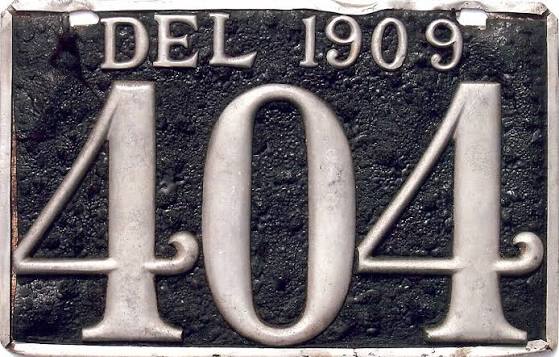
Delaware’s license plate history dates to 1909, when the state issued its first state license plates.
Delaware Plate History at a Glance
| Year | What Changed |
|---|---|
| 1909 | First state-issued Delaware license plate |
| 1940s | Black-and-white porcelain plates become part of Delaware plate history |
| 1947 | Delaware law establishes rear-only plate display |
| 1950s | Black stainless-steel tags enter the story |
| 1986 | Delaware formally recognizes authentic and exact reproduction historic plates |
| 2009 | Delaware marks 100 years of state-issued plates |
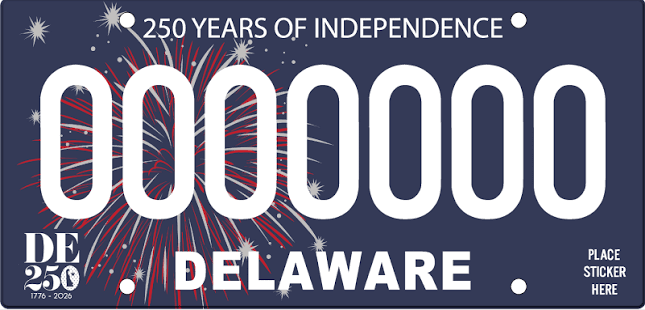
| 2026 | Delaware 250 plate available during the state’s America 250 commemoration |
SOURCE: Delaware Public Archives; Delaware Division of Motor Vehicles; Delaware General Assembly.
Delaware’s First State-Issued Plates
Delaware began issuing state license plates in 1909.
This date was confirmed by the Delaware General Assembly when it authorized the centennial plate program commemorating the 100th anniversary of the first state-issued Delaware plate in 2009. Prior to 1909, Delaware motorists registered with the state but provided their own makeshift tags.
The earliest 1909 plates were produced using durable iron with a porcelain enamel finish, featuring stark white lettering over a dark blue background with “DEL” and the year “09” stacked along the side.
Why Are Some Delaware License Plates Black and White?
Delaware has maintained an unusual connection to its historic black-and-white plates.
The Delaware Public Archives specifically identifies two classic eras that defined this look:
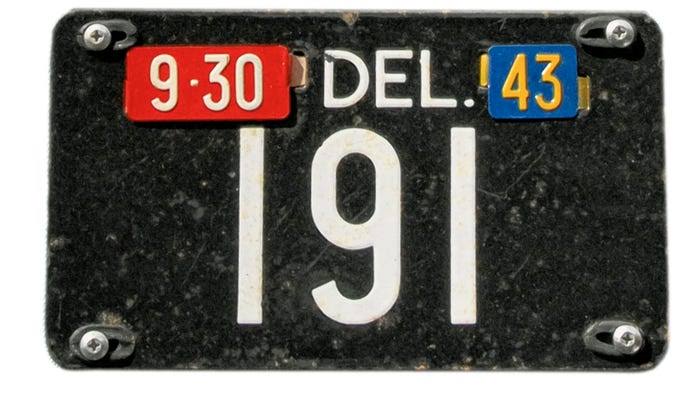
- Black-and-white porcelain plate sets from the 1940s
- Black stainless-steel tags from the 1950s
Today, qualifying Delaware registration numbers can still be displayed on authorized black-and-white reproduction plates.
The distinction is straightforward: the number is the vehicle’s actual Delaware registration number assigned by DMV. The black-and-white plate is simply an alternative physical plate displaying that assigned number. Most black tags spotted on modern roads are authentic reproductions authorized by state law, rather than delicate 1940s originals.
Porcelain or Stainless Steel?
Delaware’s authorized black-and-white plate tradition includes both porcelain and stainless-steel versions for qualifying registrations.
Porcelain-coated plates replicate the pre-1947 era, recognizable by their glossy enameled finish and the traditional small diamond separator stamped between digit groupings on numbers up to 86,999. Stainless-steel tags replicate the 1950s series, utilizing embossed bare-metal numerals on an enameled black field without the diamond separator, authorized for passenger numbers up to 200,000.
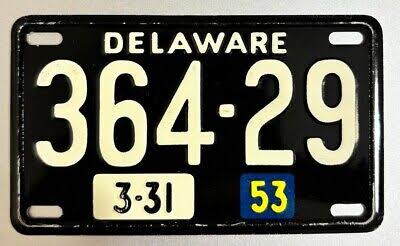
A black-and-white Delaware plate on the road can be a completely legitimate current registration, not merely an antique plate.
Why Are Low-Number Delaware License Plates So Valuable?
Delaware has developed an unusual culture around low-digit registration numbers.
Unlike in most states, the number itself can carry considerable prestige. The Delaware Public Archives notes that Delaware drivers buy, sell and barter to obtain desirable registration numbers.
A plate such as 123 may therefore be much more desirable than 582741, even though both serve exactly the same registration purpose. Lower numbers — particularly one-, two-, three-, and four-digit tags — are the most coveted because they have existed since the early decades of Delaware motoring and are strictly finite in supply.
It’s the Number, Not Just the Plate
When people talk about a valuable Delaware “plate,” much of the value is associated with the right to that particular registration number.
The physical plate can take different authorized forms. For example, an eligible low number may first be issued on a standard blue-and-gold plate and then displayed on a qualifying black-and-white porcelain or stainless-steel plate.
Delaware DMV’s low-digit lotteries explicitly explain this process: the registrant receives the legal assignment of the number, after which they can order an authorized black plate through the state-approved manufacturer if the serial falls within the qualifying historical range.
Delaware Actually Holds Lotteries for Low Numbers
Delaware DMV periodically releases available low-digit registration numbers through lotteries and special events.
Recent lotteries held by the Delaware DMV have made batches of available four-digit and five-digit numeric tags accessible to the public without costly private transfers.
Winners receive the right to assign the available number to an eligible vehicle. Delaware DMV has explained that winners initially receive the standard blue-and-gold plate and, when eligible, can subsequently obtain an authorized black-and-white version.
For current lottery schedules and rules, check the Delaware Division of Motor Vehicles.
A Delaware Tradition
Low-number tags have become part of Delaware culture. The Delaware Public Archives describes registration tags as both status symbols and connections to the state’s past.
Numbers often remain within families across generations, change hands through estate transfers, or become highly sought-after when an owner relinquishes rights. Not every Delaware driver obsesses over their number, but the state has a far stronger low-number plate culture than is typical across the rest of the country.
The Standard Delaware License Plate
The current standard Delaware plate has an unusually simple appearance:
- Dark blue background
- Gold/yellow lettering
- “DELAWARE” centered across the top
- Registration number centered in the middle
- “THE FIRST STATE” centered along the bottom
Delaware’s standard plate is visually restrained compared with the scenic mountain ranges, fruit graphics, and gradient backdrops used by many states. The blue and gold color scheme also directly honors Delaware’s official state colors.
Why Does the Delaware Plate Say “The First State”?
Delaware is known as The First State because it was the first of the original thirteen colonies to ratify the United States Constitution, taking action on December 7, 1787, in Dover.
The proud nickname has appeared on Delaware passenger license plates for decades, serving as a concise reminder of Delaware’s foundational place in American history every time a tag is spotted on the highway.
Does Delaware Require a Front License Plate?
Delaware generally displays its registration plate on the rear of the vehicle.
Under Delaware Code Title 21 § 2121, motor vehicle number plates must be attached to the rear of the vehicle, a requirement that has been firmly codified in state law since at least 1947. Vehicles in Delaware are not issued front registration plates.
Delaware Protects Its Historic Plate Tradition
Delaware’s black-and-white plate tradition is not simply an informal collector practice.
Delaware Administrative Code Regulation 2279, effective in 1986, expressly authorized the display of authentic historic plates as well as exact reproductions made to original specifications for qualifying vehicles.
The regulation explicitly noted strong public sentiment for preserving and recognizing historic plates on the road. This official legal sanction is why vintage-styled porcelain and stainless steel tags remain a routine sight on Delaware highways today.
Delaware 250
Delaware authorized a special Delaware 250 plate as part of the state’s commemoration of America’s 250th anniversary and Delaware’s own 250th anniversary of Separation Day.
Under the authorizing legislation, qualifying Delaware plates may substitute “Delaware 250” in place of the standard slogan “The First State.” The authorization runs through the 2026 anniversary commemoration year.
Antique Vehicle Plates
Delaware also maintains a separate antique motor vehicle registration program.
Under Delaware law (21 Del. C. § 2196), an antique motor vehicle must generally be more than 25 years old and maintained or restored substantially to manufacturer specifications.
It is important not to confuse official antique vehicle registrations with authorized black-and-white reproduction plates. Antique plates carry specific vehicle-age and operational restrictions, whereas an authorized black porcelain or stainless-steel plate can be placed on a brand-new daily driver if the assigned registration number qualifies.
How to Recognize a Delaware Plate
When searching for Delaware on the road, look for:
- A dark blue background with gold/yellow characters
- “DELAWARE” prominently across the top
- “THE FIRST STATE” centered across the bottom
- Unusually short numeric registrations (often without letters)
- Black-and-white porcelain or stainless-steel plates on qualifying registrations
Specialty and organizational plates exist, but Delaware’s standard blue-and-gold and historic black tags represent the overwhelming majority of sightings.
Frequently Asked Questions
Why are Delaware license plates black?
Delaware allows authorized reproductions of its historic 1940s porcelain and 1950s stainless-steel black-and-white plates to be displayed on qualifying numeric registrations.
Are black Delaware license plates legal?
Yes. State regulation authorizes authentic plates and officially approved reproductions for eligible registration numbers assigned through the Delaware DMV.
Why are low-number Delaware license plates valuable?
Delaware has a long cultural tradition of valuing low registration numbers as historic status symbols. Because these numbers are strictly limited and can be legally transferred between owners, high demand creates significant market value.
What is the lowest Delaware license plate number?
Plate number 1 is reserved by Delaware tradition for the Governor, number 2 for the Lieutenant Governor, and number 3 for the Secretary of State. The lowest numbers in private hands are typically two- and three-digit plates preserved in Delaware families for generations.
Can Delaware license plate numbers be bought and sold?
Yes. Delaware law permits vehicle owners to complete a legal transfer of rights to a registration number through the DMV, often involving an agreement between private parties followed by official paperwork.
Why does Delaware say “The First State”?
Delaware was the first state to ratify the United States Constitution, doing so on December 7, 1787.
Does Delaware require a front license plate?
No. Delaware law requires passenger vehicles to display their assigned registration plate only on the rear.
When did Delaware first issue license plates?
Delaware issued its first state-produced license plates in 1909, a milestone formally recognized in Delaware legislation.
What is a Delaware porcelain plate?
It is an enameled iron or steel plate manufactured in the style of Delaware’s 1942 series, authorized for eligible numbers up to 86,999.
Where Are You Likely to Spot a Delaware Plate?
Because Delaware is geographically compact, neighboring Mid-Atlantic highways and vacation corridors are the best places to look:
- Delaware highways (I-95, Route 1, US 13, US 113)
- Maryland (especially US 50 and the Eastern Shore)
- Southeastern Pennsylvania and the Philadelphia metro area
- Southern New Jersey via the Delaware Memorial Bridge
- The greater Washington/Baltimore Interstate corridors
- Delaware and Maryland Atlantic beach destinations
Sources and Historical References
- Delaware Public Archives — What’s the Story with Delaware License Plates?
- Delaware Division of Motor Vehicles — Vehicle Services & Plate Regulations
- Delaware Administrative Code: Title 2 Transportation § 2279 Motor Vehicle Registration Plates.
- Delaware Code: Title 21 Motor Vehicles § 2121 (Number and Registration Plates) and § 2196 (Antique Motor Vehicles).
- Delaware General Assembly: 76 Del. Laws, c. 274 (House Bill 460, 144th General Assembly) — Centennial Plate Program.