IN American plate atlas
Indiana
The Hoosier State
Meet the plate, people, places, and stories behind one of the road-trip game’s fifty-one essential finds.
Capital
IndianapolisState bird
Northern cardinalJoined the Union
December 11, 181601
A quick trip through time
The Indiana story
Indiana grew through agriculture, canals, railroads, manufacturing, basketball culture, and the rise of Indianapolis as a transportation hub.
02
Bumper-sized history
About the plate
Indiana’s plates have featured pastoral scenes, covered bridges, bicentennial themes, and the state’s tourism identity. Specialty options are common.
Deep Dive Archive · State Volume 12
Indiana License Plate History
Indiana’s license plates have changed considerably over more than a century, from simple numbered metal tags to colorful designs promoting the state and its landmarks.
For plate spotters, Indiana has another useful feature: many plates contain a county identifier. That can provide an extra clue about where in Indiana the vehicle was registered.
Over the years, Indiana plates have promoted tourism, celebrated the state’s bicentennial and featured everything from covered bridges to the torch and stars of the Indiana state flag.
Indiana Plate Timeline
| Year | What changed |
|---|---|
| 1913 | Indiana begins issuing state license plates (registration itself dates to 1905) |
| 1956 | Indiana adopts the standardized 6 × 12-inch plate size |
| 1963 | County numbers become part of the plate serial |
| 1981 | First multi-year plate; annual physical replacement ends |
| 1984–1987 | “Wander Indiana” tourism-era plate |
| 1987–1990 | “Back Home Again” plate |
| 2003–2008 | Farm-scene plate era |
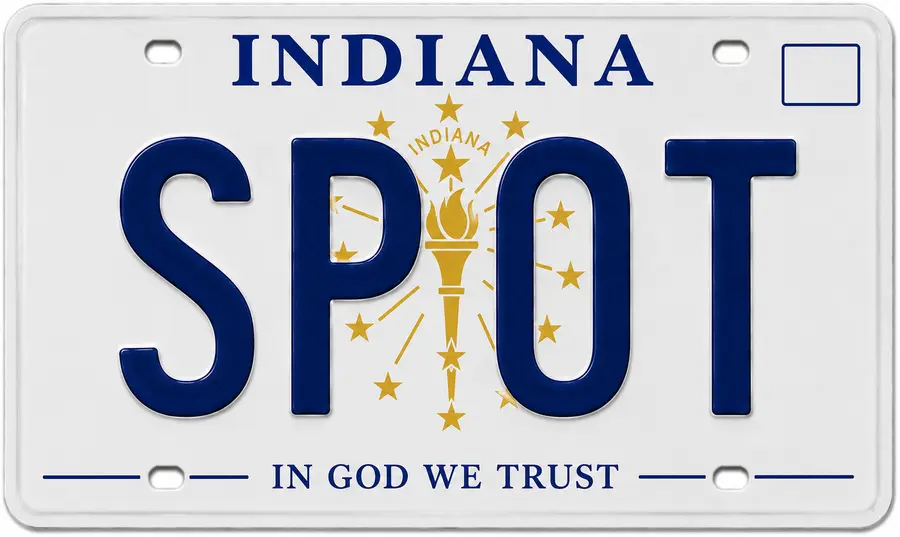
| 2008 | Blue-and-white standard design with the state flag’s torch and stars |
| 2013 | Bicentennial plate becomes the standard passenger base |
| 2017 | Covered bridge standard plate introduced |
| 2025 | Blackout plate added as an optional standard-design alternative |
Indiana’s First License Plates
Indiana first required motorists to register their vehicles in 1905. For the next several years, the state assigned registration numbers but left the plates themselves to the owners, who provided their own — typically initials or numbers on leather or metal affixed to the vehicle.
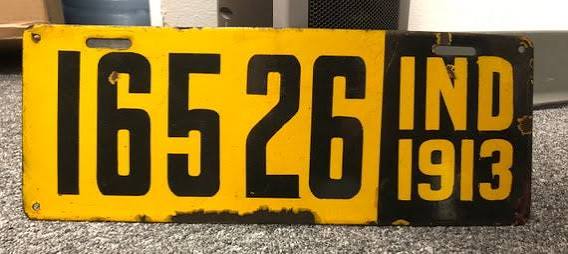
That changed on July 1, 1913, when the state began manufacturing and issuing its own license plates. The first state-issued plate was porcelain, with a black number on yellow and an “IND 1913” marker on the right side. Registration and plate issuance are not the same thing: 1905 started one system, 1913 started the other.
From Annual Plates to Longer-Lived Designs
Like most states, Indiana replaced the physical plate every year for decades, rotating colors so police could spot an expired tag at a glance. A few shifts gradually ended that cycle:
- 1956 — Indiana adopted the standardized 6 × 12-inch North American plate size that is still used today.
- 1964 — reflective sheeting first appeared on Indiana plates, making them easier to read at night.
- 1981 — the “Hoosier State” plate became Indiana’s first multi-year base in over 25 years, renewed with decals instead of a new plate. Indiana’s 1980 issue was the last single-year passenger plate issued anywhere in the United States.
Since then, Indiana has renewed registrations with stickers while keeping the same base plate for several years at a time.
What Does the County Number on an Indiana License Plate Mean?
For most of the last century, an Indiana plate told you the county where the vehicle was registered.
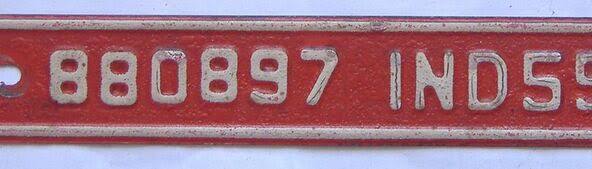
From 1950 to 1962, standard passenger plates carried a two-letter county prefix. Starting in 1963, the BMV switched to a simpler system: a number from 1 to 92 assigned to each county in alphabetical order, worked into the serial itself.
On the 1963–2008 bases the county number was stamped into the plate as part of the serial. Since the 2008 redesign, the serial (now 123A, 123AB or 123ABC) no longer contains the county. Instead, the county appears on its own — as a white sticker on the 2008 base, and screened into the bottom-right corner of every plate issued since the 2013 Bicentennial base.
Overflow numbers existed too: until 2008, Marion County also used 93, 95, 97, 98 and 99, and Lake County used 94 and 96.
How Indiana County Numbers Work
Indiana’s 92 counties are simply numbered in alphabetical order. Adams County is 1, Allen County is 2, Bartholomew County is 3, and so on through Whitley County at 92. The number has no connection to population or geography — only to where the county falls in the alphabet.
This makes Indiana different from states such as Montana, where county numbers trace back to historic population rankings rather than alphabetical order.
Useful County Numbers to Know
| County Number | County / Major City |
|---|---|
| 2 | Allen — Fort Wayne |
| 45 | Lake — Gary, Hammond |
| 49 | Marion — Indianapolis |
| 71 | St. Joseph — South Bend |
| 79 | Tippecanoe — Lafayette / West Lafayette |
| 82 | Vanderburgh — Evansville |
The “Wander Indiana” Plate
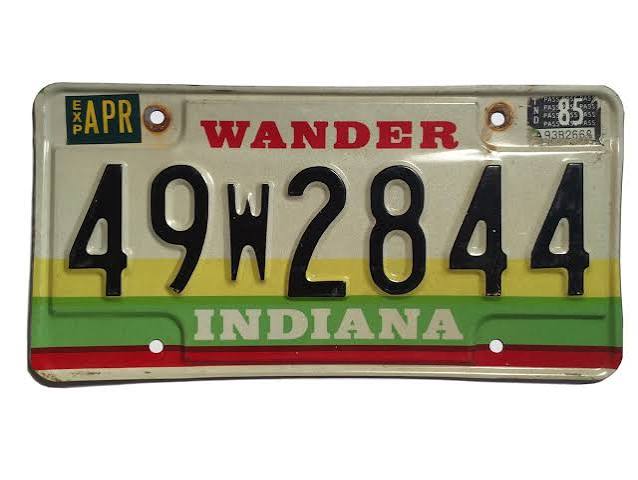
Indiana used its license plates to promote tourism with the “Wander Indiana” slogan, issued from 1984 to 1987.
The plate had a reflective white base with a colorful graphic background in blue, yellow and red tones, dark serial characters and the slogan “Wander Indiana” across the design. It kept the county-coded serial format of the era, and like the other plates of its time it was replaced by a new design after three years.
“Back Home Again”
From 1987 to 1990, Indiana’s standard plate carried the slogan “Back Home Again” on a reflective blue, white and gold background with blue serials.
The phrase comes from the song “(Back Home Again in) Indiana,” written in 1917 about longing for the Hoosier State. The song is a strong Indiana tradition — but the plate itself is the subject here: a three-year base design of the late 1980s, preceded by Wander Indiana and followed by the 1990 “Hoosier Hospitality” plate.
Indiana’s Bicentennial Plate
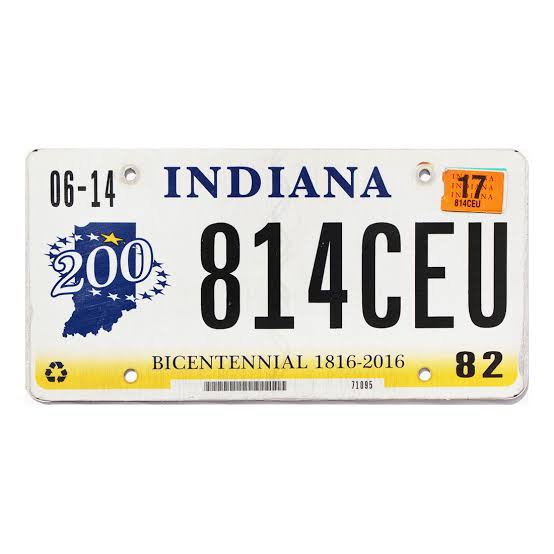
Indiana became a state in 1816 and celebrated its bicentennial in 2016. To mark it, the BMV made the Bicentennial plate the standard passenger base starting in 2013.
The design has a white background fading to gold, a large “200” over a dark blue Indiana state shape, and a circle of 19 stars — the 19th star enlarged and colored gold, echoing the state flag’s design, where the 19th star represents Indiana as the 19th state. The corners carry the expiration date, year and county number.
It remained the standard through 2016 and stayed valid on the road until the rolling replacement process swapped it out for the covered bridge plate between 2020 and 2023.
Indiana’s Covered Bridge License Plate
Introduced January 1, 2017, the covered bridge plate is Indiana’s longest-running standard passenger design. The dark blue serial sits on a reflective country-scene graphic featuring a covered bridge.
A covered bridge suits Indiana well: the state preserves a significant collection of historic covered bridges, and Parke County alone has more than 30 — the densest concentration in the United States. Serials follow the 123A, 123AB or 123ABC format, with the expiration date, year and county number in the corners.
Registrants receive reissued plates on a rolling seven-year cycle, keeping the same number each time.
What Does the Current Indiana License Plate Look Like?
As of 2026, the covered bridge plate remains the standard passenger design. It shows a reflective country-scene graphic with a covered bridge, dark blue serials in the 123A / 123AB / 123ABC format, no slogan, and the expiration date, year and county number screened in the corners. Plates are issued by the Indiana Bureau of Motor Vehicles (BMV).
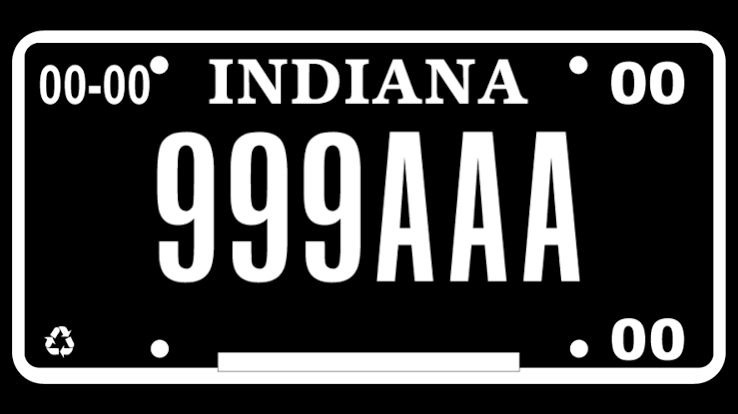
In August 2025 the BMV added a Blackout plate: an all-black background with white lettering, available for an additional $45 fee at BMV branches. It is an alternative design, not a replacement — the covered bridge plate is still the default issue.
Source: Indiana Bureau of Motor Vehicles.
Why You May See Different Indiana Standard Plates
Several standard-looking designs can be on the road at once:
- Retired bases still valid. Indiana reissues plates on a rolling cycle, so a vehicle that has not been reissued may still carry the 2008 blue torch-and-stars plate or even the 2013 Bicentennial plate — on a current registration.
- The current standard. The 2017 covered bridge plate is the design most new registrations receive.
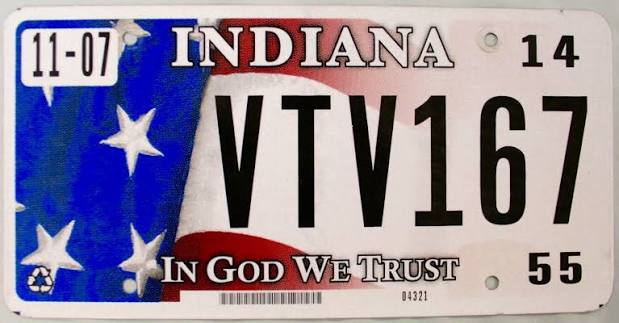
- Optional standard alternatives. Designs like In God We Trust and the 2025 Blackout plate are standard-passenger options, not specialty plates.
- Specialty plates. College, military and organization plates use their own artwork on the current base format.
For spotters, this means a blue torch-and-stars Indiana plate is not necessarily an old tag — it can be a perfectly current registration.
Specialty Plates
Beyond the standard designs, Indiana offers numerous specialty plates associated with colleges and universities, military service, organizations, causes and professional groups. Purdue, Indiana University and Notre Dame plates are among the most visible on the road.
Historic Vehicles
Indiana registers vehicles at least 25 years old as historic vehicles, which can carry a tan “Historic” plate showing the state seal. Collector-vehicle registration is available at a reduced fee for vehicles used as collector’s items rather than primary transportation.
Indiana also permits authentic model year plates: a collector vehicle may display an original Indiana-issued plate from the vehicle’s model year, provided the plate passes BMV inspection — it must be metal, legible, and in good condition. The historic plate and registration certificate are carried in the vehicle, and the registration is renewed annually.
Source: Indiana BMV — Historic Vehicle & Authentic Model Year License Plates.
Does Indiana Require a Front License Plate?
No. Indiana requires a single license plate, displayed on the rear of standard passenger vehicles — a rule in place since 1956. Front plates are only required on certain commercial vehicles such as specific trucks. On motorcycles, the single plate is also displayed on the rear.
How to Recognize an Indiana Plate
- INDIANA spelled out on the plate
- Current standard: a country-scene graphic with a covered bridge and dark blue serials
- County number in the bottom-right corner, separate from the serial
- Serial format 123A, 123AB or 123ABC — three digits followed by letters
- Rear-only display on passenger vehicles
Specialty plates can look very different, but they share the rear-only rule and the same corner-sticker layout.
Frequently Asked Questions
When did Indiana first issue license plates?
Indiana required vehicle registration in 1905, but the state began manufacturing and issuing its own plates on July 1, 1913. Before that, owners provided their own plates.
What does the number on an Indiana license plate mean?
On plates issued from 1963 to 2008, the leading number identified the county of registration, 1 through 92 in alphabetical order. Since 2008, the county number appears in the bottom-right corner of the plate instead.
What county is 49 on an Indiana license plate?
Marion County — Indianapolis.
What county is 2 on an Indiana license plate?
Allen County — Fort Wayne.
How are Indiana county numbers assigned?
Alphabetically. Adams County is 1, Allen County is 2, and the list continues through Whitley County at 92.
What was the Wander Indiana license plate?
Indiana’s standard passenger plate from 1984 to 1987, carrying the “Wander Indiana” tourism slogan on a colorful graphic background.
What does “Back Home Again” mean on an Indiana license plate?
It references the song “(Back Home Again in) Indiana” from 1917. The phrase appeared on the standard plate from 1987 to 1990.
What is on the current Indiana license plate?
The standard passenger plate features a covered bridge on a reflective country-scene background with dark blue serials in the 123A/123AB/123ABC format. It has been the standard design since 2017.
Does Indiana require a front license plate?
No. Indiana requires a single plate on the rear of passenger vehicles.
Can an old car use an old Indiana license plate?
Yes. Vehicles at least 25 years old can register as historic or collector vehicles, and collector vehicles may display an authentic Indiana plate from the vehicle’s model year after BMV inspection. The registration itself is renewed annually.
Where Are You Likely to Spot an Indiana Plate?
Indiana plates turn up most often in the neighboring states — Illinois, Ohio, Michigan and Kentucky — along the Midwest’s busiest corridors. Interstates 65, 70, 80/90 and 74 all cross Indiana, feeding traffic toward Chicago, Louisville, Cincinnati and Detroit, so Hoosier plates are a routine sighting at big-ten games, lake destinations and cross-country stops in between.