AK American plate atlas
Alaska
The Last Frontier
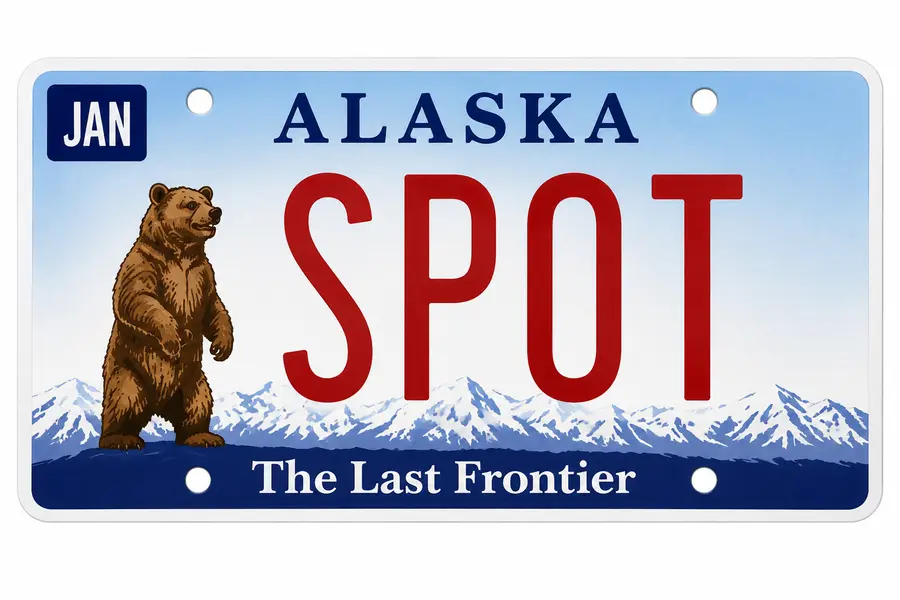
Alaska began issuing regular territorial license plates in 1921, decades before becoming the 49th state on January 3, 1959. From Benny Benson’s state flag to the iconic 1976 standing bear and classic yellow Last Frontier plates, Alaska has one of America’s most recognizable license plate traditions.
Capital
JuneauState bird
Willow ptarmiganJoined the Union
January 3, 195901
A quick trip through time
The Alaska story
Purchased from Russia in 1867, Alaska grew through Indigenous history, gold rushes, military development, fishing, and oil. It is the largest state by area and one of the least densely populated.
02
Bumper-sized history
About the plate
Alaska plates often celebrate the Last Frontier identity. Spotting one in the Lower 48 feels like finding a traveler with a very long story.
Deep Dive Archive · State Volume 04
The Detailed History of Alaska License Plates
Over a century of territorial registration, Benny Benson’s state flag, the iconic standing bear, Gold Rush centennial art, and “The Last Frontier” identity in the 49th State.
Why Alaska’s License-Plate History Is Unique
Alaska has an unusually rich, storied license-plate history shaped by its unique path from Russian colony to frontier territory and finally the 49th U.S. state on January 3, 1959. Decades before statehood, Alaska began issuing regular territorial motor vehicle license plates in 1921.
Because Alaska is geographically vast and separated from the Lower 48 by Canada, its license plates have served as vital ambassadors of state pride and identity. Over the past century, Alaska has repeatedly used its license plates to express its dramatic landscapes and heritage through Benny Benson’s Big Dipper and North Star flag, the official motto “North to the Future,” the Indigenous name “The Great Land,” the immortal moniker “The Last Frontier,” a legendary standing Kodiak/grizzly bear, the Klondike Gold Rush, and statehood jubilees. Today, Alaska’s classic golden-yellow and blue plate remains one of America’s most recognizable and coveted road-trip sights.
Executive Chronology & Key Milestones
A century of Alaska registration milestones, from early territorial stampings through statehood and today’s dual-standard options:
| Period | Milestone | Significance & Details |
|---|---|---|
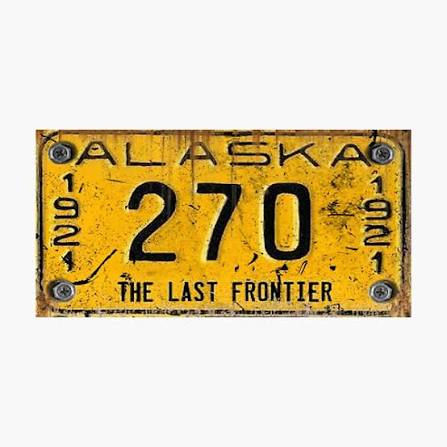
| 1921 | First regular territorial license plates | Alaska begins issuing regular territorial motor vehicle plates with vertical “1921”, “ALASKA”, and “AUTO LICENSE”. |
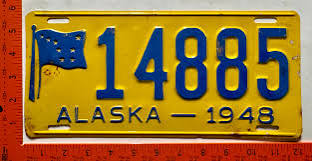
| 1948 | Alaska flag begins appearing on passenger plates | The 1927 Benny Benson flag design (Big Dipper and North Star) makes its first appearance on embossed passenger plates. |
| 1956 | First standard 6 × 12-inch Alaska plate | Alaska adopts the standardized 6 × 12-inch North American plate dimensions for uniform mounting. |
| 1959 | Alaska becomes the 49th state (Jan 3, 1959) | 1958 territorial plates revalidated for 1959, serving as historic transitional artifacts crossing into statehood. |
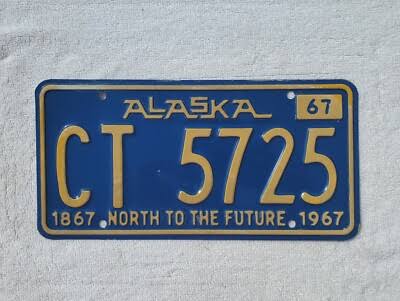
| 1966–67 | Alaska Purchase Centennial / “North to the Future” plate | Commemorates the 1867 purchase from Russia; introduces totem pole artwork and Alaska’s new state motto. |
| 1968–69 | “The Great Land” plate | Short-lived white-and-blue plate celebrating the Aleut root meaning of the name Alaska (Alyeska). |
| 1970–75 | Yellow-and-blue “North to the Future” era | Return to blue embossed characters on golden-yellow background, cementing Alaska’s signature colors. |
| 1976–81 | Standing Kodiak bear plate | Iconic Bicentennial-era illustrated design featuring a standing brown bear against mountains and evergreen forests. |
| 1981–97 | Yellow state-flag “The Last Frontier” plate | Introduction of the classic reflective golden-yellow base with the Alaska flag and “The Last Frontier” slogan. |
| 1997/98–2004 | Gold Rush Centennial graphic plate | Commemorative multi-color graphic depicting gold prospectors; won ALPCA 1998 Plate of the Year. |
| 2004/05 | Return of classic yellow Last Frontier design | Alaska phases out scenic graphics and returns to the timeless, highly readable yellow-and-blue flag identity. |
| 2008–09 | 50th anniversary of statehood plate | Special commemorative standard plate celebrating 1959–2009 with mountains, sunrise, and “Alaska 50” emblem. |
| 2010 | Last Frontier plate reinstated as principal standard | Classic yellow Last Frontier returns to primary standard issuance following the 50th statehood celebration. |
| 2015 | Bear design returns as a standard plate option | Alaska Legislature authorizes a modern Grizzly Bear plate modeled after the 1976 design as a no-cost standard choice. |
| 2022 | Alaska moves to one rear plate for standard vehicles | Effective August 11, 2022 (HB 130), Alaska eliminates the front plate mandate for standard passenger motor vehicles. |
| Present | Dual standard choices: Last Frontier & Grizzly Bear | Motorists select between classic Gold Last Frontier and Grizzly Bear as standard options alongside specialty designs. |
3. Alaska Before License Plates & Territorial Status
The United States purchased Alaska from the Russian Empire in 1867 for $7.2 million—about two cents per acre. For decades, the vast northern territory was governed successively by the U.S. Army, the Department of the Treasury (Customs), and the U.S. Navy before being organized as a civil judicial district under the Organic Act of 1884 and an incorporated U.S. Territory in 1912.
During the early automotive era in the 1900s and 1910s, motorized vehicles in Alaska were few and largely concentrated in gold-boom towns like Nome, Fairbanks, Juneau, and Valdez. Before 1921, there was no centralized territorial vehicle registration act or standardized passenger plate program. Any early vehicle identification was strictly confined to local municipal ordinances or specific commercial, stage, or for-hire vehicles.
Crucial Collector Distinction: Regular, official Alaska motor-vehicle registration began in 1921. All Alaska plates issued from 1921 through 1958 are territorial plates, not state plates. This distinction makes early Alaska plates among the most prized territorial artifacts in American numismatic and license-plate collecting.
4. The First Alaska License Plate (1921)
In 1921, the Territory of Alaska issued its inaugural regular passenger license plates. The design was striking, purposeful, and immediately established a golden-yellow and dark palette that would echo through Alaska plate history for over a century.
The 1921 plate was stamped with:
- Background: Rich golden-yellow painted heavy-gauge steel.
- Characters: Black embossed serial numerals.
- Top Header: “ALASKA” embossed prominently across the upper border.
- Bottom Legend: “AUTO LICENSE” stamped across the bottom edge.
- Date: “1921” stamped vertically along the left edge.
Because Alaska’s road network was limited to localized trails and wagon roads (such as the early Valdez–Fairbanks Richardson Trail), total vehicle registrations were extremely low—only the first few hundred serial numbers were ever pressed. Surviving authentic 1921 territorial plates are exceptionally rare museum pieces today.
5. The Territorial Plate Era (1920s–1940s)
Throughout the 1920s, 1930s, and 1940s, Alaska continued issuing annual stamped metal license plates as an incorporated U.S. Territory. Each year featured rotated high-contrast enamel color combinations—such as white on green, black on orange, and yellow on blue—enabling marshals, territorial police, and road commissioners to spot expired tags at a glance.
During this era, Alaska’s registration totals expanded gradually as critical overland links were developed: the Alaska Railroad (completed 1923), the upgrading of the Richardson Highway, the Steese Highway to Circle, and during World War II, the legendary construction of the 1,700-mile Alaska Highway (ALCAN) in 1942.
Because Alaska remained an isolated territory with harsh winters, gravel roads, and tiny populations, the survival rate of early territorial plates was minuscule. Collectors covet these plates for their distinctive typography, heavy steel fabrication, and historical connection to Alaska’s pre-state frontier days.
6. The Alaska Flag Appears on Passenger Plates
In 1948, the Territory of Alaska made a historic design leap by embossing the Alaska flag directly onto its passenger license plates.
The flag had been designed in 1927 by 13-year-old Benny Benson, an Alaska Native student (of Sugpiaq/Alutiiq descent) at the Jesse Lee Home for Children in Seward. Benson entered a territory-wide school contest open to 7th through 12th graders across Alaska. His winning design depicted eight gold stars against a deep blue field: seven stars forming the Big Dipper (part of Ursa Major, the Great Bear, symbolizing strength) pointing directly to Polaris (the North Star), representing the future of the northernmost territory.
Benny Benson’s flag captured the soul of Alaska. When territorial officials placed the eight-star constellation on the 1948 plate, it established an enduring visual anchor that would become the centerpiece of Alaska’s most iconic modern license plates.
7. The Statehood Transition (1958–1959)
On January 3, 1959, President Dwight D. Eisenhower signed the official proclamation admitting Alaska as the 49th state of the United States.
For license-plate historians and collectors, the statehood transition produced a fascinating artifact: Alaska did not stamp a brand-new baseplate on statehood day. Instead, the 1958 territorial plate was revalidated for 1959 using revalidation tabs/stickers. This meant Alaska motorists drove into American statehood displaying physical plates that were stamped under territorial governance.
Having already adopted the standard North American 6 × 12-inch dimensions in 1956, Alaska’s post-statehood plates quickly transitioned to commemorative annual and multi-year bases celebrating the 49th state’s newfound sovereignty.
8. Centennial of Purchase: “North to the Future”
In 1966, Alaska issued its very first official plate slogan to celebrate the upcoming centennial of the 1867 Alaska Purchase from Russia. The plate read: “1867 — NORTH TO THE FUTURE — 1967” across the bottom.
The slogan “North to the Future” was coined by Richard Peter, news director of the Alaska Centennial Commission, to describe Alaska as a land of boundless promise and opportunity. The phrase was so widely embraced that the Alaska State Legislature formally adopted “North to the Future” as the official state motto in 1967.
Visually, the 1966–67 plate was a standout: it featured a stylized Indigenous totem pole graphic flanked by an eagle on the left side, golden-yellow embossed numerals, and deep blue background coloring that made it one of the most celebrated anniversary plates of the 1960s.
9. “The Great Land” Era
Following the centennial celebration, Alaska briefly introduced a new slogan: “THE GREAT LAND” on its 1968 and 1969 plates.
The base featured a clean white background with dark blue embossed characters and the Benny Benson Alaska flag positioned between the serial groups. The phrase “The Great Land” directly reflects the indigenous etymology of the name Alaska, derived from the Aleut (Unangam Tunuu) word Alaxsxaq or Alyeska, meaning “the great land” or “the object towards which the action of the sea is directed” (the mainland).
While short-lived, this issue reinforced the central role of Indigenous heritage and geographic scale in Alaska’s public branding.
10. Yellow & Blue “North to the Future” Multi-Year Base
In 1970, Alaska returned to “NORTH TO THE FUTURE” as its standard passenger slogan, dropping the 1867–1967 centennial dates and standardizing on the classic color scheme: dark blue characters on a bright golden-yellow field.
This 1970–1975 series featured the Alaska flag in the center separator, “ALASKA” across the top header, and the state motto embossed along the bottom. This design established the durable multi-year sticker registration model in Alaska and solidified blue-and-gold as Alaska’s definitive plate palette.
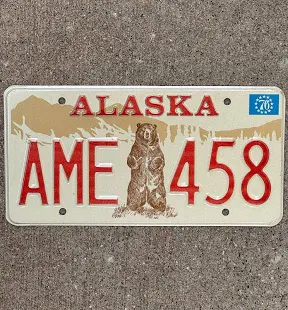
11. The Legendary 1976 Standing Kodiak Bear Plate
In 1976, to celebrate the United States Bicentennial (1776–1976), Alaska introduced what would become one of the most famous and beloved license plates in American history: the Standing Bear plate.
Designed by Juneau graphic artist Ward Wells, the plate departed dramatically from standard American plate aesthetics. It featured:
- Reflective White Base: High-visibility bead-coated white background.
- Embossed Red Characters: Crimson red serial letters and numbers.
- Standing Kodiak / Grizzly Bear: A magnificent brown bear standing upright on its hind legs at the left, towering over mountain peaks and dense spruce evergreen forests.
- Bicentennial Motif: Stamped with “1776–1976” and “ALASKA” across the top header.
The bear plate was an instant sensation among motorists, tourists, and collectors worldwide. Its daring visual artistry stood out so powerfully that when Alaska sought to revitalize its standard lineup four decades later, this exact 1976 design was chosen by the Legislature to be reborn.
12. The Classic Yellow “Last Frontier” Flag Plate
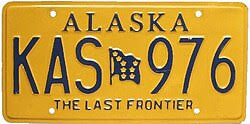
In 1981, Alaska unveiled the design that millions of Americans immediately picture when they think of an Alaska license plate: the Gold “Last Frontier” base.
The design was a masterclass in clarity and state symbolism:
- Background: Vibrant reflective golden-yellow enamel.
- Serials & Lettering: Bold cobalt blue embossed typography.
- Centerpiece: Benny Benson’s Alaska state flag (Big Dipper and North Star in gold on blue) placed squarely in the center between the three-letter and three-number serial blocks.
- Header: “ALASKA” across the top.
- Bottom Slogan: “THE LAST FRONTIER” embossed along the bottom edge.
The phrase “The Last Frontier” captured Alaska’s vast, rugged wilderness, low population density, and pioneering spirit. Because the golden-yellow and blue colors matched the Alaska state flag, this clean design forged an indelible connection between the vehicle tag and Alaska state identity.
13. The Gold Rush Centennial Graphic Plate
To honor the 100th anniversary of the historic 1897–1898 Klondike and Alaska Gold Rushes—which brought tens of thousands of prospectors over the Chilkoot Trail and forever changed Alaska’s economy—the Alaska Legislature authorized a full-color graphic standard plate.
Issued from late 1997 through 2004, the Gold Rush Centennial plate was an elaborate scenic composition depicting snowcapped mountain peaks, a rising golden sun, evergreen trees, and a silhouette of a gold prospector panning for gold alongside a pack horse. The bottom legend read “Gold Rush Centennial.”
The artistic achievement was recognized by the Automobile License Plate Collectors Association (ALPCA), which awarded Alaska the prestigious Plate of the Year award for 1998 (shared with Idaho).
14. Return of the Classic Yellow Flag Plate
As the Gold Rush Centennial commemoration concluded, Alaska made a deliberate and unusual design decision: rather than adopting an even more complex digital graphic, Alaska returned to its classic golden-yellow “The Last Frontier” flag design in 2004/2005.
While many U.S. states continuously cluttered their plates with busy photo-realistic gradients that compromised legibility, Alaska recognized the immense visual power and heritage of its bold yellow-and-blue flag base. The restored design was celebrated by law enforcement for high contrast and by motorists for timeless Alaskan authenticity.
15. 50 Years of Statehood Commemorative Issue
To celebrate Alaska’s golden jubilee of statehood (1959–2009), Alaska issued a special commemorative standard baseplate from 2008 through 2009.
The baseplate featured a scenic mountain vista under a golden sunrise, the Alaska state flag, the official “Alaska 50” jubilee logo, and the slogan “Celebrating Statehood 1959–2009.” Following the anniversary year, the standard yellow Last Frontier plate was reinstated as Alaska’s principal issue in 2010.
16. The Bear Returns: Alaska’s Modern Grizzly Bear Plate
In 2015, responding to overwhelming public fondness for the historic 1976 design, the Alaska Legislature enacted legislation directing the Division of Motor Vehicles to reintroduce the standing bear design as a co-equal standard passenger plate.
Under Alaska Statute AS 28.10.161, the modern Grizzly Bear plate faithfully reproduces Ward Wells’s original standing brown bear artwork against mountain peaks and evergreens—updating the plate without the 1776–1976 bicentennial dates and featuring crisp modern reflective materials.
Critically, Alaska DMV treats the Grizzly Bear plate not as an expensive specialty tag, but as a standard passenger option. When registering a vehicle in Alaska, motorists can choose between the classic Gold Last Frontier plate and the Grizzly Bear plate at standard fees.
Alaska’s Current Standard License Plates
Today, Alaska motorists enjoy one of the most distinctive license-plate menus in North America. Alaska DMV provides two co-equal standard passenger choices alongside select specialty designs:
| Plate Design | Visual Features | Classification & Availability |
|---|---|---|
| Standard Gold / “The Last Frontier” | Vibrant reflective golden-yellow background, blue characters, Benny Benson’s Alaska flag center, “THE LAST FRONTIER” bottom slogan. | Primary standard passenger issue; no extra fee. |
| Standard Grizzly Bear | Reflective white background, standing brown bear over mountain peaks and forest scenery, blue or red typography. | Alternate standard passenger issue (AS 28.10.161); no specialty surcharge. |
| Celebrating the Arts | Vibrant artistic scenery and Northern Lights backdrop supporting Alaska State Council on the Arts programs. | Optional specialty plate. |
| Mountain / Wildlife Conservation | Scenic depiction of Alaska wildlife (such as Caribou or Dall Sheep) supporting wildlife management initiatives. | Optional specialty plate. |
For a current catalog of all active specialty, veteran, and organizational plates, visit the official Alaska Division of Motor Vehicles (DMV) Plate Portal.
Alaska Motor Vehicle Law: Single Rear Plate Mandate (2022)
Does Alaska require a front license plate? No. Effective August 11, 2022, following the passage of House Bill 130 and revisions to Alaska Statute AS 28.10.171, Alaska transitioned to requiring only a single rear license plate for standard passenger motor vehicles.
Previously, Alaska had been a two-plate state requiring front and rear display. While motorists who were issued two plates under earlier registrations may still keep both mounted, newly registered passenger vehicles receive and require only one rear plate. This brings Alaska into alignment with neighboring Canadian territories and single-plate states across North America, simplifying vehicle aerodynamics and reducing manufacturing steel usage.
Alaska Plate Spotter’s Field Guide
Use this visual field guide to identify and date Alaska plates on highways, ferry terminals, and road trips across the continent:
| If You See… | Likely Era / Base | Spotter Notes & Key Features |
|---|---|---|
| Small plate with simple ALASKA / year design | 1921–1947 Early territorial era | Very rare territorial survivor; annual stamped color schemes (#1 to low thousands). |
| Alaska flag on older annual stamped metal plate | 1948–1965 Territorial to early statehood | Debut of Benny Benson’s 8-star flag on stamped steel baseplates. |
| Totem pole artwork + “NORTH TO THE FUTURE” + 1867–1967 | 1966–1967 Centennial base | Alaska Purchase Centennial celebration with totem pole graphic and state motto. |
| White base + blue characters + “THE GREAT LAND” | 1968–1969 The Great Land era | Short-lived slogan honoring the Aleut name Alyeska. |
| Golden-yellow base + blue characters + “NORTH TO THE FUTURE” | 1970–1975 Slogan base | Established durable yellow-and-blue multi-year registration system. |
| White base + standing brown bear + red characters + 1776–1976 | 1976–1981 Bicentennial Bear | Legendary Ward Wells standing brown bear illustration over mountains and evergreens. |
| Reflective yellow + Alaska flag center + “THE LAST FRONTIER” | 1981–1997 or 2004/05–present | Alaska’s signature standard passenger plate; unmistakable gold field with blue serials. |
| Full-color prospector panning gold + sunburst + mountain scene | 1997/98–2004 Gold Rush Centennial | Award-winning scenic commemorative base celebrating the 1897/98 Klondike Gold Rush. |
| Scenic mountain sunrise + “Celebrating Statehood 1959–2009” | 2008–2009 50th Statehood | Commemorative golden jubilee base with Alaska 50 logo. |
| Modern standing brown bear (without 1776–1976 dates) | 2015–Present Modern Grizzly Bear | Standard no-cost passenger option modeled directly after the 1976 standing bear. |
*Spotter Note: Because Alaska allows certain legacy plates to remain in continuous registration with valid renewal tabs, seeing a vintage design on the road indicates the plate’s era of issuance, though the vehicle may be in active modern operation.
Where to Spot an Alaska License Plate
Because Alaska is separated from the Lower 48 by over 500 miles of Canadian wilderness, spotting an Alaska plate anywhere on the continental U.S. highway network is one of the most rewarding catches in the license plate game.
While finding one requires a bit of road-trip luck, your odds increase dramatically along major long-distance corridors:
- Pacific Northwest Gateways: Interstate 5 through Washington and Oregon, connecting to the Alaska Marine Highway ferry terminal in Bellingham, WA.
- Military Relocation Communities: Major joint military bases (such as Joint Base Lewis-McChord in Washington, San Diego naval hubs, and Colorado Springs) where service members frequently transfer from Joint Base Elmendorf-Richardson (JBER) and Fort Wainwright.
- The Alaska Highway (ALCAN) Route: Interstates 15, 90, and 94 channeling northbound road-trippers and seasonal workers across Montana, North Dakota, and the Canadian border.
- Sunbelt Snowbird Havens: Winter RV parks and desert highways across Arizona, California, and Nevada where hearty Alaskans escape northern winters.
Alaska License Plate FAQ
Why are Alaska license plates yellow?
Alaska license plates are golden-yellow because yellow and blue are the traditional state colors of Alaska, directly mirroring the Alaska state flag. The flag’s eight gold stars represent Alaska’s mineral riches (including its famous gold strikes) against a deep blue sky. Alaska first paired yellow and dark colors on its inaugural 1921 territorial plate and made golden-yellow the permanent background of its standard “The Last Frontier” plate in 1981, creating an indelible and high-contrast state identity.
What does “The Last Frontier” mean on the Alaska license plate?
“The Last Frontier” refers to Alaska’s immense geographic scale, vast undeveloped wilderness, remote geography, and pioneering spirit. As the largest U.S. state by area—more than twice the size of Texas—Alaska contains massive tracts of roadless mountains, tundra, and coastline, representing America’s final untamed frontier. Alaska adopted “The Last Frontier” as its standard plate slogan in 1981.
What does “North to the Future” mean?
“North to the Future” is the official state motto of Alaska. Coined in 1966 by Richard Peter for the upcoming centennial of the 1867 Alaska Purchase from Russia, the slogan envisioned Alaska as a dynamic land of future economic promise, pioneering innovation, and limitless opportunity. The phrase appeared on Alaska’s 1966–67 and 1970–75 license plates and was adopted as the official state motto in 1967.
What are the stars on the Alaska license plate?
The stars on Alaska license plates depict the Big Dipper and the North Star (Polaris), the central motif of the Alaska state flag. Seven gold stars form the Big Dipper constellation (part of Ursa Major, the Great Bear, symbolizing strength), which points directly to Polaris, the North Star, symbolizing Alaska’s role as America’s northernmost beacon.
Who designed the Alaska flag?
Benny Benson, a 13-year-old Alaska Native student, designed the Alaska flag in 1927. Benson, of Sugpiaq (Alutiiq) heritage, was a seventh-grader living at the Jesse Lee Home for Children in Seward when he submitted his winning sketch in a territory-wide school contest. His design of eight gold stars on a field of blue was adopted as the official territorial flag in May 1927 and became the state flag upon statehood in 1959.
When did Alaska first issue license plates?
1921, while Alaska was still a U.S. territory. The inaugural 1921 territorial plates featured black embossed numbers on a golden-yellow background with “ALASKA” across the top, “AUTO LICENSE” along the bottom, and “1921” displayed vertically.
What year did Alaska become a state?
1959. Alaska was formally admitted as the 49th state of the Union on January 3, 1959, under a presidential proclamation signed by Dwight D. Eisenhower.
Does Alaska require a front license plate?
No. Effective August 11, 2022 under Alaska Statute AS 28.10.171 (House Bill 130), Alaska requires only a single rear license plate for standard passenger motor vehicles. Front plates are no longer required for standard passenger cars and trucks.
What animal is on the Alaska license plate?
The animal on the Alaska plate is a standing brown bear (Kodiak / grizzly bear, Ursus arctos). Originally introduced on Alaska’s celebrated 1976 U.S. Bicentennial plate designed by Ward Wells, the standing bear was brought back by the Alaska Legislature in 2015 as an official standard passenger plate option that motorists can select at standard registration fees.
Explore More License Plate Deep Dives
Compare Alaska’s territorial and frontier heritage with other iconic state designs:
Sources & Historical References
- Alaska Division of Motor Vehicles (DMV): Alaska License Plates Catalog & Vehicle Registration Standards, Department of Administration.
- Alaska State Legislature / Alaska Statutes: AS 28.10.161 (Plate Design & Grizzly Bear Standard) and AS 28.10.171 / HB 130 (Single Rear License Plate Requirement, Aug 11, 2022).
- Alaska State Archives & Historical Collections: Benny Benson 1927 Flag Contest Archives, Territorial Vehicle Registration Records (1921–1958), and 1959 Statehood Proclamation files.
- Automobile License Plate Collectors Association (ALPCA): Alaska Passenger Plate Chronology, 1921–Present Archives, and 1998 ALPCA Plate of the Year Award Documentation.
- Alaska State Museum: The Story of the Alaska Flag and Ward Wells 1976 Bicentennial Standing Bear Plate artifacts.