OR American plate atlas
Oregon
The Beaver State
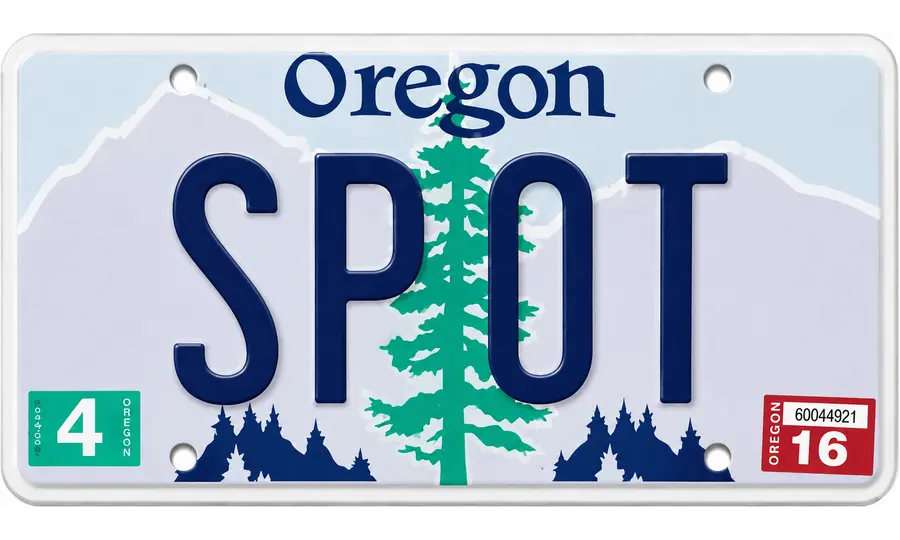
Oregon’s standard license plate is one of America’s most recognizable state plates, featuring a Douglas fir centered against a mountain backdrop. Introduced in 1988, the tree design has represented Oregon on the road for nearly four decades.
Capital
SalemState bird
Western meadowlarkJoined the Union
February 14, 185901
A quick trip through time
The Oregon story
Oregon’s history spans indigenous Pacific Northwest cultures, the historic Oregon Trail, pioneering timber and agricultural industries, scenic coastal waterways, and vibrant environmental conservation.
02
Bumper-sized history
About the plate
Oregon’s standard license plate is one of America’s most recognizable state plates, featuring a Douglas fir centered against a mountain backdrop. Introduced in 1988, the tree design has represented Oregon on the road for nearly four decades.
What Tree Is on the Oregon License Plate?
The tree on Oregon’s standard license plate is a Douglas fir, Oregon’s official state tree. Its scientific name is Pseudotsuga menziesii. The Oregon Legislative Assembly designated the Douglas fir as the state’s official tree in 1939, recognizing the towering evergreen that defines the state’s natural landscape and historic timber heritage.
The Douglas fir became the central visual element of Oregon’s standard passenger plate in 1988, when the state retired its embossed blue-and-gold design in favor of a full-color graphic base. The tree stands in the center of the plate, positioned directly between the two clusters of registration characters.
Behind the tree is a stylized mountain landscape with a soft sky gradient, with OREGON printed across the top. Because Oregon has kept this core layout for standard passenger vehicles for nearly four decades, it remains one of the easiest plates to spot on American highways.
What Is the Oregon Tree Plate?
Oregon’s “tree plate” is the standard passenger license plate introduced in 1988. It features a green Douglas fir in the center, with a stylized mountain landscape behind it and the state name across the top.
The Douglas fir has been Oregon’s official state tree since 1939, which makes it a natural visual symbol for the state. Because Oregon has issued this tree design for standard passenger vehicles for nearly 40 years rather than cycling through frequent redesigns, drivers and road-trippers commonly refer to it simply as the Oregon tree plate.
Why Is There a Douglas Fir on the Oregon License Plate?
The Douglas fir is closely tied to Oregon’s identity and geography. Dense evergreen forests blanket the Coast Range and the western slopes of the Cascades, and the timber trade was central to the state’s early economic development. When state officials planned a new graphic baseplate in the late 1980s, the state tree was a natural choice to represent Oregon on the road. While Oregon DMV records do not cite a formal artist statement, the tree visually communicates the state’s evergreen landscape.
When Did Oregon Start Using the Tree License Plate?
1988. Oregon introduced the graphic tree baseplate that year to replace the previous embossed blue-and-gold design. The tree motif has remained Oregon’s primary passenger design ever since, with the only major update being a 2004 rollover from the ABC 123 serial format to 123 ABC.
Is the Tree Really a Douglas Fir?
Yes. The tree on the plate is specifically a Douglas fir, not a generic pine or evergreen silhouette. Although motorists and road trippers often describe it casually as a pine tree, the artwork was modeled directly on Oregon’s state tree. Botanically, the Douglas fir is neither a true fir nor a pine — it belongs to its own genus, Pseudotsuga.
A Few Facts About Oregon’s Douglas Fir
- Adopted in 1939: The Oregon Legislative Assembly designated the Douglas fir as Oregon’s state tree in 1939.
- Scientific name: Pseudotsuga menziesii, named for Scottish botanist David Douglas and naturalist Archibald Menzies.
- Not a true fir: Despite its common name, the Douglas fir is not a true fir (genus Abies) or a pine (genus Pinus); its genus name translates to “false hemlock.”
- Native and widespread: Native across western North America, Douglas firs grow abundantly in western Oregon and make up the largest share of the state’s growing timber volume.
What Mountains Are on the Oregon License Plate?
The plate shows a stylized mountain landscape rather than a specifically identified peak. While motorists often guess Mount Hood or the Cascade Range, Oregon DMV plate documentation does not name a particular summit or mountain range in the design.
Oregon License Plate History
Oregon has registered motor vehicles for more than a century, transitioning from owner-made leather tags to annual stamped plates and eventually to today’s standard tree design.
Early Oregon License Plates: 1905–1958
Oregon enacted its first statewide vehicle registration law in 1905. Drivers registered with the Secretary of State for a three-dollar fee, but the state did not manufacture physical plates. Instead, vehicle owners supplied their own tags — commonly house numbers mounted on leather pads, painted wooden boards, or cut sheet metal.
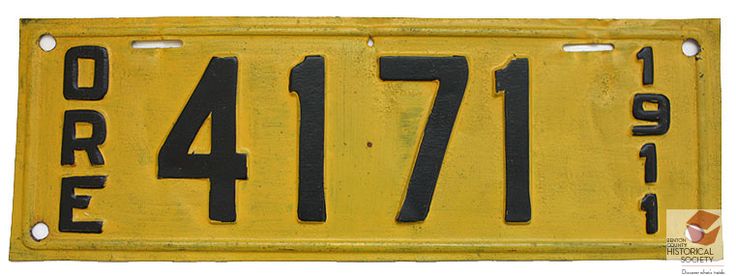
In 1911, Oregon began issuing its own official plates: porcelain-enameled steel plates featuring white numbers on a dark red-orange field with “ORE” stacked vertically on the right side. Beginning in 1916, the state adopted an annual plate system, rotating color schemes each year so law enforcement could confirm current registration at a glance.
During World War II, metal rationing prompted conservation measures. Oregon revalidated its 1942 plates for 1943 using small metal corner tabs and windshield decals, and between 1944 and 1949 the state issued only a single plate per vehicle. Annual plate issuance resumed after the war until 1956, when Oregon joined other North American states and provinces in adopting the standard 12×6-inch plate dimensions.
Pacific Wonderland: 1959–1964
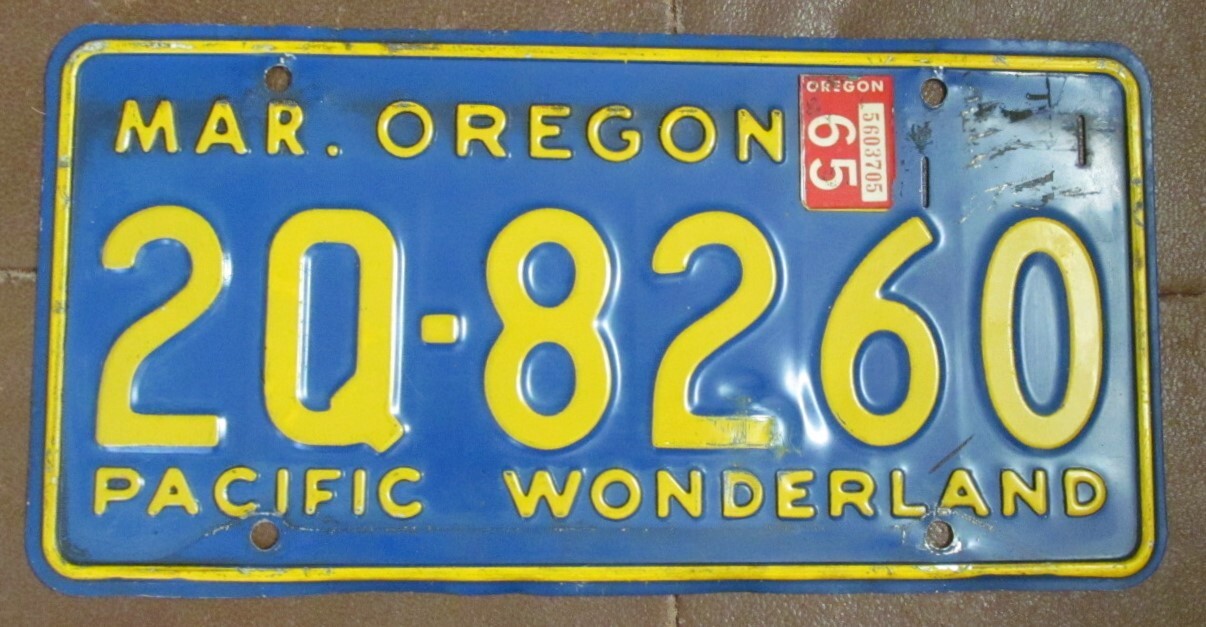
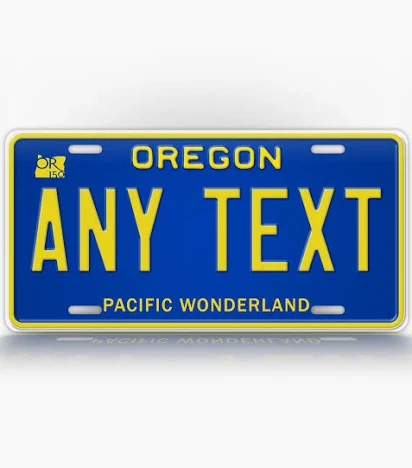
To celebrate Oregon’s 100th anniversary of statehood in 1959, the state introduced the original Pacific Wonderland plate. Designed by schoolchildren and issued through 1964, the plate used Oregon’s state colors — deep blue background with bright gold embossed characters — and stamped “PACIFIC WONDERLAND” along the bottom rim.
Blue and Gold: 1964–1987
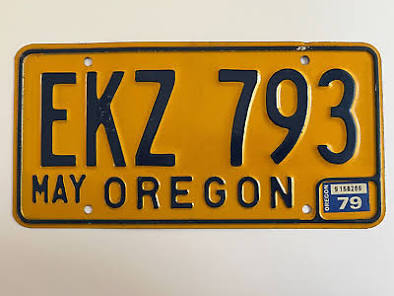
In 1964, Oregon reversed the colors to dark blue lettering on a warm gold background, with OREGON centered across the top. This durable multi-year base remained Oregon’s standard passenger plate for more than two decades, validated with annual expiration stickers, until the introduction of graphic plates in 1988.
The Douglas Fir Plate: 1988–Present
In 1988, Oregon introduced a new standard plate featuring a green Douglas fir in the center against a stylized mountain landscape. The new base shifted from the older blue-and-gold motif to a multi-color graphic layout. The tree separated the registration characters, which initially followed an ABC 123 format before rolling over to 123 ABC in 2004 when serial combinations were exhausted. Plates continue to be produced by Oregon Corrections Enterprises at the Oregon State Penitentiary in Salem.
The Return of Pacific Wonderland
In 2009, commemorating Oregon’s 150th statehood anniversary, the Legislature authorized DMV to reissue the classic 1959 Pacific Wonderland design with an “Oregon 150” seal placed between the characters. Available for a one-time $100 surcharge, proceeds benefit the Oregon State Capitol Foundation and the Oregon Historical Society. It remains one of the state’s most popular specialty options.
How to Recognize an Oregon License Plate
When spotting cars on the highway, look for these features:
- Green Douglas fir centered on the standard plate
- Mountain landscape in the background
- OREGON across the top
- Registration characters appear on either side of the tree
- Specialty and older Oregon plates can look different
Does Oregon Require a Front License Plate?
Yes. Oregon requires motor vehicles to display license plates on both the front and the rear. Under Oregon Revised Statutes 803.540 and Oregon DMV rules, standard passenger cars, vans, and pickup trucks must have both plates securely mounted and clearly visible.
A single rear plate is allowed only for specific vehicle types, including motorcycles, mopeds, trailers, campers, and registered antique or special-interest vehicles. Failing to display a front plate on a standard vehicle is a Class D traffic violation in Oregon.
Oregon License Plate FAQ
What tree is on the Oregon license plate?
The tree is a Douglas fir, Oregon’s official state tree. It has appeared at the center of Oregon’s standard passenger plate since 1988.
What is the Oregon tree plate?
The “tree plate” is Oregon’s standard passenger license plate introduced in 1988, featuring a green Douglas fir in the center against a mountain background.
Why is there a tree on the Oregon license plate?
The Douglas fir has been Oregon’s official state tree since 1939 and represents the state’s rich timber heritage and vast evergreen forests.
When did Oregon start using the tree license plate?
1988.
Is the tree on the Oregon plate a pine tree?
No. It is a Douglas fir. Although often referred to informally as a pine, it is a Douglas fir (Pseudotsuga menziesii).
What does Pacific Wonderland mean on an Oregon license plate?
Pacific Wonderland was the motto on Oregon’s 1959 statehood centennial plate, celebrating the state’s coast, rivers, and forests. Oregon reissued the design as a specialty plate in 2009.
Does Oregon require a front license plate?
Yes. Oregon law (ORS 803.540) requires two plates for standard passenger vehicles, one on the front and one on the rear.
Spotting West Coast License Plates
Tracking license plates on a road trip? Compare Oregon’s Douglas fir design with neighboring plates from Washington and California, or look for the rare Alaska plate on western highways. You can track and score all fifty states in the Spot the States game.
Sources
- Oregon DMV — License Plates
- Oregon DMV — Oregon License Plate Manual (Form 735-6726)
- Oregon Revised Statutes 803.540 — Failure to Display Plates
- Oregon Blue Book — State Tree (Douglas fir, designated 1939)
- Oregon Secretary of State — State Archives (Early Motor Vehicle Registrations)
- Oregon State University Extension — Douglas-fir (Pseudotsuga menziesii)
- Oregon State Capitol Foundation — Pacific Wonderland License Plates
- Oregon Historical Society — Pacific Wonderland and Centennial Research