NJ American plate atlas
New Jersey
The Garden State
Meet the plate, people, places, and stories behind one of the road-trip game’s fifty-one essential finds.
Capital
TrentonState bird
Eastern goldfinchRatified the Constitution
December 18, 178701
A quick trip through time
The New Jersey story
New Jersey’s location between New York and Philadelphia shaped its colonial history, Revolutionary War role, industry, suburbs, shore communities, farms, and transportation networks.
02
Bumper-sized history
About the plate
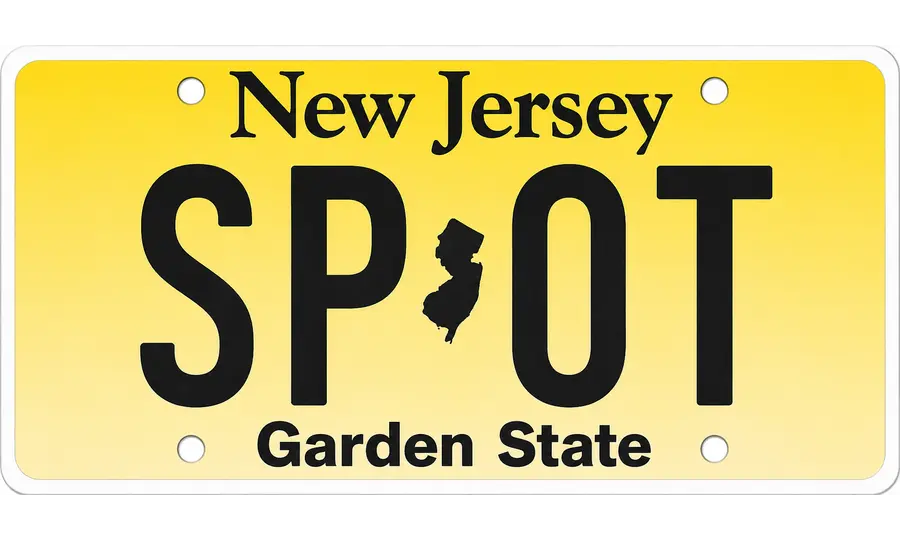
The pale buff New Jersey plate is understated but distinctive. Garden State along the bottom provides the road-trip confirmation.
Deep Dive Archive · State Volume 01
Detailed History of New Jersey License Plates
A comprehensive record of over 120 years of registration law, design evolution, production techniques, county coding, and public identity in the Garden State.
Executive Chronology & Key Milestones
New Jersey’s license-plate history is the visible record of four systems changing over time: vehicle registration law, physical manufacturing, serial allocation, and public state identity.
| Year / Period | Historical Milestone | Significance & Impact |
|---|---|---|
| 1903 | First registration law passed | Motorists supplied their own tags; registration #1 issued March 23, 1903. |
| 1908 | First state-issued plate | State assumed responsibility using framed panel tags. |
| 1909–1915 | Porcelain-on-steel annual plates | Introduced NJ’s distinctive angular numeral typography. |
| 1916 | Embossed steel replaces porcelain | Began the raised-character era that lasted nearly a century. |
| 1926 | County-coded passenger serials | First letter identified registration county (A=Atlantic, B=Bergen, E=Essex, etc.). |
| 1939 | Stacked two-letter county prefixes | Compact format accommodated expanding vehicle populations. |
| 1943 | Metal revalidation tabs | Wartime steel conservation replaced full 1943 plates with tabs on 1942 bases. |
| 1944–1946 | Rear plate issuance only | Steel shortages temporarily halted paired front-and-rear plates. |
| 1952 | Last annual baseplate | Slots accepted metal tabs for renewals through 1956. |
| 1957 | Standard 12×6 inch format | NJ adopted the North American standard plate size and windshield stickers. |
| 1959 | Buff “GARDEN STATE” base | Ended county coding and established continuous registration still valid today. |
| 1969 | Reflective plate experiment | Tested night visibility with a limited reflective run. |
| 1973 | Serial format flips to 123-ABC | Expanded capacity without changing the buff base. |
| 1977 | Full “NEW JERSEY” state name | Replaced decades of the abbreviated “N.J.” legend. |
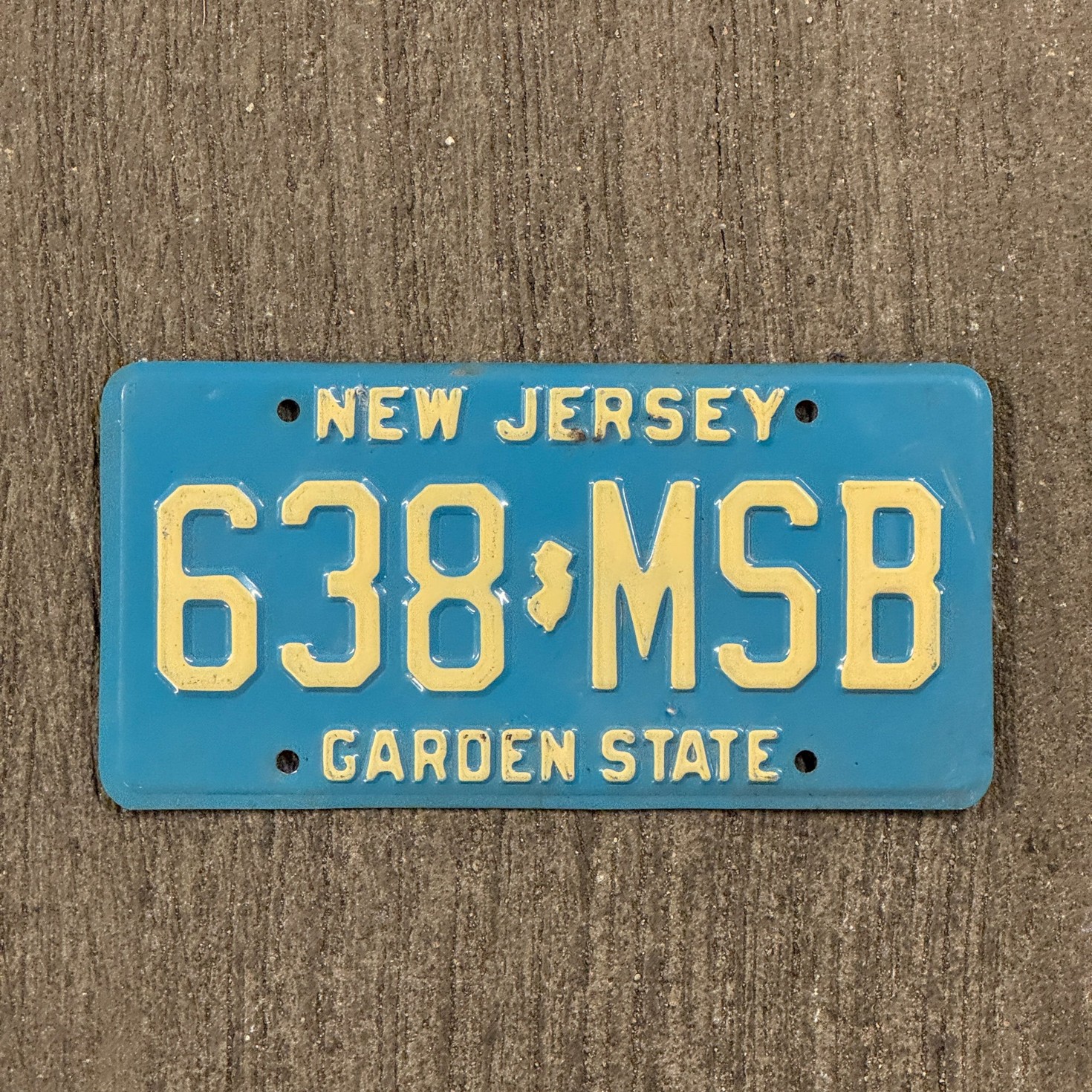
| 1979 | Blue base & state-map separator | Created NJ’s most nostalgic modern design with buff characters on blue. |
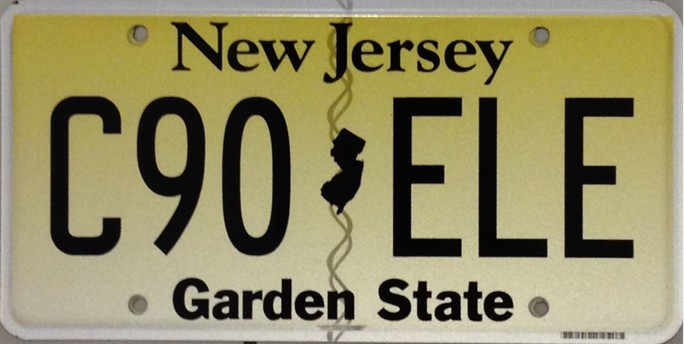
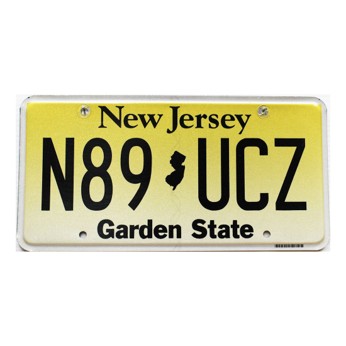
| 1992 | Yellow-to-white graphic base | Introduced the reflective gradient family issued today. |
| 1999–2004 | Dual plate-sticker experiment | Short-lived requirement to display renewal stickers on both plates. |
| 2014 | Digitally printed flat serials | Replaced embossed dies with flat printed characters and rounded font. |
| 2026 | Legislative digital & retro proposals | Plates remain an active policy subject with retro blue base proposals. |
1. Before State-Issued Plates
New Jersey entered the vehicle registration era in 1903. The state assigned registration numbers but did not manufacture physical plates. Drivers had to make or purchase their own tags, using leather backings, painted wood, aluminum kits, or house-style metal numbers mounted on frames.
Registration #1 was issued on March 23, 1903, and pre-state owner-made serials reached into the high 38,000s before the state took over production in 1908.
2. The First State Plates & Porcelain Era
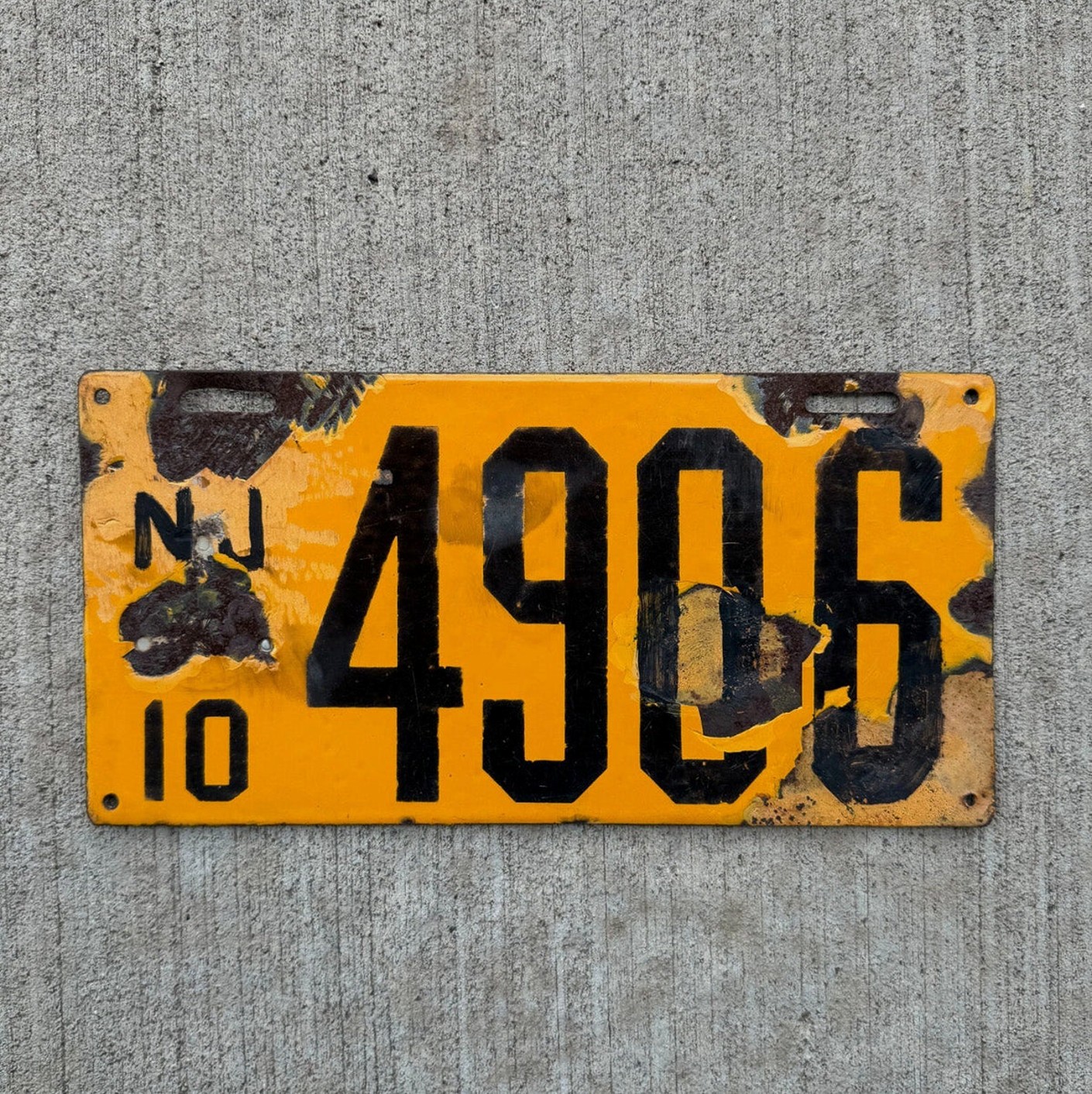
In 1908, New Jersey began issuing standard plates, starting with framed metal strip tags. From 1909 through 1915, the state produced heavy porcelain enamel over steel plates, changing colors annually. These plates introduced New Jersey's signature angular, clipped-corner numeral typeface.
3. Embossed Steel & County Coding
In 1916, New Jersey abandoned porcelain for embossed steel. Rapid vehicle growth led to the introduction of single-letter county prefixes in 1926:
- A Atlantic
- B Bergen
- C Camden
- E Essex
- F Cape May
- H Hudson
- I Somerset
- J Hunterdon
- K Middlesex
- L Mercer
- M Monmouth
- N Burlington
- O/N Ocean
- P Passaic
- R Sussex
- S Salem
- U Union
- V Morris
- W Warren
- Y Cumberland
- Z Gloucester
Populous counties like Essex quickly exhausted standard serial ranges (E99999) and required stacked overflow formats like 1/E.
4. Stacked Prefixes & Wartime Conservation
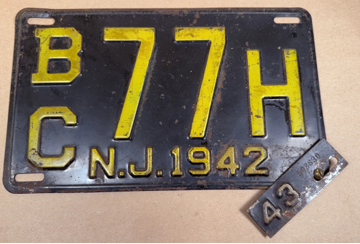
In 1939, single county letters were replaced with compact stacked two-letter blocks. World War II interrupted annual plate manufacturing—1942 plates were extended through 1943 using small metal renewal tabs. To save steel, only a single rear plate was issued from 1944 through 1946.
5. The Permanent Buff “Garden State” Base
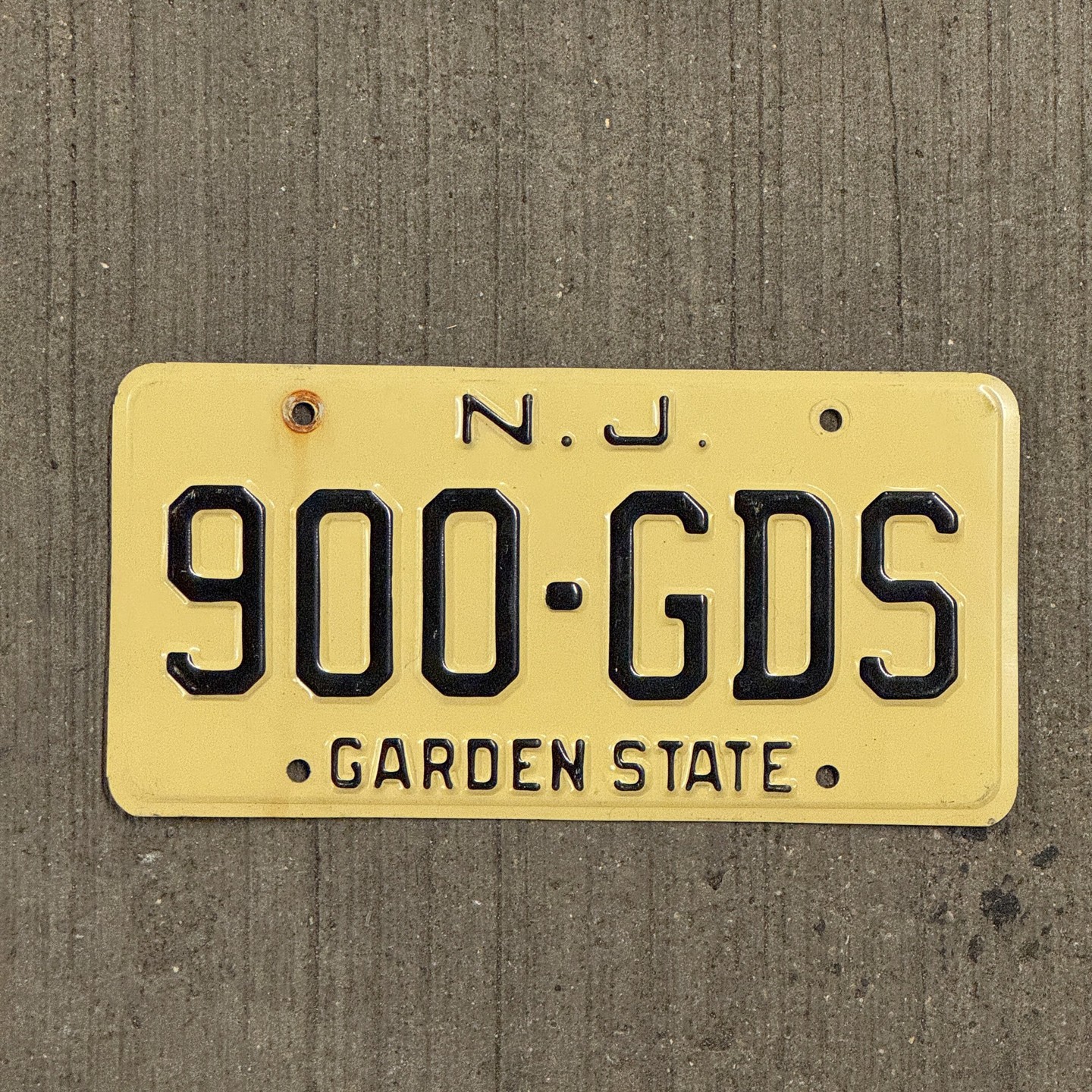
The 1952 orange-on-black plate was New Jersey's last annual base. In 1957, New Jersey adopted the North American standard 12×6 inch size. In 1959, the iconic black-on-buff base introduced the “GARDEN STATE” slogan, abolished county coding, and established a continuous registration system where validly maintained plates from 1959 remain legal on New Jersey roads today.
6. The Classic Blue Plate Era
In mid-1979, New Jersey unveiled its famous blue base featuring buff-colored characters on a rich ocean-blue field. This issue introduced a small embossed outline map of New Jersey as the serial separator—a visual element that remains part of the state's plate design today.
7. Modern Graphic Base & Flat Digital Serials
In 1992, New Jersey launched its reflective yellow-to-white gradient graphic base. In April 2014, the state transitioned from traditional embossed metal dies to 3M digital flat license plate printing. Printed rounded characters replaced the century-old raised angular NJ typeface.
State v. Carter / Roman-Rosado (2021)
In a landmark 2021 ruling, the Supreme Court of New Jersey addressed license plate frame obstruction under N.J.S.A. 39:3-33. The Court held that a frame covering part of the "GARDEN STATE" slogan does not violate state law as long as the wording remains reasonably recognizable, turning a license plate slogan into a legally defined identifying mark.