HI American plate atlas
Hawaii
The Aloha State
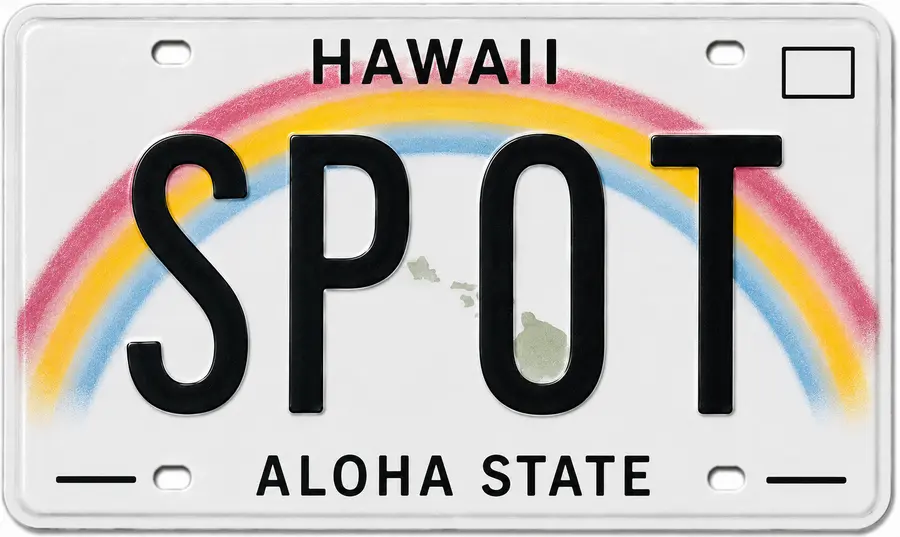
Hawaii’s standard passenger plate has carried a rainbow since 1991 — a natural symbol of islands where sunshine and trade-wind showers share the same sky. Explore why the rainbow is on the plate, how island letter codes reveal where a Hawaii plate came from, and a century of plate history from territorial tags to Aloha State.
Capital
HonoluluState bird
Nēnē (Hawaiian goose)Joined the Union
August 21, 1959Why Does Hawaii Have a Rainbow on Its License Plate?
Hawaii’s standard license plate features a rainbow, a natural symbol closely associated with the islands and their frequent rainbow conditions. The rainbow design has appeared on Hawaii’s standard passenger plates since 1991, and it has remained the defining visual feature of the plate for more than three decades.
The pairing makes sense. Rainbows are strongly associated with Hawaii because the islands produce ideal conditions for them: abundant sunshine, moisture from the surrounding ocean, steady trade winds and quick localized showers put sun and rain in the same sky on a regular basis.
Rainbows also carry cultural significance in Hawaiian tradition. The Hawaiian word for rainbow — ānuenue — appears in stories, chants and place names across the islands, and in Hawaiian tradition a rainbow could signal the presence of chiefs or gods. A symbol that belongs that completely to the islands is a natural centerpiece for the state’s most visible piece of everyday identity.
Hawaii introduced the rainbow plate in 1991, and the state has kept the design ever since. The layout has stayed essentially the same — rainbow arch, black characters, HAWAII above, ALOHA STATE below — with one small update: plates issued on or after January 1, 2025 spell the state name HAWAIʻI, with the ʻokina.
Why Are Rainbows So Common in Hawaii?
Rainbows need sunlight and water droplets at the same time, and Hawaii supplies both almost daily. Moist trade-wind air is pushed up the islands’ mountains, where it cools into clouds and frequent showers — often brief ones that drench a windward valley while the leeward coast stays sunny. Between showers, sunshine is the default, so sun and rain regularly share the same sky. Because the islands sit far out in the Pacific, the air is also unusually clean, free of the dust and pollution that wash out rainbow colors elsewhere. University of Hawaiʻi meteorologist Steven Businger has described Hawaii as one of the best places on Earth to see a rainbow.
Hawaii’s skies stage the plate’s centerpiece more reliably than almost anywhere else in the world.
What Does the Rainbow Mean in Hawaii?
In Hawaiian, a rainbow is an ānuenue. Rainbows hold significance in Hawaiian culture and appear in Hawaiian stories and place names. The Hawaiian dictionaries based on Pukui and Elbert’s work note that the rainbow figuratively symbolized the presence of gods or chiefs, and places across the islands carry rainbow names — including Waiānuenue, the falls on the Wailuku River in Hilo, which tradition associates with Hina, mother of Māui. Rainbows remain part of everyday island identity today: the University of Hawaiʻi’s athletic teams are known as the Rainbow Warriors and Rainbow Wāhine.
When Did Hawaii Start Using the Rainbow License Plate?
1991. Hawaii replaced its 1981–1990 Hawaiian warrior plate with the rainbow design in 1991. The standard design uses a reflective white background, a rainbow arch across the center, black registration characters, HAWAII at the top and ALOHA STATE at the bottom. Hawaii legislative materials specifically describe the rainbow design as the one used on standard number plates, except special number plates, beginning in 1991.
A Design That Has Lasted More Than 30 Years
The basic design introduced in 1991 is still the standard Hawaii passenger plate today. Honolulu’s Department of Customer Services has said the rainbow design has enough letter-and-number combinations to keep serving the state’s vehicle fleet, and the county has extended the serial series rather than retire the design. The only notable change in more than thirty years came in 2025, when plates began spelling the state name HAWAIʻI with the ʻokina under Act 64 of 2024. Plates issued before that date remain valid.
Hawaii License Plate History
Hawaii’s plates tell the islands’ story in order: a territory stamping HAWAII on its tags decades before statehood, the arrival of Aloha, a mid-century run of plain color bases, a king on the plate, a warrior, and finally the rainbow that has held the standard since 1991.
Hawaii License Plates Before Statehood
Hawaii was issuing plates long before it was a state. The island chain became a U.S. territory in 1898, motor vehicle registration began in the early 1900s, and Hawaii did not become the 50th state until August 21, 1959. Nearly every plate issued before that date is technically a territorial plate rather than a state plate.
Registration was also local. With no inter-island roads, each county administered its own vehicle registration. Honolulu began registering vehicles in 1906, and the first government-issued plates appeared in 1915 in Honolulu and Hawaiʻi County. Maui County followed in 1919, while Kauaʻi owners supplied their own homemade plates until 1921. In 1922, the Territory standardized plates across all the islands for the first time.
The territorial plates carried the legend HAWAII — not a “territory” marking — and serials were allocated in county blocks from the start. That county-by-county habit grew into the island letter coding that still identifies Hawaii plates today.
“Aloha” Appears on Hawaii Plates
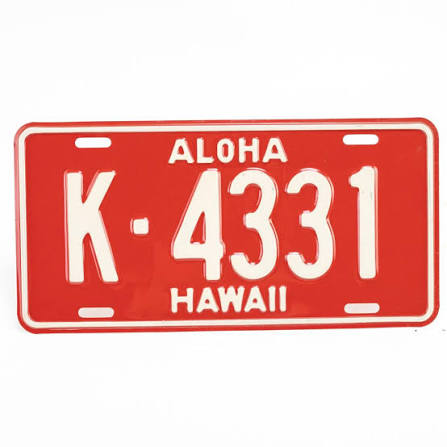
In 1957, while Hawaii was still a U.S. territory, the territory issued a new standard passenger plate with ALOHA across the top: white characters embossed on a red base, HAWAII at the bottom.
That makes 1957 a milestone worth remembering: ALOHA appeared on Hawaii plates two years before Hawaii became a state. Hawaii joined the Union on August 21, 1959, but the plate did not change right away. The red ALOHA base remained in use through 1960, serving both the last territorial years and Hawaii’s first year and a half of statehood.
From “Aloha” to “Aloha State”
In 1961, the shorter ALOHA slogan gave way to ALOHA STATE, which has stayed at the bottom of Hawaii’s standard passenger plates ever since. The nickname itself was already official: Hawaii adopted “The Aloha State” by legislative act in 1959, the year of statehood, and it is codified in Hawaii Revised Statutes §5-7.
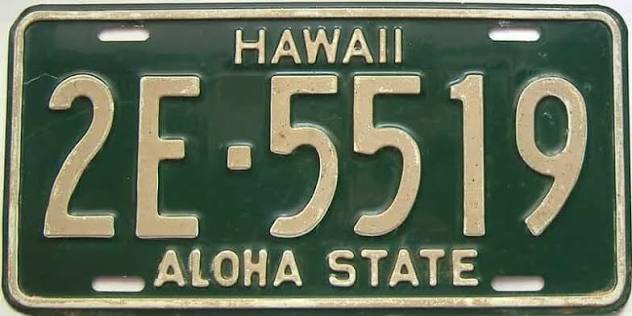
The 1961–1968 base was white embossed on dark green, with HAWAII at the top and ALOHA STATE at the bottom — the layout every later base has kept.
The Yellow Plate: 1969–1975
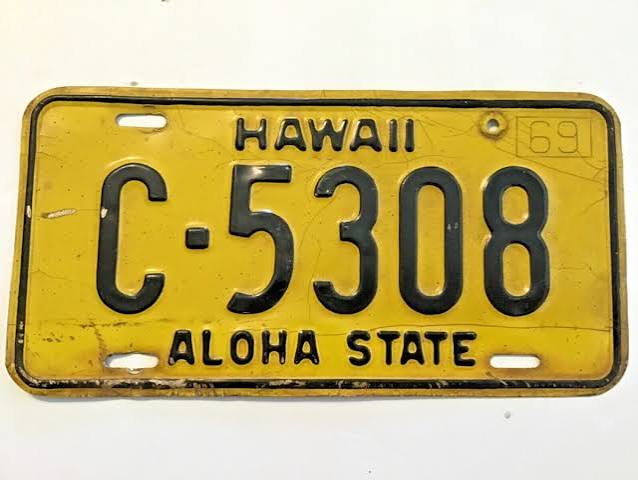
In 1969, Hawaii switched to black characters on a reflective yellow background, keeping HAWAII at the top and ALOHA STATE at the bottom. It was a plain, type-only design — and the last base before Hawaii began putting pictures on its plates.
King Kamehameha and the 1976 Scenic Plate
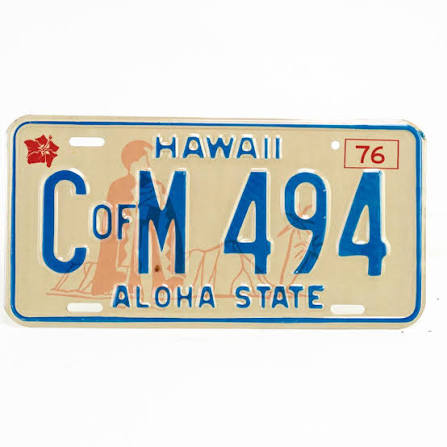
In 1976, Hawaii’s plate became pictorial. On a reflective white base with blue characters, the state screened a pink-toned background scene featuring King Kamehameha I, the monarch who unified the Hawaiian Islands into a single kingdom in the early 19th century, alongside Diamond Head — the crater known in Hawaiian as Lēʻahi that overlooks Waikīkī — and a red hibiscus at the top left. ALOHA STATE remained at the bottom, and the scenic design served Hawaii from 1976 through 1980.
The Hawaiian Warrior Plate: 1981–1990
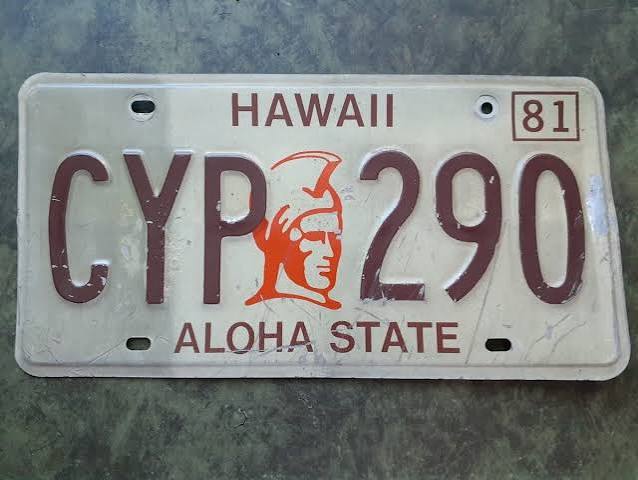
In 1981, Hawaii simplified the design: a reflective white background, brown characters, and an orange Hawaiian warrior head graphic at the center, with HAWAII and ALOHA STATE screened above and below.
The 1981 base also moved Hawaii to the modern ABC 123 serial format, with the first letter coding the county of registration. The letter reservations were settled around 1979–1980, when H, K, L and M were kept out of Honolulu’s series and reserved for the neighbor island counties — a choice made to help police identify vehicles — and those reservations still hold today.
The Rainbow Plate: 1991–Present
In 1991, the warrior came off the plate and the rainbow went on. The fuller story of the design — why Hawaii’s skies and culture make the rainbow such a natural fit — is covered at the top of this page. Since 1991, the standard passenger plate has kept the same basic layout: a reflective white background, a central rainbow arch, a black serial, HAWAII at the top and ALOHA STATE at the bottom.
Can You Tell Which Island a Hawaii License Plate Is From?
Hawaii’s four counties register vehicles independently, and standard passenger serials have historically been allocated by county. For a road-trip spotter, that means the first letter of the serial can point to the island a plate came from:
| Prefix | County / Island |
|---|---|
| H / Z | Hawaiʻi County — the Big Island |
| K | Kauaʻi County — Kauaʻi |
| M / L | Maui County — Maui, Molokaʻi and Lānaʻi |
| Other series | Honolulu County — Oʻahu |
Treat this as a practical spotting rule rather than an unbreakable code. Serial allocations have evolved over the decades — Maui didn’t need its second letter series until the L serials began in 2011, and Honolulu’s series have been extended as older runs filled up — so the boundaries between series have shifted over time. Letters I, O and Q are skipped in passenger serials because they resemble the numerals 1 and 0.
What Island Is an H Hawaii License Plate From?
Hawaiʻi County — the Big Island. Serials beginning with Z belong to the same county.
What Island Is a K Hawaii License Plate From?
Kauaʻi.
What Island Is an M Hawaii License Plate From?
Maui County — which covers Maui, Molokaʻi and Lānaʻi.
Where to Find a Hawaii License Plate on the Mainland
During a late-August trip to Virginia Beach, I found four different Hawaii plates. That is not a normal haul — Hawaii plates are genuinely uncommon on the mainland, since a vehicle has to cross an ocean to bring one over. But it wasn’t entirely luck, either. The Hampton Roads area of Virginia — Virginia Beach, Norfolk and the surrounding communities — has one of the largest concentrations of military personnel in the country, and service members regularly transfer between Hawaii and mainland installations, often bringing their vehicles and their Hawaii plates with them.
The same logic applies at other major military and naval communities: San Diego, Seattle and Tacoma, and similar hubs are reasonable places to watch for the rainbow. Even so, finding Hawaii on the mainland is still a rare treat — which is exactly what makes it worth pointing out. If you want to improve your odds, our Where to Find a Hawaii Plate guide covers where Hawaii plates are most likely to turn up on the mainland.
Hawaii License Plate FAQ
Why does Hawaii have a rainbow on its license plate?
Rainbows are closely associated with Hawaii — the islands’ mix of sunshine, ocean moisture, trade winds and quick localized showers produces them constantly — and rainbows also carry cultural significance in Hawaiian tradition. Hawaii made the rainbow the centerpiece of its standard passenger plate in 1991 and has kept it there ever since.
When did Hawaii start using the rainbow license plate?
1991.
What does the Hawaii license plate look like?
A reflective white background with a rainbow arch across the center, black registration characters, HAWAII at the top and ALOHA STATE at the bottom. Plates issued on or after January 1, 2025 spell the state name HAWAIʻI with the ʻokina.
What does “Aloha State” mean?
It is Hawaii’s official nickname, adopted by legislative act in 1959, the year of statehood. In Hawaiian, aloha reaches beyond a greeting to ideas of affection, compassion and mutual regard.
When did “Aloha State” first appear on Hawaii plates?
1961. The shorter slogan ALOHA alone appeared on territorial plates beginning in 1957.
What do the letters on a Hawaii license plate mean?
The first letter of a standard passenger serial indicates the county of registration: H or Z for Hawaiʻi County, K for Kauaʻi, M or L for Maui County, with most other letter series issued in Honolulu County.
What island is an H Hawaii plate from?
Hawaiʻi County — the Big Island.
What island is a K Hawaii plate from?
Kauaʻi.
What island is an M Hawaii plate from?
Maui County.
Does Hawaii require a front license plate?
Yes. Under Hawaii Revised Statutes §249-7, newly registered vehicles are issued two number plates, and the owner must fasten one to the front and one to the rear, kept reasonably clean and displayed unobscured. Trailers, semitrailers and motorcycles carry a single rear plate.
Who is pictured on the old Hawaii license plate?
Two figures, in sequence. The 1976–1980 scenic plate featured King Kamehameha I, who unified the Hawaiian Islands, and the 1981–1990 plate carried an orange Hawaiian warrior head graphic. Neither appears on today’s rainbow plate.
Sources
- Hawaii State Legislature — HB 105 SD1 (2023): describes the rainbow design featured on standard number plates beginning in 1991
- Hawaii Revised Statutes §249-9 — plate wording and design requirements; Act 64 of 2024 requires “Hawaiʻi” with the ʻokina on plates issued on or after Jan. 1, 2025
- Hawaii Revised Statutes §249-7 — two number plates issued at registration, one displayed on the front and one on the rear
- Hawaii Revised Statutes §5-7 — “Aloha State” as Hawaii’s official nickname
- City and County of Honolulu, Department of Customer Services — current rainbow standard design and the 2025 spelling change
- University of Hawaiʻi News — Secrets of the best rainbows on Earth, by meteorologist Steven Businger: why Hawaii’s sunshine, trade-wind showers and clean air produce frequent, vivid rainbows
- Wehewehe Wikiwiki Hawaiian Dictionaries (University of Hawaiʻi) — ānuenue, “rainbow”; the rainbow figuratively symbolized the presence of gods or chiefs (Pukui–Elbert)
- Honolulu Star-Bulletin, Kokua Line (Feb. 20, 2010) — county letter codes: H and Z for Hawaiʻi County, K for Kauaʻi, M and L for Maui, remaining series for Honolulu
- Honolulu Star-Bulletin, Kokua Line (Mar. 2, 2010) — H, K, L and M reserved for the neighbor island counties, a decision made around 1979–1980
- Hawaii State Archives — territorial-era government records
- Eric N. Tanner, All About License Plates — Hawaii passenger plate chronology and baseplate details (collector reference)